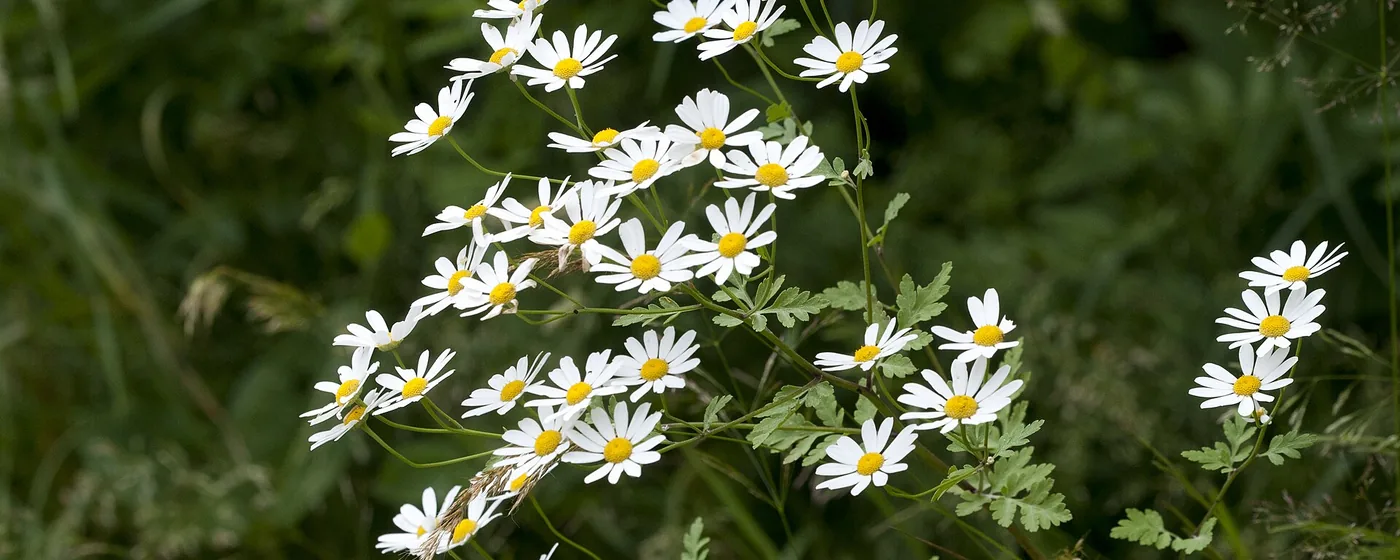
Feverfew tea is an infusion of the dried leaves of Tanacetum parthenium, a small daisy-family plant with white petals and a yellow center. It grows wild across Europe and has naturalized through much of North America. The name is a worn-down form of "febrifuge" — fever-driver — which tells you what medieval herbalists used it for. That is not what people use it for today. Nearly all modern interest in feverfew comes down to one thing: preventing migraine.
Nobody drinks this for pleasure. Feverfew is aggressively bitter, with a dry, earthy, faintly camphor-like edge that lingers after the cup is empty. Honey and lemon are the traditional rescue, and blending it with peppermint or lemon balm makes it easier to finish. Steeped in boiling water it yields a pale greenish infusion that tastes more like a tonic than a tea. There is no caffeine in it.
Feverfew is unusual among herbal teas in having actually been through randomized controlled trials — six in the 2015 Cochrane review, nine in a 2025 meta-analysis. The honest summary is a small effect on migraine frequency, from evidence Cochrane graded as low quality, using capsules and standardized extracts rather than tea. No published trial has tested the infusion. Feverfew also carries cautions most herbal teas do not. Do not take it in pregnancy. It may add to the effect of blood thinners. If ragweed or other daisy-family plants bother you, feverfew can cross-react. And stopping abruptly after months of daily use has been linked to rebound headaches. Worth knowing before the first cup.
One more thing before any of that matters: migraine is a diagnosis, not a guess. If your headaches are new, changing, or getting worse, that needs a clinician's eyes, not a teapot.
Photo: Tanacetum parthenium - Feverfew - Beyaz Papatya 1.jpg by Zeynel Cebeci — CC BY-SA 4.0. Cropped and re-encoded.
What the evidence says
Feverfew leaf preparations may modestly reduce migraine frequency
The 2015 Cochrane review found six double-blind placebo-controlled trials (561 people), too heterogeneous to pool. Its largest and most rigorous, a 2005 trial of a standardized CO2 extract (MIG-99), saw attacks fall by 1.9 per month versus 1.3 on placebo — a 0.6-attack difference. Cochrane also noted that two other rigorous trials (50 and 147 patients) found no significant difference, and that the three trials reporting positive effects were all small, with 17 to 60 participants. The 147-patient study was a dose-finding trial that failed to show benefit overall. A 2025 meta-analysis of nine trials (899 participants) reported a pooled reduction of roughly 1.1 attacks, but its authors flagged moderate heterogeneity and risks of selection and attrition bias as limiting the quality of the evidence. Parthenolide inhibits NF-kappa B in laboratory and preclinical studies, the presumed mechanism. Cochrane graded the overall evidence low quality and called for larger, more rigorous trials before firm conclusions are drawn.
The trials that found a benefit used capsules and extracts, not tea
The trials in the Cochrane review gave feverfew by mouth as capsules of dried leaf or as standardized extracts — freeze-dried leaf powder in the older studies, a supercritical CO2 extract (MIG-99) in the newer ones. No published randomized trial has tested a hot-water infusion. As early as 1985, the trial authors themselves called for a formulation controlled for sesquiterpene lactone content before drawing conclusions. Benefit from tea is unproven, and a cup of tea is not a substitute for a standardized dose.
Feverfew inhibits platelet activity in the lab, which is why bleeding risk is taken seriously
Laboratory work from the 1980s showed feverfew extracts block platelet aggregation and the platelet release reaction, apparently by neutralizing sulfhydryl groups. A 2015 narrative review lists feverfew among herbal medicines found to reduce platelet aggregation, and advises that herbal use be taken into account when interpreting platelet function and coagulation tests; it does not report a confirmed feverfew-warfarin interaction. No human trial has measured bleeding outcomes with feverfew, so the real-world risk is unknown. NCCIH nonetheless states that feverfew may slow blood clotting and should be stopped at least two weeks before scheduled surgery.
Feverfew has not been shown to help rheumatoid arthritis
Folklore credits feverfew with easing arthritis. The one placebo-controlled test gave 41 women with rheumatoid arthritis either dried chopped feverfew (70 to 86 mg daily) or placebo for six weeks, and found no difference in stiffness, pain, grip strength, or inflammatory markers. One small trial is not the last word, but it is the only word, and it is negative.
Sources: [10]
Stopping long-term daily feverfew abruptly has been linked to rebound headache
In a 1985 double-blind trial, 17 people already eating fresh feverfew leaves daily switched to freeze-dried feverfew capsules or placebo. The nine given placebo, effectively stopped cold, had a significant rise in headache frequency and severity, nausea, and vomiting. The NIH's LactMed database likewise notes that rebound headaches can occur with rapid discontinuation. Reference sources call the broader cluster, which can also include anxiety and muscle stiffness, "post-feverfew syndrome." Tapering rather than stopping abruptly is the usual advice.
Sources: [6]
Traditionally used for fever, menstrual complaints, and digestive upset
European herbal practice used feverfew for fevers, painful periods, stomach upset, and respiratory complaints long before migraine, and NCCIH lists a similar range of historical uses. None of these uses has been tested in a controlled human trial. Drinking feverfew tea for cramps or a fever follows custom, not data — which is also part of why pregnancy is a hard no.
No published human clinical trials found for this use.
How to brew Feverfew Tea
Bring water to a full boil, pour it over the leaves, cover the cup, and strain after five to ten minutes. Longer steeping mainly buys more bitterness.
- Start at five minutes. Ten is punishing, and no evidence says a longer steep extracts more active compound.
- Never chew fresh feverfew leaves. Mouth sores and irritation are the classic result, and NCCIH warns about it specifically.
- Do not treat cups as doses. Parthenolide content varies by batch and is unknowable at home.
Safety, side effects & who should avoid it
Feverfew is not a casual herbal tea. Skip it in pregnancy, avoid it with blood thinners or daisy-family allergy, and taper rather than stop abruptly. It is also not a substitute for getting a new or changing headache pattern properly evaluated.
Who should avoid it
- Anyone pregnant. NCCIH says plainly: do not take feverfew while pregnant, because it may affect uterine contractions.
- Anyone allergic or sensitive to ragweed, chrysanthemums, marigolds, daisies, chamomile, or other Asteraceae (Compositae) plants. Cross-reactions are documented, and parthenolide is feverfew's main contact allergen.
- Anyone on an anticoagulant or antiplatelet drug — warfarin, heparin, apixaban, rivaroxaban, clopidogrel, daily aspirin — without a pharmacist's approval.
- Anyone with a bleeding disorder, or facing surgery or dental work soon. NCCIH advises stopping feverfew at least two weeks before scheduled surgery.
- People who are breastfeeding. The NIH's LactMed database notes there are no data on whether feverfew's components pass into breast milk, and that some reviewers recommend against its use while nursing.
- Children and teenagers, in whom feverfew is not adequately studied and no dose is established.
- Anyone self-treating a headache that has not been diagnosed. Get the diagnosis first. A sudden "worst headache of your life," a headache with fever, stiff neck, confusion, weakness, numbness, or vision loss, a headache after a head injury, or a headache pattern that is new or steadily worsening needs urgent medical assessment — not tea.
Possible side effects
- Nausea, bloating, indigestion, abdominal pain. Gastrointestinal complaints were among the most common adverse events in the reviewed trials, though Cochrane described the events reported as mild and transient.
- Mouth ulcers and mouth irritation — classically from chewing fresh leaves, but also reported with capsules.
- Allergic contact dermatitis. In sensitized people, airborne particles released by flowering feverfew plants have been shown to trigger reactions, with parthenolide identified as the allergen.
- Rebound headache, nausea, vomiting, and reportedly anxiety and muscle or joint stiffness after abruptly stopping long-term daily use ("post-feverfew syndrome").
- Rash or hives. Get urgent care for swelling of the face or throat, or trouble breathing.
Medication interactions
- Anticoagulants and antiplatelets (warfarin, heparin, apixaban, rivaroxaban, clopidogrel, aspirin, including low-dose daily aspirin). Feverfew inhibits platelet aggregation in the lab and NCCIH notes it may slow blood clotting, so bleeding risk may add up. This has not been quantified in people.
- NSAIDs such as ibuprofen, naproxen, and diclofenac: theoretically additive platelet effects, plus additive stomach irritation.
- Other supplements reported to reduce platelet aggregation: ginkgo, garlic, ginger, ginseng, high-dose fish oil, turmeric.
- Migraine drugs. NCCIH states that feverfew may interact with some medicines used for migraine; ask your prescriber before combining it with triptans, ergotamines, or a preventive.
- Drugs cleared by cytochrome P450 enzymes. In test-tube work, feverfew extract inhibited the six major human drug-metabolizing CYP enzymes (1A2, 2C8, 2C9, 2C19, 2D6, 3A4). Whether that happens at the amounts people actually drink is unknown and no clinical interaction has been demonstrated, but it is a reason to have a pharmacist review your medicine list.
Pregnancy & breastfeeding
Do not drink feverfew tea while pregnant. NCCIH is unambiguous that it may affect uterine contractions, and feverfew's traditional use as a menstrual stimulant points the same way. For breastfeeding, the NIH's LactMed database reports no data on the excretion of feverfew's components into breast milk and no data on safety in nursing mothers or infants; some reviewers recommend against use while nursing. Talk to your doctor and choose a different tea.
How much is too much
No established limit for the tea, because the tea has never been studied. The capsule trials used a standardized CO2 extract at 6.25 mg three times daily for up to 16 weeks; a separate 1989 rheumatoid arthritis trial used 70 to 86 mg of dried chopped leaf daily for six weeks. Neither maps onto a teaspoon of loose leaf. One cup a day is the customary amount; no evidence supports more.
Taste & pairing
Tasting notes: Bitter, Earthy.
Pairs well with: Honey, Lemon.
Best time to drink: Regular consumption for prevention.
Frequently asked questions
How many cups of feverfew tea can I drink a day?
No established safe limit; the tea has never been studied. Custom points to about one cup a day, but that is tradition, not evidence. If you take any blood thinner, including daily aspirin, the right number is zero until a pharmacist says otherwise.
Should I drink feverfew tea during a migraine, or every day?
The evidence concerns daily preventive use: trials counted attacks per 28 days across 12 to 16 weeks of continuous dosing. No trial has tested feverfew for stopping an attack already underway. And remember the trials used capsules and standardized extracts, not tea.
What happens if I stop drinking feverfew tea suddenly?
Long-term daily users who stop abruptly have reported rebound headaches, nausea, vomiting, and reportedly anxiety and muscle or joint stiffness — "post-feverfew syndrome." It was first seen in a 1985 trial when habitual users of fresh leaves switched to placebo and their headaches and nausea worsened. Taper over several weeks instead.
Can I drink feverfew tea if I'm allergic to ragweed or chamomile?
No. Feverfew is in the Asteraceae family alongside ragweed, chamomile, chrysanthemums, marigolds, and daisies, and cross-reactions are documented. Its parthenolide is a known contact allergen: in one study, feverfew-allergic patients reacted to airborne particles collected from flowering plants, with parthenolide identified as the responsible allergen. Reactions of this kind appear to be uncommon, but standard advice is to avoid feverfew if these plants affect you.
Is feverfew tea safe if I already take a prescription migraine preventive?
Ask your prescriber first. NCCIH states that feverfew may interact with some migraine medicines, and laboratory work shows feverfew extract inhibiting the main liver enzymes that clear many prescription drugs. That interaction has not been demonstrated in people, but the safe move is to check before adding it.
References
- Feverfew for preventing migraine.. The Cochrane database of systematic reviews, 2015. PubMed 25892430 · doi:10.1002/14651858.CD002286.pub3
- Systematic review and meta-analysis of: evaluating its efficacy in migraine relief.. Natural product research, 2025. PubMed 41422534 · doi:10.1080/14786419.2025.2602038
- Efficacy and safety of 6.25 mg t.i.d. feverfew CO2-extract (MIG-99) in migraine prevention--a randomized, double-blind, multicentre, placebo-controlled study.. Cephalalgia : an international journal of headache, 2005. PubMed 16232154 · doi:10.1111/j.1468-2982.2005.00950.x
- The efficacy and safety of Tanacetum parthenium (feverfew) in migraine prophylaxis--a double-blind, multicentre, randomized placebo-controlled dose-response study.. Cephalalgia : an international journal of headache, 2002. PubMed 12230594 · doi:10.1046/j.1468-2982.2002.00396.x
- Randomised double-blind placebo-controlled trial of feverfew in migraine prevention.. Lancet (London, England), 1988. PubMed 2899663 · doi:10.1016/s0140-6736(88)92289-1
- Efficacy of feverfew as prophylactic treatment of migraine.. British medical journal (Clinical research ed.), 1985. PubMed 3929876 · doi:10.1136/bmj.291.6495.569
- Exploring the Phytochemistry, Signaling Pathways, and Mechanisms of Action of(L.) Sch.Bip.: A Comprehensive Literature Review.. Biomedicines, 2024. PubMed 39457613 · doi:10.3390/biomedicines12102297
- Inhibition of platelet behaviour by feverfew: a mechanism of action involving sulphydryl groups.. Folia haematologica (Leipzig, Germany : 1928), 1988. PubMed 2465950
- The influence of herbal medicine on platelet function and coagulation: a narrative review.. Seminars in thrombosis and hemostasis, 2015. PubMed 25839871 · doi:10.1055/s-0035-1549089
- Feverfew in rheumatoid arthritis: a double blind, placebo controlled study.. Annals of the rheumatic diseases, 1989. PubMed 2673080 · doi:10.1136/ard.48.7.547
- Compositae dermatitis from airborne parthenolide.. The British journal of dermatology, 2007. PubMed 17300241 · doi:10.1111/j.1365-2133.2006.07674.x
- Simultaneous determination of the inhibitory potency of herbal extracts on the activity of six major cytochrome P450 enzymes using liquid chromatography/mass spectrometry and automated online extraction.. Rapid communications in mass spectrometry : RCM, 2004. PubMed 15384148 · doi:10.1002/rcm.1621
Last reviewed and updated . HelperTea is written by an enthusiast, not a clinician, and is not medically reviewed. How we research and rate evidence. Found an error? Tell us — safety corrections get priority.