Everyone feels anxious sometimes. It becomes a medical problem when the worry outruns what is actually happening, lasts for months, and starts eating into your work, sleep, or relationships. Ordinary stress usually has a cause you can name and fades when the cause does. Both are real. Only one is a diagnosis.
Here is the honest state of the evidence. Almost every positive trial of a calming herb used a concentrated, standardized extract in a capsule, at doses far higher than a teabag delivers. And when researchers finally tested an actual herbal tea, giving 210 surgical patients either a calming blend or a lemon-flavored placebo tea, anxiety fell by the same amount in both groups. A warm drink and a pause are genuinely soothing. Separating that from the plant is harder than the internet suggests.
So tea is a reasonable, low-risk part of winding down. It is not a treatment for an anxiety disorder, and it will not stop a panic attack. If your anxiety runs most days for six months, if you are avoiding places or people, or if you have had a panic attack, talk to a doctor. Effective treatments exist. Tea is not one of them, and no teabag should delay a real one.
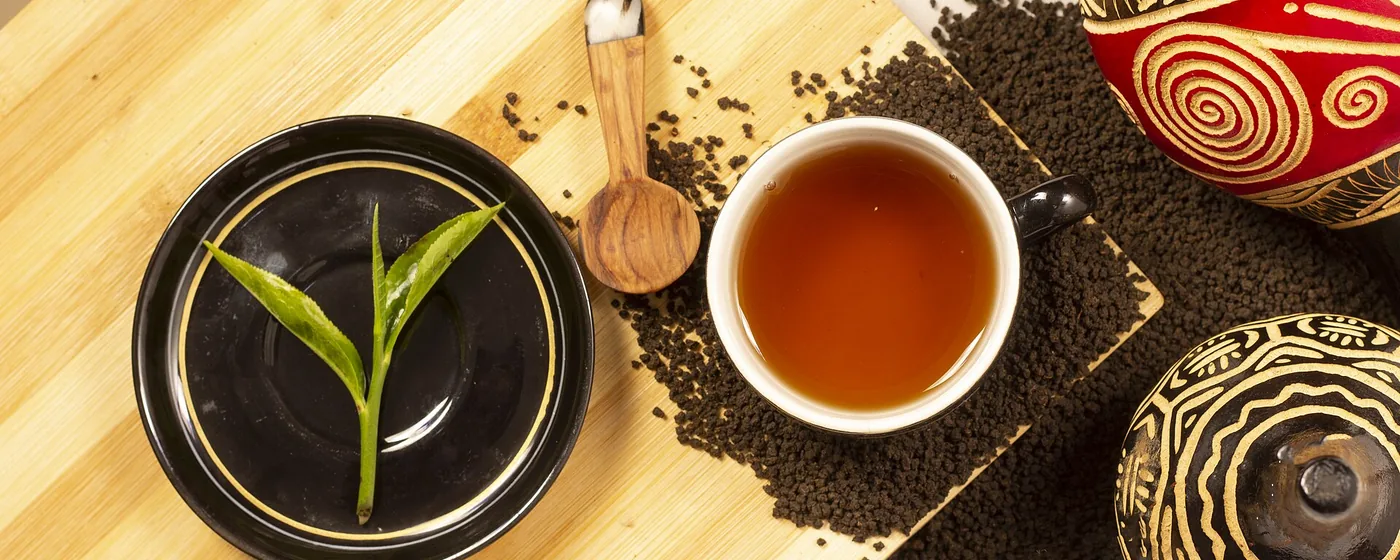
Photo: A Moment of Tea Tradition.jpg by Maliqbhai — CC BY-SA 4.0. Cropped and re-encoded.
Ranked by evidence
Chamomile Tea
The best-studied calming herb, and the first thing to try for low-grade everyday anxiety.
moderate evidence
Chamomile's apigenin weakly binds the benzodiazepine sites on GABA-A receptors, the target of prescription anti-anxiety drugs. In a 2009 trial of 57 people with generalized anxiety disorder, eight weeks of chamomile extract beat placebo modestly; a larger follow-up held symptoms down but missed its relapse endpoint. A 2022 network meta-analysis could not confirm chamomile beats placebo. Every trial used capsule extract, not a teabag.
Passionflower Tea
Best for short bursts of situational nerves: a dental appointment, a presentation, a flight.
limited evidence
Passionflower appears to increase GABA activity, which quiets nerve signaling. Three small trials agree: 36 people with generalized anxiety improved about as much on passionflower extract as on the benzodiazepine oxazepam, and two preoperative trials found a single dose before surgery lowered anxiety without sedation. Yet the 2022 meta-analysis found it no better than placebo, and a real calming tea only matched a placebo tea.
Lemon Balm Tea
For daytime stress when you still need to think clearly: bright, lemony, not sedating.
limited evidence
Lemon balm's rosmarinic acid slows GABA breakdown in the lab. Human data is thin and oddly dose-sensitive: in 24 volunteers, a 600 mg lemon balm and valerian combination blunted anxiety during a stress task, but 1,800 mg made anxiety worse, and every dose slightly worsened cognitive performance. A three-week trial of a commercial extract reported better anxiety and mood scores.
Lavender Tea
Drink it for the aroma and the ritual; the trial evidence belongs to a capsule.
limited evidence
Lavender's linalool and linalyl acetate appear to modulate calcium channels in nerve cells. A swallowed lavender essential-oil capsule, Silexan, is the most convincing herbal preparation for anxiety: a meta-analysis found it beat placebo, and the 2022 network meta-analysis ranked it the one herb with a clear effect. But Silexan is a standardized 80 mg dose of essential oil, and no trial shows steeping the flowers reproduces it.
Valerian Root Tea
For stress that mostly shows up as bad sleep, and only in the evening.
limited evidence
Valerenic acid interacts with GABA-A receptors, and the root is long used as a sedative. A 2020 systematic review of 60 studies concluded valerian is broadly safe but that its results are inconsistent, probably because commercial extract quality varies so widely. The 2022 meta-analysis found insufficient evidence it helps anxiety, and NCCIH agrees.
Matcha
The only caffeinated tea here, and a bad bet if caffeine sets you off.
limited evidence
L-theanine, green tea's calming amino acid, lowered subjective stress and cortisol at 200 mg doses. A 39-person trial of a matcha bred for a high theanine-to-caffeine ratio found less anxiety than placebo matcha, its authors noting that caffeine antagonizes theanine. But those doses far exceed a cup, the 2022 meta-analysis found theanine no better than placebo, and 480 mg of caffeine triggered panic attacks in 59% of people with panic disorder.
How to choose between them
Start with what you want the tea to do. For a background hum of worry, chamomile has the most human data and tastes mildly of apples. For one specific stressful hour, passionflower is the herb with trials on exactly that, and it did not make people drowsy. Lemon balm is bright and lemony for a stressful workday. Lavender turns soapy if you overdo it. Save valerian for evenings: it is the most sedating, and never mix it with alcohol or sedatives.
Everything except matcha is caffeine-free, which matters: caffeine provokes anxiety and panic in people prone to it. These teas are low-risk, not risk-free. Chamomile shares a plant family with ragweed, chrysanthemums, marigolds, and daisies, and case reports describe anaphylaxis after drinking chamomile tea; it may also interact with warfarin and liver-metabolized drugs. Passionflower should be avoided in pregnancy and can deepen sedation under anesthesia, so tell your surgical team two weeks ahead. Valerian has been linked to rare liver injury, usually in multi-herb products, and stopping it abruptly after long daily use can cause rebound anxiety and insomnia.
When to see a doctor
See a doctor, not a teabag, if anxiety has run most days for six months or longer, or is interfering with work, sleep, or relationships. Get prompt care for panic attacks, especially a first one: chest pain, a pounding heart, and breathlessness can also signal a cardiac or thyroid problem. Other red flags are unexplained weight loss with a racing pulse and tremor, anxiety that began after starting a new medication or cutting back on alcohol or benzodiazepines, and anxiety severe enough that you drink or use sedatives to get through the day. If you are having thoughts of harming yourself, call or text 988 in the United States. Never stop a prescribed anxiety medication to try tea instead, and never stop a benzodiazepine abruptly.
Frequently asked questions
Chamomile or passionflower: which should I try first?
Chamomile is better studied for slow-burn everyday anxiety, and was tested in people with a diagnosis. Passionflower has the trials in short, situational anxiety, and it did not sedate people. Chamomile is safer in pregnancy, riskier if you have ragweed or daisy allergies.
How long does calming tea take to work?
There is no honest number; the teas have barely been studied. The passionflower trials dosed 30 to 90 minutes before a stressful event. The chamomile capsule trials ran eight weeks before separating from placebo, so one cup is unlikely to change much.
How many cups a day is safe?
One to three cups a day of chamomile, lemon balm, or lavender is generally well tolerated, though no effective dose for tea has ever been established. NCCIH notes passionflower tea has been used safely for up to seven nights. Keep valerian occasional, and see a doctor if you develop nausea, dark urine, or yellowing skin or eyes.
Can I drink these teas if I take an SSRI or a benzodiazepine?
Ask your pharmacist about your medication first, and never treat tea as a replacement. Chamomile, lavender, valerian, and passionflower can all deepen the sedation from benzodiazepines, sleep aids, and alcohol. Chamomile may also interact with warfarin.
Is green tea or matcha good for anxiety?
It cuts both ways. Green tea contains L-theanine, which reduced subjective stress in small trials, but those used 200 mg of isolated theanine, more than a cup delivers, and a 2022 meta-analysis found it no better than placebo. Both teas also contain caffeine, which at 480 mg provoked panic attacks in most participants with panic disorder.
Are calming teas safe during pregnancy?
Avoid passionflower, which may stimulate uterine contractions. For chamomile, lavender, valerian, and lemon balm, nobody knows: safety in pregnancy and breastfeeding has not been adequately studied. Occasional culinary amounts differ from daily medicinal use. Ask your obstetrician or midwife first.
References
- A randomized, double-blind, placebo-controlled trial of oral Matricaria recutita (chamomile) extract therapy for generalized anxiety disorder. Journal of Clinical Psychopharmacology, 2009. PubMed 19593179 · doi:10.1097/JCP.0b013e3181ac935c
- Long-term chamomile (Matricaria chamomilla L.) treatment for generalized anxiety disorder: A randomized clinical trial. Phytomedicine, 2016. PubMed 27912875 · doi:10.1016/j.phymed.2016.10.012
- Short-term open-label chamomile (Matricaria chamomilla L.) therapy of moderate to severe generalized anxiety disorder. Phytomedicine, 2016. PubMed 27912871 · doi:10.1016/j.phymed.2016.10.013
- Medicinal herbs for the treatment of anxiety: A systematic review and network meta-analysis. Pharmacological Research, 2022. PubMed 35378276 · doi:10.1016/j.phrs.2022.106204
- Passionflower in the treatment of generalized anxiety: a pilot double-blind randomized controlled trial with oxazepam. Journal of Clinical Pharmacy and Therapeutics, 2001. PubMed 11679026 · doi:10.1046/j.1365-2710.2001.00367.x
- Preoperative oral Passiflora incarnata reduces anxiety in ambulatory surgery patients: a double-blind, placebo-controlled study. Anesthesia and Analgesia, 2008. PubMed 18499602 · doi:10.1213/ane.0b013e318172c3f9
- Passiflora incarnata Linneaus as an anxiolytic before spinal anesthesia. Journal of Anesthesia, 2011. PubMed 22048283 · doi:10.1007/s00540-011-1265-6
- Exploring the Effects of a Calming Herbal Tea Blend on Perioperative Anxiety: A Randomized Clinical Trial. Journal of Medicinal Food, 2024. PubMed 39514279 · doi:10.1089/jmf.2024.0170
- Anxiolytic effects of a combination of Melissa officinalis and Valeriana officinalis during laboratory induced stress. Phytotherapy Research, 2006. PubMed 16444660 · doi:10.1002/ptr.1787
- The possible "calming effect" of subchronic supplementation of a standardised phospholipid carrier-based Melissa officinalis extract in healthy adults with emotional distress and poor sleep conditions: results from a prospective, randomised, double-blinded, placebo-controlled clinical trial. Frontiers in Pharmacology, 2023. PubMed 37927585 · doi:10.3389/fphar.2023.1250560
- Lavender Oil Preparation (Silexan) for Treating Anxiety: An Updated Meta-Analysis. Journal of Clinical Psychopharmacology, 2017. PubMed 27861196 · doi:10.1097/JCP.0000000000000615
- Valerian Root in Treating Sleep Problems and Associated Disorders-A Systematic Review and Meta-Analysis. Journal of Evidence-Based Integrative Medicine, 2020. PubMed 33086877 · doi:10.1177/2515690X20967323
- Stress-Reducing Function of Matcha Green Tea in Animal Experiments and Clinical Trials. Nutrients, 2018. PubMed 30308973 · doi:10.3390/nu10101468
- Effects of L-Theanine Administration on Stress-Related Symptoms and Cognitive Functions in Healthy Adults: A Randomized Controlled Trial. Nutrients, 2019. PubMed 31623400 · doi:10.3390/nu11102362
- Anti-Stress, Behavioural and Magnetoencephalography Effects of an L-Theanine-Based Nutrient Drink: A Randomised, Double-Blind, Placebo-Controlled, Crossover Trial. Nutrients, 2016. PubMed 26797633 · doi:10.3390/nu8010053
- Caffeine challenge test in panic disorder and depression with panic attacks. Comprehensive Psychiatry, 2007. PubMed 17445520 · doi:10.1016/j.comppsych.2006.12.001
- A case of anaphylactic reaction to chamomile tea in a patient with mugwort pollinosis. Allergology International, 2019. PubMed 30952586 · doi:10.1016/j.alit.2019.02.011
Last reviewed and updated . HelperTea is written by an enthusiast, not a clinician, and is not medically reviewed. How we research and rate evidence. Found an error? Tell us — safety corrections get priority.