Poor sleep takes a few forms: trouble falling asleep, trouble staying asleep, waking too early, or sleeping through and still feeling wrecked. Most people go through stretches of this after stress, travel, or illness, and it passes. When it happens at least three nights a week for three months and starts damaging your days, that is chronic insomnia disorder, a medical condition rather than a tea problem.
Here is the honest version of what tea can do. No herbal tea has been shown to treat chronic insomnia. Where trials find a benefit it is modest, and it appears on questionnaires asking how people felt they slept rather than on objective measures like polysomnography. Most studies people cite used concentrated extracts in capsules, not a teabag in a mug, so your cup delivers a smaller, less predictable dose. What tea reliably gives you is a warm, caffeine-free, screen-free ritual before bed. For mild, occasional restlessness, that is worth something.
If your insomnia is chronic, see a doctor rather than shopping for tea. The American Academy of Sleep Medicine strongly recommends cognitive behavioral therapy for insomnia (CBT-I) as first-line treatment, and it holds up better over time than herbs or sleeping pills.
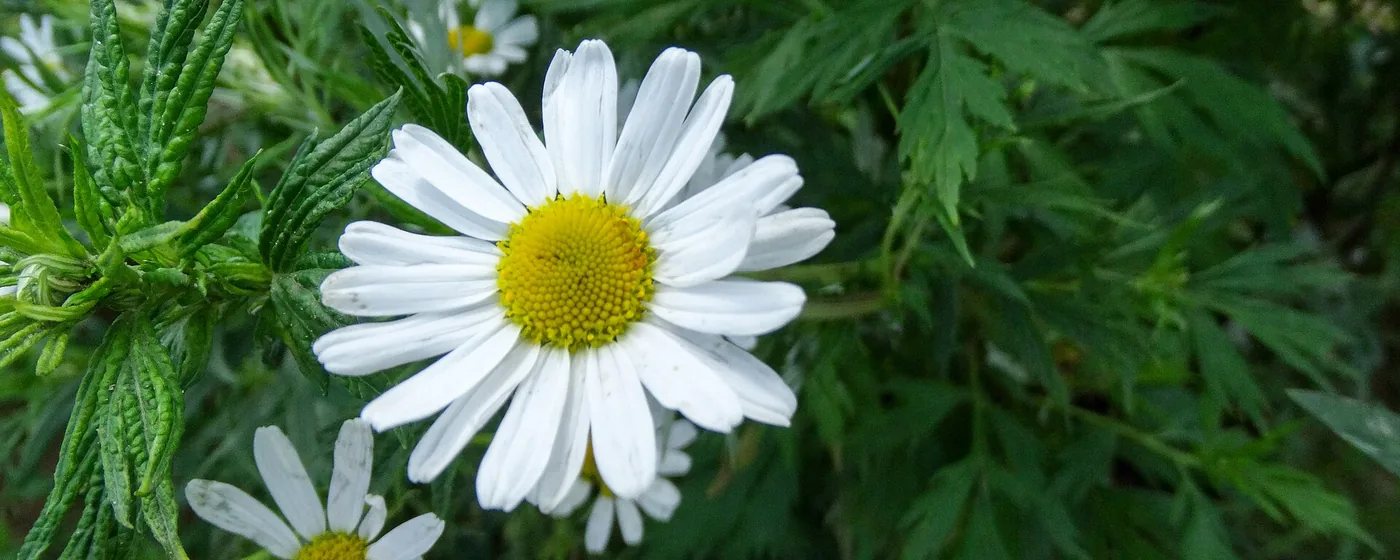
Photo: Chamomile (14561518539).jpg by YuJeen from Riga, Latvia — CC BY 2.0. Cropped and re-encoded.
Ranked by evidence
Chamomile Tea
The sensible starting point, and the best-supported herb in a field where the evidence is weak overall.
moderate evidence
Chamomile's apigenin binds benzodiazepine sites on GABA-A receptors in laboratory studies. A 2019 meta-analysis of randomized trials found it improved self-reported sleep quality, but the same review found no change in insomnia severity. Up close the evidence thins: a 28-day placebo-controlled pilot in chronic insomnia found no improvement in any sleep diary measure, and a chamomile tea trial in postpartum women saw benefits vanish by four-week follow-up.
Passionflower Tea
Best pick if you want evidence for the tea itself, not a capsule, and your sleep is restless rather than disordered.
limited evidence
Passionflower is thought to act on GABA signaling, though largely on animal and test-tube evidence. It has what the others lack: a double-blind, placebo-controlled crossover trial of the actual tea. Forty-one healthy adults drank a cup nightly for a week and rated their sleep better than on placebo. But only one of six diary measures moved, participants had mild sleep fluctuations rather than insomnia, and polysomnography showed no objective change.
Lemon Balm Tea
A gentle, easy-drinking option when bedtime anxiety and a busy mind keep you awake.
limited evidence
Lemon balm's rosmarinic acid appears to inhibit GABA transaminase in the lab, leaving more GABA available. A 2024 double-blind crossover trial found a standardized extract cut Insomnia Severity Index scores about three points more than placebo. But that product was engineered to improve absorption of lemon balm's polyphenols, precisely because ordinary extracts had given inconsistent results in people. A mug of tea is not that product.
Sources: [7]
Valerian Root Tea
The most famous sleep herb and the most oversold; try gentler options first, and skip it if you have liver concerns.
limited evidence
Valerian is the most heavily studied herbal sedative, and the results disappoint. A meta-analysis of 18 placebo-controlled trials found no effect on how long people took to fall asleep and none on rated sleep quality; only a crude yes-or-no question favored it. An earlier meta-analysis found a similar yes-or-no benefit but detected publication bias. The American Academy of Sleep Medicine suggests clinicians not use valerian for insomnia; a 2020 review blames the inconsistency on variable extract quality.
Lavender Tea
Pick it for the aroma and the wind-down ritual; the research is mostly about smelling lavender, not drinking it.
limited evidence
Almost all of lavender's human sleep evidence involves inhaled essential oil. A meta-analysis of aroma inhalation trials reported the largest effect for lavender among single oils studied, though such trials are small and hard to blind, since participants can smell what they were given. Oral lavender oil capsules improved sleep mainly as a knock-on effect of reduced anxiety. The one published trial of lavender tea showed no significant sleep benefit.
How to choose between them
Start with taste, because the tea you actually finish is the one that helps. Chamomile is apple-like and honeyed, lemon balm light and citrusy, passionflower mild and faintly grassy. Lavender is perfumed and turns soapy if steeped too long. Valerian smells like damp earth and old socks, and plenty of people cannot get a cup down.
All five are caffeine-free. Caffeinated teas here, including sencha, matcha, Earl Grey, Assam, and Darjeeling, belong to your morning: caffeine taken even six hours before bed measurably cuts total sleep time. None of these herbs are sedatives. Drink your cup 30 to 60 minutes before bed, keep it modest so a full bladder does not wake you, and give it a couple of weeks.
When to see a doctor
Book an appointment if you have trouble sleeping at least three nights a week for three months or more; that is chronic insomnia disorder, and CBT-I treats it better than anything you can steep. Get evaluated promptly for loud snoring, gasping or choking at night, witnessed pauses in breathing, or heavy daytime sleepiness, which point toward sleep apnea. No tea touches apnea, and untreated it raises cardiovascular risk. Other red flags: an irresistible urge to move your legs at night, falling asleep while driving, or new insomnia with unexplained weight loss, night sweats, or breathlessness lying flat. Sleeplessness with persistent hopelessness or thoughts of harming yourself needs urgent help. Never stop a prescription sleeping pill abruptly.
Frequently asked questions
Chamomile or valerian tea: which is better for sleep?
Start with chamomile: better evidence for subjective sleep quality, better taste, gentler. Valerian carries a bigger reputation than its data justify. Meta-analyses found no effect on how quickly people fell asleep, and the American Academy of Sleep Medicine suggests clinicians not use it for insomnia. It also causes more side effects, including grogginess and vivid dreams.
How long before bed should I drink sleep tea?
About 30 to 60 minutes before you want to be asleep, leaving time to wind down without a full bladder waking you. Do not expect one cup to do much: in trials that found any benefit, people drank the tea nightly for one to four weeks. It is a habit you build, not a pill you take.
How much chamomile tea should I drink for sleep?
There is no established dose for chamomile tea, and anyone quoting a precise one is guessing. Capsule trials used 200 to 270 mg of standardized extract twice daily; a typical teabag holds one to three grams of dried flowers, a different and less predictable thing. Tea trials used about one cup in the evening. One or two cups is reasonable; escalating is not.
Can I drink green tea or matcha at night?
Not if you want to sleep. Caffeine lingers: in a placebo-controlled trial, a moderate dose taken six hours before bedtime still measurably reduced total sleep time, and participants did not always notice. Green tea, matcha, black teas, and oolong all contain caffeine, and decaf retains a little. For an evening cup, use a herbal tea above, or naturally caffeine-free rooibos.
Is sleepy tea just placebo?
Partly. Benefits show up almost entirely in how people rate their own sleep, and largely disappear when sleep is measured objectively. But a nightly warm, caffeine-free cup is a real behavioral cue that the day is over, which is the logic behind parts of CBT-I. The tea may be doing less than the ritual. Neither is nothing.
Is it safe to drink these teas every night, or with my medication?
For most healthy adults an occasional evening herbal tea is low-risk, but ask a pharmacist if you take medication regularly. Do not combine these teas with alcohol, benzodiazepines, prescription sleep drugs, opioids, or sedating antihistamines. Chamomile has reported interactions with warfarin and can trigger reactions in people allergic to ragweed, daisies, or marigolds. Valerian is a rare cause of liver injury, usually alongside other herbs. Little is known about safety in pregnancy or breastfeeding.
References
- Therapeutic efficacy and safety of chamomile for state anxiety, generalized anxiety disorder, insomnia, and sleep quality: A systematic review and meta-analysis of randomized trials and quasi-randomized trials. Phytotherapy Research, 2019. PubMed 31006899 · doi:10.1002/ptr.6349
- Preliminary examination of the efficacy and safety of a standardized chamomile extract for chronic primary insomnia: a randomized placebo-controlled pilot study. BMC Complementary and Alternative Medicine, 2011. PubMed 21939549 · doi:10.1186/1472-6882-11-78
- Effects of an intervention with drinking chamomile tea on sleep quality and depression in sleep disturbed postnatal women: a randomized controlled trial. Journal of Advanced Nursing, 2015. PubMed 26483209 · doi:10.1111/jan.12836
- The effects of chamomile extract on sleep quality among elderly people: A clinical trial. Complementary Therapies in Medicine, 2017. PubMed 29154054 · doi:10.1016/j.ctim.2017.09.010
- A double-blind, placebo-controlled investigation of the effects of Passiflora incarnata (passionflower) herbal tea on subjective sleep quality. Phytotherapy Research, 2011. PubMed 21294203 · doi:10.1002/ptr.3400
- Passiflora incarnata L.: ethnopharmacology, clinical application, safety and evaluation of clinical trials. Journal of Ethnopharmacology, 2013. PubMed 24140586 · doi:10.1016/j.jep.2013.09.047
- Effects of Melissa officinalis Phytosome on Sleep Quality: Results of a Prospective, Double-Blind, Placebo-Controlled, and Cross-Over Study. Nutrients, 2024. PubMed 39683592 · doi:10.3390/nu16234199
- Effectiveness of Valerian on insomnia: a meta-analysis of randomized placebo-controlled trials. Sleep Medicine, 2010. PubMed 20347389 · doi:10.1016/j.sleep.2009.12.009
- Valerian for sleep: a systematic review and meta-analysis. The American Journal of Medicine, 2006. PubMed 17145239 · doi:10.1016/j.amjmed.2006.02.026
- Valerian Root in Treating Sleep Problems and Associated Disorders-A Systematic Review and Meta-Analysis. Journal of Evidence-Based Integrative Medicine, 2020. PubMed 33086877 · doi:10.1177/2515690X20967323
- Clinical Practice Guideline for the Pharmacologic Treatment of Chronic Insomnia in Adults: An American Academy of Sleep Medicine Clinical Practice Guideline. Journal of Clinical Sleep Medicine, 2017. PubMed 27998379 · doi:10.5664/jcsm.6470
- Effects of Lavender Tea on Fatigue, Depression, and Maternal-Infant Attachment in Sleep-Disturbed Postnatal Women. Worldviews on Evidence-Based Nursing, 2015. PubMed 26523950 · doi:10.1111/wvn.12122
- A systematic literature review and meta-analysis of the clinical effects of aroma inhalation therapy on sleep problems. Medicine (Baltimore), 2021. PubMed 33655928 · doi:10.1097/MD.0000000000024652
- Efficacy of Silexan in subthreshold anxiety: meta-analysis of randomised, placebo-controlled trials. European Archives of Psychiatry and Clinical Neuroscience, 2017. PubMed 29150713 · doi:10.1007/s00406-017-0852-4
- Behavioral and psychological treatments for chronic insomnia disorder in adults: an American Academy of Sleep Medicine clinical practice guideline. Journal of Clinical Sleep Medicine, 2021. PubMed 33164742 · doi:10.5664/jcsm.8986
- Caffeine effects on sleep taken 0, 3, or 6 hours before going to bed. Journal of Clinical Sleep Medicine, 2013. PubMed 24235903 · doi:10.5664/jcsm.3170
- Acute Liver Injury After Long-Term Herbal "Liver Cleansing" and "Sleep Aid" Supplement Use. The Journal of Emergency Medicine, 2021. PubMed 33579656 · doi:10.1016/j.jemermed.2021.01.004
Last reviewed and updated . HelperTea is written by an enthusiast, not a clinician, and is not medically reviewed. How we research and rate evidence. Found an error? Tell us — safety corrections get priority.