A cold is a viral infection of the nose and throat. More than 200 different viruses can cause one, which is why there is no cure or vaccine. Most colds clear in about a week, though a cough or a blocked nose can linger for 10 to 14 days. Nothing you drink kills the virus.
What tea can do is make the wait more bearable. In a randomized study of 30 people with a cold or flu, a hot drink gave immediate, sustained relief from runny nose, cough, sneezing, sore throat, chilliness and tiredness; the same drink at room temperature relieved only three of those symptoms. The hot drink did not change objectively measured nasal airflow at all; it changed how people felt. Warmth, steam and fluid do most of the work.
So read the rankings as a guide to comfort, not cure. No tea here has been shown to reliably shorten a cold. Even elderberry, the most-studied here, has conflicting results, and its trials tested concentrated syrups, not tea. Tea is the wrong tool if you are getting worse instead of better: a fever that will not break, trouble breathing, or chest pain needs a doctor, not another cup.
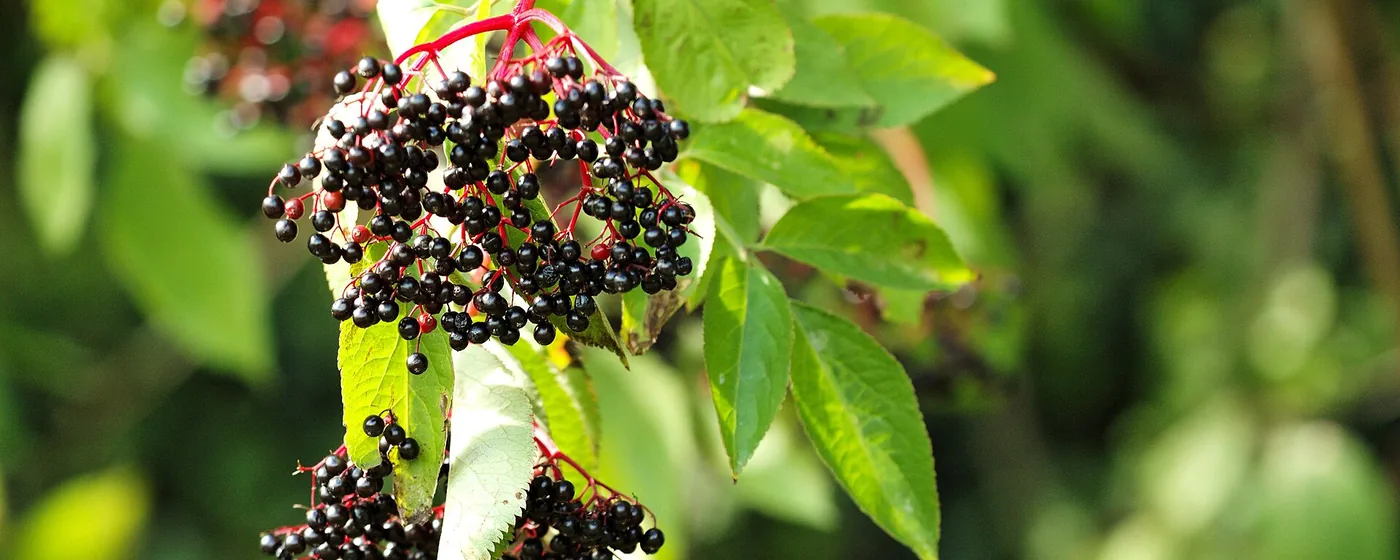
Photo: Elderberry-20060924-004.jpg by Gary Houston — CC0. Cropped and re-encoded.
Ranked by evidence
Peppermint Tea
The best pick when a stuffy nose is what is bothering you most.
limited evidence
Menthol activates cold receptors in the nasal lining, and the brain reads that as clearer airflow. In two double-blind trials in people with colds, an 11 mg menthol lozenge significantly improved the sensation of nasal airflow within about 10 minutes, while measured nasal resistance did not budge. Tea delivers less menthol than a lozenge but adds hot steam. Plainly: you will probably feel less congested, but your nose is not more open.
Ginger Tea
Best for a raw throat and the chills, especially last thing at night.
Traditional use
Gingerols and shogaols, ginger's pungent compounds, stimulate saliva and warm a raw throat. The laboratory case is thinner than it sounds: a hot-water extract of fresh ginger, though not dried, reduced respiratory syncytial virus plaque formation in human airway cell lines, an effect never tested in people. There are no human trials of ginger for a cold. This ranking rests on long use and the comfort of a hot drink.
Elderberry Tea
The most-studied herb here, worth an early try if you accept the shaky evidence.
limited evidence
A 2018 meta-analysis of randomized trials found that elderberry supplementation reduced upper respiratory symptoms, but it pooled only 180 participants. A trial in 312 air travelers reported shorter, milder colds. Against that, an FDA-regulated double-blind trial in 87 emergency-room patients with confirmed influenza found no benefit. All of these trials used concentrated extracts or syrups. Nobody has tested elderberry tea.
Echinacea Tea
For people who want to take something at the first sneeze, with expectations kept low.
limited evidence
A Cochrane review of 24 double-blind trials in 4,631 people concluded that echinacea products have not been shown to help treat a cold once you have one. Prevention trials showed consistent but non-significant trends, and a post-hoc pooling suggested a 10 to 20 percent relative reduction the reviewers called of questionable clinical relevance. A later network meta-analysis rated it only probably beneficial against influenza.
Marshmallow Root Tea
Best for a dry, tickly cough and a throat that feels scraped raw.
limited evidence
Marshmallow root is rich in mucilage, gel-forming polysaccharides that coat the throat and dull the irritation behind a dry cough. Human evidence is weak: two prospective surveys of 822 people using an aqueous marshmallow root extract reported relief within about 10 minutes, but neither had a placebo group. Warm liquid alone can do that.
Sources: [10]
Licorice Root Tea
A sweet throat soother for occasional use; skip it if you have high blood pressure.
Traditional use
Licorice root is a traditional throat remedy: sweet, mildly demulcent, easy to drink when swallowing hurts. There are no good randomized trials of it for a cold, so the benefit rests on long use, not data. The safety signal is better documented. A meta-analysis of 18 studies in 337 people found that consuming at least 100 mg of glycyrrhizic acid daily raised systolic blood pressure by about 5.5 mmHg and lowered plasma potassium; a 2024 meta-analysis of 8 trials found the same. NCCIH warns that large or long-term intake can cause irregular heartbeat and cardiac arrest.
How to choose between them
Start with the symptom bothering you most. Blocked nose: peppermint, for the menthol. Sore, scraped throat: marshmallow root, which coats, or ginger, which warms. Shivery at 10pm: ginger. Set on something antiviral: elderberry, with clear eyes about the evidence. All six are caffeine-free, so any can be drunk at night. Honey suits all of them, but never give it to a baby under one.
The side effects are where they differ. Peppermint can worsen reflux. Echinacea is in the daisy and ragweed family, and NCCIH notes that allergic reactions, some severe, do happen. Elderberry tea must be made from commercially dried or cooked berries; raw berries, leaves and stems cause nausea, vomiting and severe diarrhea. Licorice root has a real ceiling: an occasional cup is fine for most healthy adults, but regular use raises blood pressure, and it should be avoided in pregnancy, in heart or kidney disease, and alongside corticosteroids or blood pressure medication. If you are pregnant or take prescription drugs, ask a pharmacist.
When to see a doctor
Most colds need no doctor. Call one for trouble breathing or fast breathing, chest pain, a fever lasting more than four days, symptoms dragging past 10 days without improving, or symptoms that improve and then worsen again, which can signal a bacterial sinus or chest infection. Dehydration, meaning very little urine or dizziness on standing, also warrants a call. Seek care promptly for any fever in a baby under three months, a child who is unusually drowsy or struggling to breathe, or anyone whose asthma, COPD or immune-suppressing condition is worsening. Confusion, a stiff neck, or severe headache with fever are emergencies.
Frequently asked questions
Ginger tea or lemon and honey: which is better for a cold?
No head-to-head trial exists. Honey has the strongest support: a Cochrane review of six trials in 899 children found it probably relieves cough better than no treatment or placebo over the first few days. Lemon mostly adds flavor. Combine them, and never give honey to a baby under one.
Should I drink elderberry tea at the first sign of a cold, and how much?
The trials reporting a benefit used standardized extracts or syrups, started within 48 hours of symptoms, at doses far above what a tea bag delivers. There is no established dose for elderberry tea, because it has never been tested. One to three cups a day of commercially dried berries is unlikely to harm a healthy adult. Never brew raw berries, leaves or stems.
Can I drink these teas alongside cold medicine?
Usually, with two checks. Licorice root should not be combined with corticosteroids, diuretics or blood pressure medication, because it lowers potassium and raises blood pressure. Echinacea has conflicting evidence around interactions with drugs processed by the liver, so ask a pharmacist if you take something with a narrow safety margin, like warfarin.
Are these teas safe for children with a cold?
Weak peppermint, ginger and marshmallow root teas are widely used and generally low-risk in older children, but doses have never been established, and NCCIH notes rashes in children given echinacea in trials. Licorice root is not appropriate for children. Never add honey for a baby under one, and never apply menthol products to an infant's face.
How many cups a day, and does timing matter?
Drink as much warm liquid as you comfortably want. The relief is short-lived: in the menthol trials the improved sense of airflow appeared within about 10 minutes and faded within 30. A cup before bed and another when you wake up congested beats three in one sitting. Keep licorice root occasional, because its blood-pressure effect depends on dose and duration.
References
- The effects of a hot drink on nasal airflow and symptoms of common cold and flu.. Rhinology, 2008. PubMed 19145994
- The effects of oral administration of (-)-menthol on nasal resistance to airflow and nasal sensation of airflow in subjects suffering from nasal congestion associated with the common cold.. The Journal of pharmacy and pharmacology, 1990. PubMed 1981905 · doi:10.1111/j.2042-7158.1990.tb06625.x
- The effects of menthol on reaction time and nasal sensation of airflow in subjects suffering from the common cold.. Clinical otolaryngology and allied sciences, 1990. PubMed 2323078 · doi:10.1111/j.1365-2273.1990.tb00430.x
- Fresh ginger (Zingiber officinale) has anti-viral activity against human respiratory syncytial virus in human respiratory tract cell lines.. Journal of ethnopharmacology, 2012. PubMed 23123794 · doi:10.1016/j.jep.2012.10.043
- Black elderberry (Sambucus nigra) supplementation effectively treats upper respiratory symptoms: A meta-analysis of randomized, controlled clinical trials.. Complementary therapies in medicine, 2018. PubMed 30670267 · doi:10.1016/j.ctim.2018.12.004
- Elderberry Supplementation Reduces Cold Duration and Symptoms in Air-Travellers: A Randomized, Double-Blind Placebo-Controlled Clinical Trial.. Nutrients, 2016. PubMed 27023596 · doi:10.3390/nu8040182
- Elderberry Extract Outpatient Influenza Treatment for Emergency Room Patients Ages 5 and Above: a Randomized, Double-Blind, Placebo-Controlled Trial.. Journal of general internal medicine, 2020. PubMed 32929634 · doi:10.1007/s11606-020-06170-w
- Echinacea for preventing and treating the common cold.. The Cochrane database of systematic reviews, 2014. PubMed 24554461 · doi:10.1002/14651858.CD000530.pub3
- Interventions for preventing influenza: An overview of Cochrane systematic reviews and a Bayesian network meta-analysis.. Journal of integrative medicine, 2021. PubMed 34544670 · doi:10.1016/j.joim.2021.09.001
- Marshmallow Root Extract for the Treatment of Irritative Cough: Two Surveys on Users' View on Effectiveness and Tolerability.. Complementary medicine research, 2018. PubMed 30064132 · doi:10.1159/000489560
- Honey for acute cough in children.. The Cochrane database of systematic reviews, 2018. PubMed 29633783 · doi:10.1002/14651858.CD007094.pub5
- The association between consistent licorice ingestion, hypertension and hypokalaemia: a systematic review and meta-analysis.. Journal of human hypertension, 2017. PubMed 28660884 · doi:10.1038/jhh.2017.45
- Effects of Licorice Functional Components Intakes on Blood Pressure: A Systematic Review with Meta-Analysis and NETWORK Toxicology.. Nutrients, 2024. PubMed 39519602 · doi:10.3390/nu16213768
Last reviewed and updated . HelperTea is written by an enthusiast, not a clinician, and is not medically reviewed. How we research and rate evidence. Found an error? Tell us — safety corrections get priority.