Bloating is the feeling of pressure, gas, or fullness in the abdomen. Distension is the visible version, when your waistband genuinely tightens over the day. Both are common: in one community survey using the Rome IV criteria, about half of the adults asked reported bloating or distension, and roughly 8 percent met criteria for functional abdominal bloating and distension (PMID 37267460). Most everyday bloating traces back to swallowed air, constipation, eating quickly, a large meal, or a food that disagrees.
Here is the honest version of what tea can do. Several of these herbs contain volatile oils that relax gut smooth muscle, which can help trapped gas move along and ease cramping. But nearly all of the good human evidence comes from concentrated preparations, mainly enteric-coated peppermint oil capsules, not from a teabag in a mug, which gives a smaller, less predictable dose. A cup may take the edge off a bloated evening. It will not fix lactose intolerance, celiac disease, bacterial overgrowth, or chronic constipation.
If your bloating is new and persistent, or comes with pain, bleeding, vomiting, or weight loss, see a doctor rather than reaching for the kettle.
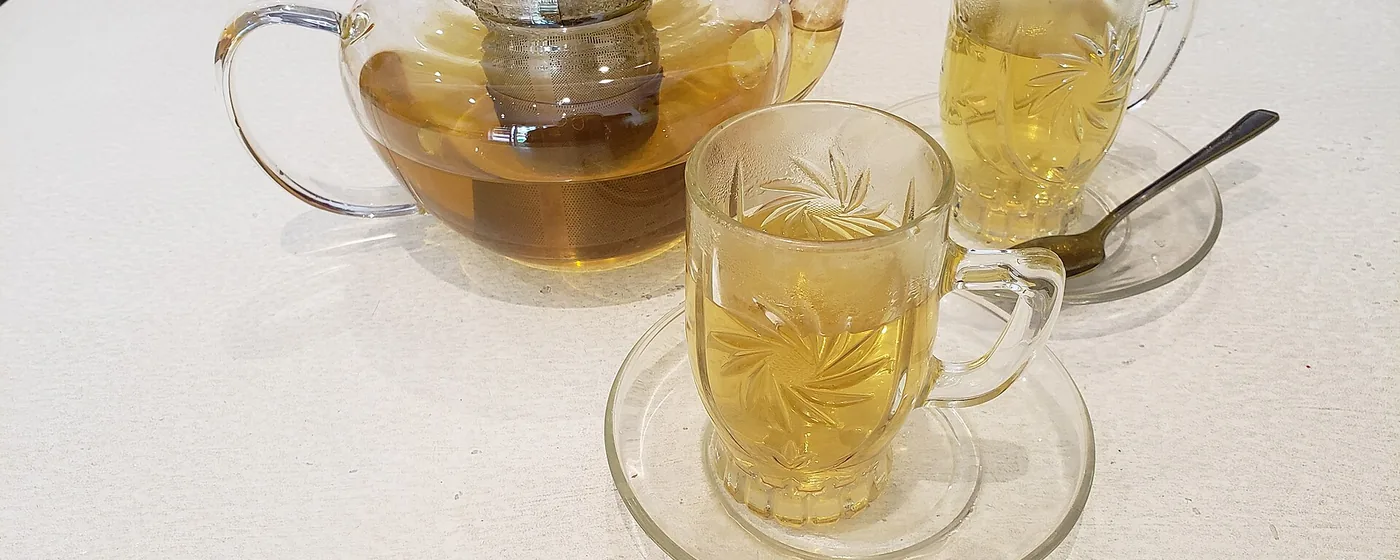
Photo: Peppermint Tea in a pot - Abyssinia.jpg by Andy Li — CC0. Cropped and re-encoded.
Ranked by evidence
Peppermint Tea
Best evidence of the five, though it comes from peppermint oil capsules, not tea.
limited evidence
Menthol blocks calcium channels in intestinal smooth muscle, relaxing a cramping gut so trapped gas can move. Enteric-coated peppermint oil capsules beat placebo for overall IBS symptoms in several meta-analyses of randomized trials (PMIDs 30654773, 24100754, 19008265), and a network meta-analysis ranked it first among traditional IBS therapies (PMID 31859183). But capsules deliver measured doses to the small intestine; tea has not been tested that way, and an umbrella review judged even the capsule effects small and low-certainty (PMID 39110917).
Fennel Tea
The classic after-dinner cup for gas, and best if peppermint gives you heartburn.
limited evidence
Fennel seeds contain anethole, a volatile oil that relaxes gut muscle, the basis of fennel's long use as a carminative for gas and colic. The best human data is a 30-day randomized trial in 121 people with IBS, where curcumin plus fennel essential oil beat placebo on symptom severity (PMID 27308645). A systematic review counted it among the credibly designed positive trials, but noted most such results have never been replicated (PMID 31987249). Plain fennel tea has never been tested.
Chamomile Tea
Best when bloating comes with stress, cramping, or a restless evening.
limited evidence
Chamomile contains apigenin and volatile oils that relax gut smooth muscle in the lab. Its human evidence is indirect: it is one of nine herbs in the extract STW 5, and a meta-analysis of three placebo-controlled trials found STW 5 improved the most bothersome symptom of functional dyspepsia, where fullness and bloating are prominent (PMID 15606389). Chamomile alone has not been tested for bloating, and NCCIH concludes its evidence remains insufficient. A soothing, low-risk cup, not a treatment.
Sources: [10]
Ginger Tea
Choose it when nausea or a heavy stomach dominates; keep expectations low.
limited evidence
Gingerols speed gastric emptying and stimulate the contractions that push food out of the stomach. In a randomized, double-blind crossover trial in 11 people with functional dyspepsia, 1.2 g of ginger cut median gastric half-emptying time from about 16 minutes to 12, yet produced no measurable improvement in symptoms (PMID 21218090). That negative result matters. Ginger's stronger support is for nausea, which NCCIH says it may help in pregnancy.
Sources: [11]
Lemon Balm Tea
A gentle option when bloating flares with anxiety; the least studied here.
Traditional use
Lemon balm has been used since antiquity for indigestion, and its rosmarinic acid relaxes smooth muscle in the lab. Like chamomile, it is one of nine components of STW 5 (PMID 15606389), but being an ingredient in a combination that works tells you little about the ingredient alone. No controlled trial has tested lemon balm for bloating. It is here because it is gentle and traditionally used, not proven.
Sources: [10]
How to choose between them
All five are caffeine-free, so any can be drunk at night. Peppermint is the strongest pick on evidence and tends to act quickly. But menthol relaxes the valve at the top of the stomach, and heartburn is the most commonly reported side effect in peppermint oil trials (PMID 24100754), so if you have reflux, start with fennel or chamomile. Fennel is sweet, licorice-like, the traditional choice for gas. Chamomile is apple-like and mild, but skip it if you react to ragweed, daisies, chrysanthemums or marigolds, and ask a pharmacist first if you take warfarin (PMID 16636327). Ginger is warming, best when nausea dominates, and can aggravate heartburn.
Steep 5 to 10 minutes with a lid on the cup, since the oils that do the work otherwise drift off in the steam. One cup after a meal, two or three a day at most. If nothing changes after a week or two, look at what you eat, how fast, and whether constipation is the real problem.
When to see a doctor
Most bloating is benign; some patterns are not. See a doctor if bloating comes with abdominal pain, blood in the stool or black, tarry stools, vomiting, diarrhea, worsening heartburn, fever, or unintentional weight loss. Bloating present on most days for three weeks or more needs prompt evaluation, especially in women over 50, and especially with pelvic pain, feeling full very quickly when eating, or urinating more often or urgently, because persistent bloating can be an early sign of ovarian cancer. A lasting change in bowel habits or a family history of bowel or ovarian cancer also warrants a visit. Do not quietly drink tea for months while something goes unexamined.
Frequently asked questions
Is peppermint tea as effective as peppermint oil capsules for bloating?
Almost certainly not. The trials showing benefit used enteric-coated capsules delivering a measured dose of oil past the stomach (PMID 30654773). A teabag gives a smaller, more variable amount of menthol, and has never been tested for bloating. Tea is a reasonable first try; if bloating persists, ask a clinician about capsules.
Should I drink tea for bloating before or after a meal?
For fullness and gas after eating, drink it after the meal; responders usually notice something within 20 to 40 minutes. No trial has compared timing, so this is mechanism, not evidence. Steep it covered so those oils stay in the cup.
How much fennel tea is safe to drink?
Two or three cups a day is an ordinary adult amount. Fennel contains estragole, which caused tumors in rodents at high doses of the isolated compound; one review judged the risk from ordinary fennel tea very small (PMID 15138375). Still, avoid sustained medicinal use in pregnancy or breastfeeding, and do not give fennel tea to infants or young children without a pediatrician's advice. Fennel also cross-reacts with celery, carrot and mugwort allergies (PMID 12078423).
Can I drink these teas if I have acid reflux or GERD?
Be careful with peppermint. Menthol relaxes the valve between the esophagus and stomach, and heartburn is the most frequently reported side effect in peppermint oil trials (PMID 24100754). Ginger can provoke heartburn too. Chamomile, fennel and lemon balm are better tolerated. Peppermint alone may worsen indigestion, though a peppermint-plus-caraway oil combination has trial support in functional dyspepsia (PMID 36502789).
Do detox or flat-tummy teas help bloating?
No, and some carry real risk. Many work by including senna, a stimulant laxative. A bowel movement is not the same as treating bloating, and regular unsupervised senna use can cause cramping, dehydration and electrolyte disturbances. Green tea, oolong and dandelion detox blends have no good human evidence for bloating.
Is chamomile tea safe with blood thinners?
Ask a pharmacist first. NCCIH reports interactions between chamomile and warfarin, and a published case describes a woman on warfarin hospitalized with internal bleeding after using chamomile tea and lotion (PMID 16636327). One case is not proof, but the caution is fair. Chamomile is also in the daisy family, so people allergic to ragweed, chrysanthemums or marigolds may react to it.
References
- Disorders of Gut-brain Interaction on the US-Mexico Border: A Survey Using Rome IV Criteria.. Journal of clinical gastroenterology, 2024. PubMed 37267460 · doi:10.1097/MCG.0000000000001858
- The impact of peppermint oil on the irritable bowel syndrome: a meta-analysis of the pooled clinical data.. BMC complementary and alternative medicine, 2019. PubMed 30654773 · doi:10.1186/s12906-018-2409-0
- Peppermint oil for the treatment of irritable bowel syndrome: a systematic review and meta-analysis.. Journal of clinical gastroenterology, 2014. PubMed 24100754 · doi:10.1097/MCG.0b013e3182a88357
- Effect of fibre, antispasmodics, and peppermint oil in the treatment of irritable bowel syndrome: systematic review and meta-analysis.. BMJ (Clinical research ed.), 2008. PubMed 19008265 · doi:10.1136/bmj.a2313
- Efficacy of soluble fibre, antispasmodic drugs, and gut-brain neuromodulators in irritable bowel syndrome: a systematic review and network meta-analysis.. The lancet. Gastroenterology & hepatology, 2019. PubMed 31859183 · doi:10.1016/S2468-1253(19)30324-3
- Nutritional Interventions in Adult Patients With Irritable Bowel Syndrome: An Umbrella Review of Systematic Reviews and Meta-analyses of Randomized Clinical Trials.. Nutrition reviews, 2025. PubMed 39110917 · doi:10.1093/nutrit/nuae107
- Menthacarin, a Proprietary Peppermint Oil and Caraway Oil Combination, Improves Multiple Complaints in Patients with Functional Gastrointestinal Disorders: A Systematic Review and Meta-Analysis.. Digestive diseases (Basel, Switzerland), 2022. PubMed 36502789 · doi:10.1159/000528553
- Curcumin and Fennel Essential Oil Improve Symptoms and Quality of Life in Patients with Irritable Bowel Syndrome.. Journal of gastrointestinal and liver diseases : JGLD, 2016. PubMed 27308645 · doi:10.15403/jgld.2014.1121.252.ccm
- Western herbal medicines in the treatment of irritable bowel syndrome: A systematic review and meta-analysis.. Complementary therapies in medicine, 2019. PubMed 31987249 · doi:10.1016/j.ctim.2019.102233
- Meta-analysis: phytotherapy of functional dyspepsia with the herbal drug preparation STW 5 (Iberogast).. Alimentary pharmacology & therapeutics, 2004. PubMed 15606389 · doi:10.1111/j.1365-2036.2004.02275.x
- Effect of ginger on gastric motility and symptoms of functional dyspepsia.. World journal of gastroenterology, 2011. PubMed 21218090 · doi:10.3748/wjg.v17.i1.105
- Warfarin interaction with Matricaria chamomilla.. CMAJ : Canadian Medical Association journal, 2006. PubMed 16636327 · doi:10.1503/cmaj.051191
- [Fennel tea: risk assessment of the phytogenic monosubstance estragole in comparison to the natural multicomponent mixture].. Forschende Komplementarmedizin und klassische Naturheilkunde, 2004. PubMed 15138375 · doi:10.1159/000078232
- Food allergy and IgE sensitization caused by spices: CICBAA data (based on 589 cases of food allergy).. Allergie et immunologie, 2002. PubMed 12078423
Last reviewed and updated . HelperTea is written by an enthusiast, not a clinician, and is not medically reviewed. How we research and rate evidence. Found an error? Tell us — safety corrections get priority.