Sinus congestion is not really a plumbing problem. During a cold or an allergy flare, the blood vessels lining your nose and sinuses swell and the tissue makes more mucus. The passage narrows, airflow drops, and pressure builds behind your cheekbones and forehead. Usually the cause is a virus that clears on its own within a week to ten days.
Here is the honest version of what tea can do. No tea shrinks swollen sinus tissue, drains a blocked sinus, or treats an infection. What a hot, aromatic drink reliably does is make your nose feel clearer. In a randomized study of 30 people with colds or flu, a hot drink improved subjective nasal airflow and eased runny nose, cough and sneezing, while objective airflow measurements did not change at all. That gap between feeling better and measuring better runs through nearly all the research below. The relief is real. It is comfort, not treatment.
Even the steam earns less credit than you would expect: reviewing six trials of heated, humidified air, Cochrane found no clear benefit for the common cold. Saline nasal irrigation has better support than any tea here, though those trials are small too. And skip the kettle entirely if you have a fever that will not quit, facial pain severe enough to stop you working, or symptoms that improved and then turned worse.
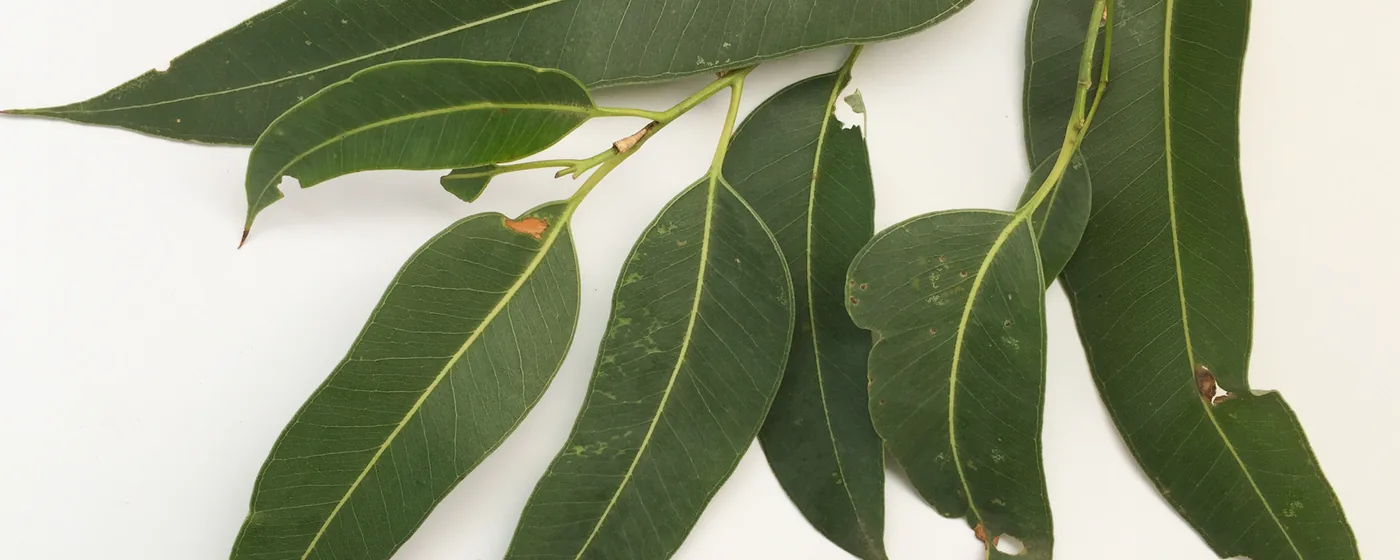
Photo: Eucalyptus punctata - adult leaves.jpg by Geekstreet — CC BY-SA 4.0. Cropped and re-encoded.
Ranked by evidence
Peppermint Tea
The default choice for most people who just want to breathe more easily tonight.
moderate evidence
Menthol, peppermint's main aromatic compound, activates cold-sensing nerve receptors in the nose, and the brain reads that cold signal as a rush of clear air. In a double-blind trial of 62 people with colds, an 11 mg menthol lozenge produced a marked subjective sensation of decongestion within 10 minutes, while rhinomanometry showed no change in actual nasal resistance. Note that these trials tested lozenges and a hot fruit drink, not peppermint tea. Read this as relief you can feel, not congestion you have cleared.
Eucalyptus Tea
Worth trying if peppermint feels too mild and the pressure sits behind your brow.
limited evidence
Eucalyptus leaves contain 1,8-cineole, or eucalyptol, the source of the sharp camphor-like aroma. In a double-blind, placebo-controlled trial of 152 adults with acute non-purulent rhinosinusitis, 200 mg cineole capsules three times daily beat placebo on a symptom score covering nasal obstruction, discharge and headache on bending. But that trial delivered 600 mg of purified cineole a day, and nobody has measured how much reaches a cup of steeped leaf. It is a reason to try the tea, not proof the tea works.
Sources: [4]
Ginger Tea
A sensible pick when congestion arrives with a sore throat or general cold achiness.
limited evidence
Ginger's pungency comes from gingerols and shogaols, which show anti-inflammatory activity in laboratory work. In a randomized, double-blind trial, 80 adults with allergic rhinitis took either 500 mg ginger extract or 10 mg loratadine. Both groups improved on nasal symptom scores, with no significant difference between them. There was no placebo arm, so much of that improvement may simply be time passing, and the study used a standardized extract rather than steeped root.
Sources: [5]
Nettle Tea
Only worth considering if your congestion is allergy-driven, and even then keep expectations low.
limited evidence
Nettle is a long-standing folk remedy for hay fever, and lab work hints its extracts interfere with histamine signaling. The human evidence is thin. A 1990 double-blind trial of 98 people found freeze-dried nettle rated modestly better than placebo on global assessment, but only slightly better in daily symptom diaries. A later placebo-controlled trial of nettle root tablets found symptoms improved, and improved just as much on placebo.
Thyme Tea
A traditional respiratory herb for people who want warm and savory rather than minty.
Traditional use
Thyme has been used in European herbal practice for centuries for coughs and chest congestion, and thymol, a constituent of its essential oil, kills bacteria in a petri dish. A petri dish tells you little about a human sinus, and we could not find clinical trials of thyme, in any form, for sinus congestion. What it reliably offers is what any hot aromatic drink offers: warmth, fluid and steam.
How to choose between them
None of these five contain caffeine, so you can drink any of them at 10pm. The trade-offs are speed, taste and stomach. Peppermint and eucalyptus work through aromatic compounds you inhale off the cup, so the effect arrives within minutes and fades within an hour. Sip them while they steam, and expect to repeat. Ginger and nettle work slowly and vaguely if at all.
Side effects deserve a hard look. Peppermint relaxes the valve at the top of the stomach, and heartburn is a recognized side effect, so skip it if you have reflux. Ginger can cause heartburn too. Never add eucalyptus essential oil to a drink: swallowed eucalyptus oil has caused seizures and hospitalization, and one Australian study found it a leading agent in poisoning admissions among children under five. Steeped leaf is not concentrated oil, but keep both away from young children. NCCIH warns that menthol should not be inhaled by or applied to the face of infants and small children, because it can affect their breathing. If you take warfarin, blood pressure or diabetes medication, run nettle past a pharmacist first.
When to see a doctor
Most sinus congestion clears on its own. Contact a clinician if symptoms last more than 10 days without improving, if they worsen after you had started to improve, if a fever lasts more than three or four days, if your headache or facial pain is severe, or if you have had several sinus infections this past year. Congestion dragging past 12 weeks is chronic rhinosinusitis and needs evaluation, not tea. Persistent blockage on one side only, especially with bloody discharge, should be checked. Seek emergency care for swelling or redness around an eye, vision changes, a stiff neck, confusion, or a sudden severe headache: these can signal infection spreading toward the eye or brain.
Frequently asked questions
Peppermint or eucalyptus tea, which is better for a stuffy nose?
Peppermint has the better-transferred evidence: menthol trials showed a fast, reliable sensation of clearer breathing. Eucalyptus has the better condition-specific trial, but it tested 600 mg of purified cineole in capsules, a dose no teabag delivers. Start with peppermint; try eucalyptus if it does nothing.
How long does it take for tea to relieve sinus congestion?
If it helps, it helps fast. In the menthol lozenge trial the subjective sense of an open nose appeared within about 10 minutes. The effect depends on aromatic vapor and warmth, so it usually fades within an hour. Nothing here builds up over days.
How many cups a day is reasonable?
For peppermint, ginger and thyme, two to four cups a day of ordinary-strength tea is generally well tolerated by healthy adults. Eucalyptus and nettle are less well characterized as teas, so keep them to a cup or two. No therapeutic dose has been established.
Can I add eucalyptus essential oil to my tea to make it stronger?
No. Swallowed eucalyptus oil has caused vomiting, drowsiness, seizures and deaths, and even small ingestions warrant a medical assessment. Essential oils are not food ingredients. If you want more eucalyptus, use more leaf, never oil.
Is tea better than a decongestant like pseudoephedrine?
No, and not the same kind of thing. Decongestants constrict blood vessels and reduce swelling, which measurably improves nasal airflow. Tea changes how your nose feels, not how open it is. It pairs fine with a decongestant, saline rinse or antihistamine, but does not replace one.
Are these teas safe for children or during pregnancy?
Weak peppermint or ginger tea is generally considered acceptable for older children, but keep eucalyptus and strong menthol vapors away from infants and small children, since inhaled menthol can affect breathing. In pregnancy, culinary amounts of ginger have reasonable safety data; eucalyptus, nettle and thyme in medicinal amounts do not. Ask a pharmacist first.
References
- The effects of a hot drink on nasal airflow and symptoms of common cold and flu.. Rhinology, 2008. PubMed 19145994
- The effects of oral administration of (-)-menthol on nasal resistance to airflow and nasal sensation of airflow in subjects suffering from nasal congestion associated with the common cold.. The Journal of pharmacy and pharmacology, 1990. PubMed 1981905 · doi:10.1111/j.2042-7158.1990.tb06625.x
- Menthol: effects on nasal sensation of airflow and the drive to breathe.. Current allergy and asthma reports, 2003. PubMed 12662469 · doi:10.1007/s11882-003-0041-6
- Therapy for acute nonpurulent rhinosinusitis with cineole: results of a double-blind, randomized, placebo-controlled trial.. The Laryngoscope, 2004. PubMed 15064633 · doi:10.1097/00005537-200404000-00027
- Ginger extract versus Loratadine in the treatment of allergic rhinitis: a randomized controlled trial.. BMC complementary medicine and therapies, 2020. PubMed 32312261 · doi:10.1186/s12906-020-2875-z
- Randomized, double-blind study of freeze-dried Urtica dioica in the treatment of allergic rhinitis.. Planta medica, 1990. PubMed 2192379 · doi:10.1055/s-2006-960881
- Efficacy of Supportive Therapy of Allergic Rhinitis by Stinging Nettleroot extract: a Randomized, Double-Blind, Placebo-Controlled, Clinical Trial.. Iranian journal of pharmaceutical research : IJPR, 2017. PubMed 29844782
- Heated, humidified air for the common cold.. The Cochrane database of systematic reviews, 2017. PubMed 28849871 · doi:10.1002/14651858.CD001728.pub6
- Saline nasal irrigation for acute upper respiratory tract infections.. The Cochrane database of systematic reviews, 2015. PubMed 25892369 · doi:10.1002/14651858.CD006821.pub3
- Saline irrigation for chronic rhinosinusitis.. The Cochrane database of systematic reviews, 2016. PubMed 27115216 · doi:10.1002/14651858.CD011995.pub2
- Eucalyptus oil poisoning among young children: mechanisms of access and the potential for prevention.. Australian and New Zealand journal of public health, 1997. PubMed 9270157 · doi:10.1111/j.1467-842x.1997.tb01703.x
- A Pediatric Case of Accidental Eucalyptus Oil Poisoning from New Delhi, India: Emergency Measures, Historical Context, and Implications for Practice.. Cureus, 2019. PubMed 31723495 · doi:10.7759/cureus.5734
Last reviewed and updated . HelperTea is written by an enthusiast, not a clinician, and is not medically reviewed. How we research and rate evidence. Found an error? Tell us — safety corrections get priority.