Most sore throats are viral, part of an ordinary cold, and they pass on their own. In Cochrane's review of 29 antibiotic trials in more than 15,000 people, 82 percent of those given a placebo or no treatment were symptom-free within a week (PMID 34881426).
So, plainly: no tea here kills a virus, treats strep, or shortens the illness. What a hot drink gives is temporary comfort, and that is measurable: in 30 people with a cold or flu, a hot drink relieved sore throat immediately and lastingly, while the same drink at room temperature did not (PMID 19145994). Some herbs add mucilage, a slick gel that coats irritated tissue. Relief lasts minutes to an hour, not days — which is why trials showing a benefit have people drinking four to six cups a day. And the best-supported thing to put in the cup is honey, not the herb.
Skip the tea and get help now if you cannot swallow your own saliva, are drooling, are struggling to breathe, or have severe one-sided pain with a muffled voice.
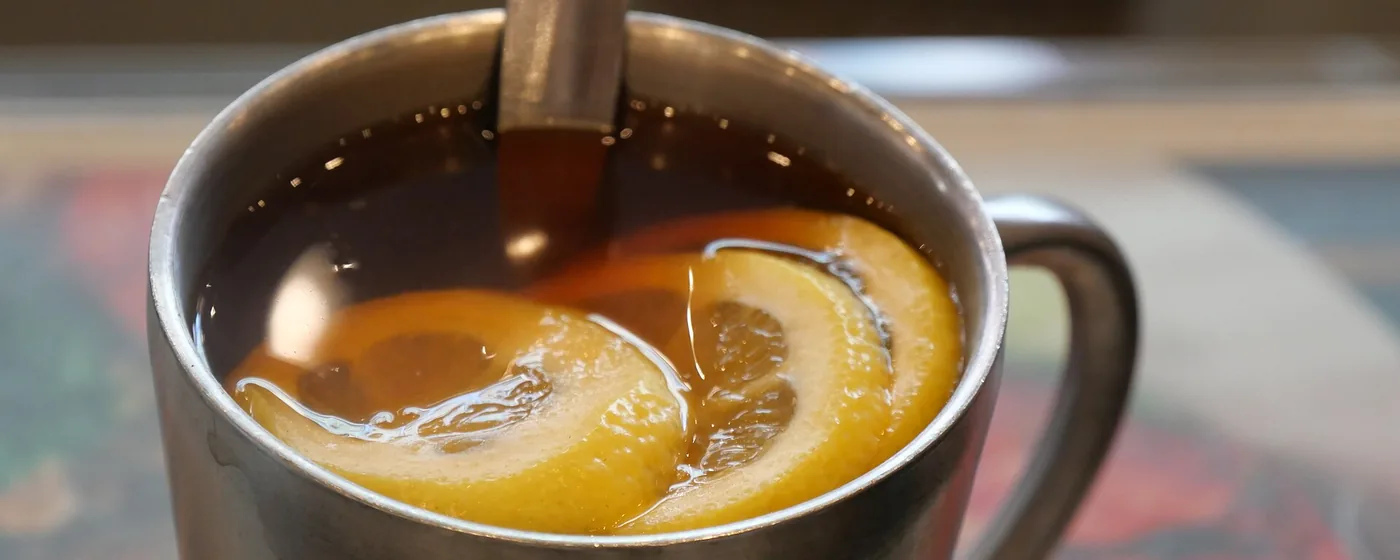
Photo: A Hong Kong style Hot Lemon Tea in Kowloon Cafe at Tsuen Wan.jpg by Peachyeung316 — CC BY-SA 4.0. Cropped and re-encoded.
Ranked by evidence
Licorice Root Tea
The best-studied option, if your blood pressure is normal and you keep it short.
moderate evidence
Licorice coats irritated tissue and is mildly anti-inflammatory. It is the first ingredient in Throat Coat, the tea that beat placebo for pain on swallowing in 60 adults with acute pharyngitis, five minutes after the first cup (PMID 12804082). A network meta-analysis of 70 trials (7,141 patients) also ranked gargled licorice among the top agents for preventing sore throat after intubation (PMID 32820466), as did a 2024 meta-analysis (PMID 38861781) — though those patients gargled before surgery rather than sipping tea with a cold.
Slippery Elm Tea
For a raw throat, when you want the coating without licorice's risks.
limited evidence
Slippery elm bark is rich in mucilage, a gel that coats the throat lining. It was the second ingredient in that Throat Coat blend, which relieved pain within five minutes (PMID 12804082). But the trial was small, manufacturer-funded, and tested eight herbs at once, so we cannot say how much belonged to slippery elm. Nothing has tested it alone.
Sources: [1]
Marshmallow Root Tea
A milder demulcent if slippery elm feels too thick.
limited evidence
Marshmallow root works like slippery elm: its mucilage forms a film over inflamed tissue. It was the fourth ingredient in the Throat Coat blend (PMID 12804082) — the closest thing to evidence it has. No trial has tested it by itself for a sore throat.
Sources: [1]
Peppermint Tea
Worth trying if a cough keeps the throat raw and you don't get heartburn.
limited evidence
Menthol produces a cooling sensation, which is why peppermint turns up in throat lozenges. In a small human experiment, inhaling menthol vapor raised the threshold at which people coughed at an irritant (PMID 22465565). But that measured cough, not throat pain, and used vapor, not tea. Peppermint also relaxes the valve above the stomach, so skip it if reflux is irritating your throat.
Sources: [8]
Chamomile Tea
For evenings, when the throat is more annoying than painful.
Traditional use
Chamomile has soothed irritated throats for centuries, and its flowers show anti-inflammatory activity in the lab. But we found no human trial of chamomile tea for sore throat, and NCCIH concludes the evidence is too thin to rate its usefulness. The warmth and fluid are doing the work. Avoid it if you react to ragweed, daisies, or marigolds.
How to choose between them
Start with what your throat feels like. Raw and painful to swallow? You want a demulcent: licorice, slippery elm, or marshmallow root, in that order of evidence. A cough scraping the throat? Peppermint. Just want warmth at 10pm? Chamomile, for comfort, not a studied effect. All five are caffeine-free.
Then taste and safety decide it. Licorice is intensely sweet; slippery elm and marshmallow are bland and faintly slimy. Licorice is also the one tea here with a real ceiling: its glycyrrhizin raises blood pressure and lowers potassium. One healthy 43-year-old who drank two liters of licorice tea daily for eight weeks developed severe hypokalemia, muscle breakdown, and focal weakness (PMID 33570024). Treat licorice as a few-day remedy, and pick slippery elm or marshmallow root instead if you have high blood pressure, heart or kidney disease, low potassium, or you are pregnant or take diuretics, digoxin, or corticosteroids.
When to see a doctor
Get emergency care if you cannot swallow your own saliva, are drooling, have trouble or noisy breathing, cannot open your mouth fully, or have severe one-sided throat pain with neck swelling or a muffled, hot-potato voice. Those can mean an abscess beside the tonsil or a swollen epiglottis. Call your doctor within a day or two for a fever above 100.4°F with tender neck glands and white patches on the tonsils but no cough; that pattern makes strep likely, and strep needs a swab. Also call for a sore throat with a rash, one lasting beyond a week (most resolve inside seven days; PMID 34881426), or one that keeps returning. One easily missed emergency: if you take carbimazole, methimazole, propylthiouracil, or clozapine, a sore throat with fever needs a same-day blood count, because these drugs can rarely destroy the white cells that fight infection. Same urgency during chemotherapy or immunosuppression.
Frequently asked questions
Licorice, slippery elm, or marshmallow root — which works best?
No study has compared them head to head. Licorice has the most evidence, though most comes from gargling licorice solutions before surgery, not sipping tea (PMID 32820466). Slippery elm and marshmallow root were both ingredients in the one blended tea that beat placebo in acute pharyngitis (PMID 12804082). Try licorice first unless your blood pressure is high — then go straight to the other two.
Does adding honey to tea really help a sore throat?
This is the part of the cup with the best evidence. A meta-analysis of 14 studies found honey improved combined upper-respiratory symptom scores and reduced cough frequency and severity versus usual care (PMID 32817011), and a double-blind trial in 300 children aged one to five found honey beat placebo for nighttime cough and sleep (PMID 22869830). Most of that measured cough rather than throat pain, and reviewers rated the risk of bias as moderate. One absolute rule: never give honey to a baby under 12 months, because of infant botulism.
How often should I drink it, and how fast does it work?
Fast, and briefly. In the pharyngitis trial people drank 5 to 8 ounces four to six times daily, and pain on swallowing was lower than placebo five minutes after the first cup; researchers stopped measuring at thirty minutes (PMID 12804082). That short window is why the dosing is repeated cups. Make it warm enough to soothe, not hot enough to scald. If you need steady relief, an over-the-counter pain reliever does more — and you can use both.
Is licorice tea safe if I have high blood pressure?
No, and this is worth being firm about. Glycyrrhizin mimics aldosterone, making you retain sodium and lose potassium. NCCIH notes that even modest amounts can be dangerous with hypertension, heart disease, or kidney disease, and that large or prolonged intake has caused irregular heart rhythms and cardiac arrest. Published cases include licorice-tea hypokalemia severe enough to cause muscle breakdown (PMID 33570024), a hypertensive crisis with eye and kidney damage (PMID 29538199), and arrhythmia from chronic use (PMID 34422484). Licorice also interacts with diuretics, digoxin, and corticosteroids, and is not recommended in pregnancy. Drink slippery elm or marshmallow root instead.
Can I drink these teas if I have strep throat?
You can, but know what you are getting. Tea does nothing to strep bacteria; if you were prescribed antibiotics, finish the course. Antibiotics reduce symptoms and complications when the cause is bacterial (PMID 34881426) — tea is comfort on top, not a substitute. One precaution: mucilage teas form a coating film in the gut, so take oral medications an hour or two apart. That is mechanism, not documented interaction, but it costs nothing.
References
- Safety and efficacy of a traditional herbal medicine (Throat Coat) in symptomatic temporary relief of pain in patients with acute pharyngitis: a multicenter, prospective, randomized, double-blinded, placebo-controlled study.. Journal of Alternative and Complementary Medicine, 2003. PubMed 12804082 · doi:10.1089/10755530360623400
- Efficacy of topical agents for prevention of postoperative sore throat after single lumen tracheal intubation: a Bayesian network meta-analysis.. Canadian Journal of Anaesthesia, 2020. PubMed 32820466 · doi:10.1007/s12630-020-01792-4
- Effect of peri-intubation non-pharmacological interventions on postoperative laryngeal symptoms: A systematic review with meta-analysis and meta-regression.. Intensive & Critical Care Nursing, 2024. PubMed 38861781 · doi:10.1016/j.iccn.2024.103728
- Antibiotics for treatment of sore throat in children and adults.. Cochrane Database of Systematic Reviews, 2021. PubMed 34881426 · doi:10.1002/14651858.CD000023.pub5
- The effects of a hot drink on nasal airflow and symptoms of common cold and flu.. Rhinology, 2008. PubMed 19145994
- Effectiveness of honey for symptomatic relief in upper respiratory tract infections: a systematic review and meta-analysis.. BMJ Evidence-Based Medicine, 2020. PubMed 32817011 · doi:10.1136/bmjebm-2020-111336
- Effect of honey on nocturnal cough and sleep quality: a double-blind, randomized, placebo-controlled study.. Pediatrics, 2012. PubMed 22869830 · doi:10.1542/peds.2011-3075
- Sweet taste and menthol increase cough reflex thresholds.. Pulmonary Pharmacology & Therapeutics, 2012. PubMed 22465565 · doi:10.1016/j.pupt.2012.03.005
- Pseudohyperaldosteronism with severe hypokalaemia and focal paresis triggered by licorice tea.. Ugeskrift for Laeger, 2021. PubMed 33570024
- Hypertensive crisis with 2 target organ impairment induced by glycyrrhizin: A case report.. Medicine (Baltimore), 2018. PubMed 29538199 · doi:10.1097/MD.0000000000010073
- How Much Is Too Much? Exploring Pseudohyperaldosteronism in Glycyrrhizic Acid Toxicity From Chronic Licorice Root Consumption.. Cureus, 2021. PubMed 34422484 · doi:10.7759/cureus.16454
Last reviewed and updated . HelperTea is written by an enthusiast, not a clinician, and is not medically reviewed. How we research and rate evidence. Found an error? Tell us — safety corrections get priority.