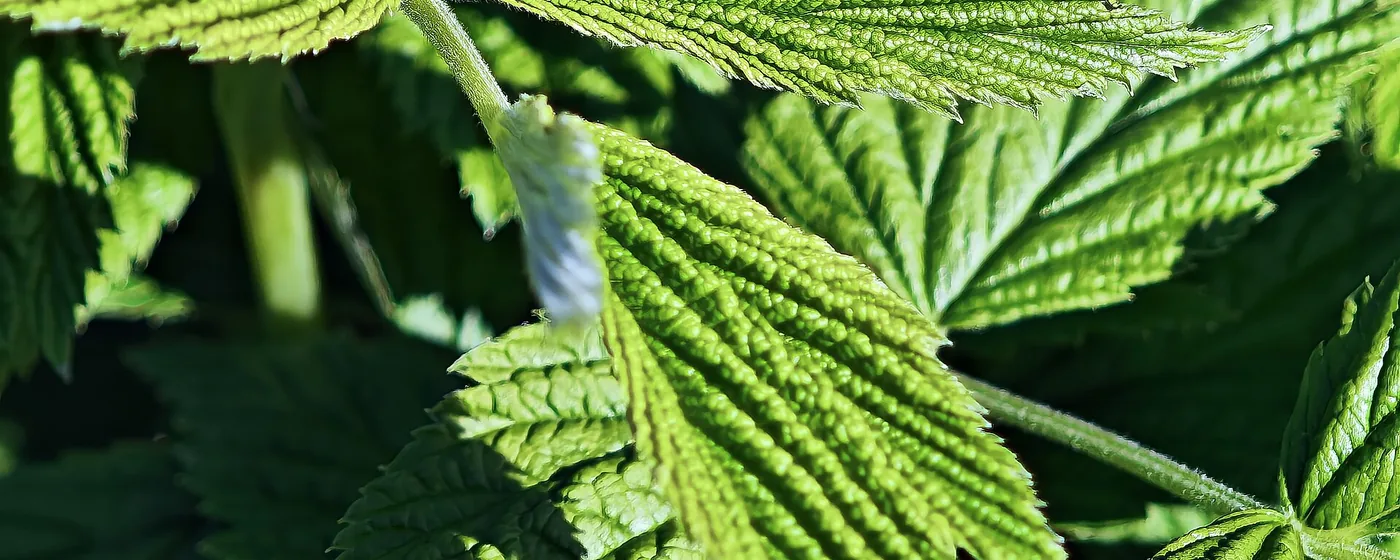
Red raspberry leaf tea is made from the dried leaves of Rubus idaeus, the same shrub that grows the red raspberries you eat. The leaf tastes nothing like the berry, and a fruity red "raspberry tea" from the grocery aisle usually contains no raspberry leaf at all. The leaf is naturally caffeine-free. It is commonly described as containing tannins, along with flavonoids and trace minerals.
On the tongue it is surprisingly plain. Most people describe a mild, slightly grassy cup that resembles a weak, unsweetened black tea, with a dry, astringent finish from the tannins and only a faint fruitiness. Steeped too long, it turns drying and a little bitter. Honey and a squeeze of lemon are the traditional companions, and they do soften the astringency.
What people actually reach for it is pregnancy. Red raspberry leaf has a long reputation as a "uterine tonic" taken in the final weeks to tone the uterus, shorten labor, and ease delivery, and it is genuinely popular — in a 2026 Australian survey of 561 pregnant women, 37% reported using it, making it the most common herb in that group, though an earlier Melbourne survey put the figure closer to 14%.
That reputation is older and larger than the evidence. Only one placebo-controlled trial has ever tested it, in fewer than 200 women, and it did not shorten the first stage of labor. A rat study found the opposite of what people hope for: longer pregnancies. Outside pregnancy, the leaf is a folk remedy for period cramps, diarrhea, and sore throats — traditions with essentially no clinical testing behind them. It is a pleasant, plain tea. It is not a proven medicine, and in pregnancy it is not a casual one.
Photo: (MHNT) Rubus idaeus - Feuillage.jpg by Didier Descouens — CC BY-SA 4.0. Cropped and re-encoded.
What the evidence says
Has not been shown to shorten labor
The only placebo-controlled trial randomized 192 low-risk first-time mothers to raspberry leaf tablets (1.2 g twice daily) or placebo from 32 weeks. It did not shorten the first stage of labor. The authors did report a second stage about 9.6 minutes shorter, but the trial found no statistically significant relationship between tablet use and birth outcomes, and a 2021 systematic review that re-examined it described that second-stage difference as clinically meaningful yet not statistically significant. In other words, it may well be chance. That 2021 review of 13 studies called the overall evidence weak. A 2023 review judged the labor-induction effect weak and raised the possibility of a negative effect on cervical ripening.
Effects on forceps and cesarean rates are unresolved, and the data conflict
In the 2001 trial, 19.3% of the raspberry leaf group had a forceps delivery versus 30.4% on placebo — but the same trial reported no statistically significant relationship between tablet use and birth outcomes, so this difference may be chance. A 1999 retrospective study of 108 women, by overlapping authors, pointed the same direction. Pulling the other way, a 2019 systematic review linked oral raspberry leaf to cesarean delivery in observational data (adjusted odds ratio 3.47, 95% CI 1.45-8.28). A 2024 observational study of 91 women found fewer cesareans in the raspberry leaf group, but its authors cautioned that the results cannot be relied on or generalized. The true direction is unknown.
In rats, raspberry leaf lengthened pregnancy and altered offspring development
Wistar rats given raspberry leaf orally throughout pregnancy had a longer gestation — the opposite of the effect people hope for — and their female offspring showed accelerated reproductive development. The authors wrote that this raised concerns about the safety of raspberry leaf in pregnancy. A 2009 review singled out this study as the one animal experiment pointing to possible risk to the unborn child. These are rodent findings at set doses and may not carry over to people drinking tea. They are, however, the reason "no proven harm" is not the same as "proven safe."
Extracts act on smooth muscle in the lab, but inconsistently
Lab work since the 1940s shows raspberry leaf extracts altering isolated animal and human smooth muscle, including uterine tissue — sometimes relaxing it, sometimes strengthening contractions. A 2002 study found it also relaxed guinea-pig intestine. A 2021 review found this inconsistency across five in-vitro and two animal studies, and noted toxicity when high doses were given by injection to animals. None of this has been shown in people drinking tea.
Reported to lower blood sugar in a single case — treat this as a risk, not a benefit
A 38-year-old woman with insulin-treated gestational diabetes developed hypoglycemia and needed her insulin dose lowered after drinking raspberry leaf tea at 32 weeks. The authors confirmed the timing when she stopped the herb and later restarted it. That is one case report, not a trial, and it cannot tell us how often this happens. The authors urged that women with gestational diabetes be cautioned about raspberry leaf and have their glucose monitored more closely.
Sources: [10]
May interfere with how the body clears some medications
Raspberry leaf extracts inhibited three major drug-metabolizing enzymes — CYP1A2, CYP2D6, and CYP3A4 — in a study using recombinant human enzymes (IC50 values 44, 47, and 81 micrograms per milliliter). Based on the dosing of the commercial products tested, the authors considered clinically relevant inhibition possible. It has never been tested in living people, so this remains theoretical.
Sources: [11]
Traditionally used for menstrual cramps, diarrhea, sore throats, and as a nourishing tonic
These uses rest on custom rather than data — a PubMed search for raspberry leaf and dysmenorrhea returns no clinical trials. Astringent tannins are the usual folk rationale for the diarrhea and gargle uses. The same gap applies to iron, calcium, and antioxidant claims.
No published human clinical trials found for this use.
How to brew Raspberry Leaf Tea
Bring water to a full boil and pour it over the leaves. Cover the mug while it steeps, then strain. Start at five minutes; longer steeps pull more tannin and make the cup drier and more astringent.
- Keep it covered while steeping; an open mug cools too fast to extract properly.
- Cold-brewing overnight in the fridge gives a smoother, less tannic cup.
- If you take iron, leave an hour or two between the supplement and the tea.
Safety, side effects & who should avoid it
Raspberry leaf tea has a long history of use and few reported problems in healthy, non-pregnant adults — though it has never been formally studied for safety in that group. Its safety in pregnancy has not been established, an animal study raised concerns about longer gestation and offspring development, and it may lower blood sugar. It is not a casual drink.
Who should avoid it
- Anyone pregnant who has not cleared it with a midwife or doctor; no guideline endorses it and safety data are absent.
- Pregnant people before the third trimester; the usual 32-week start is convention, not a tested threshold.
- High-risk pregnancy: previous cesarean, prior preterm birth, placenta previa, vaginal bleeding, twins, or a planned cesarean.
- People with gestational diabetes, or diabetes treated with insulin or sulfonylureas, unless blood glucose is closely monitored.
- Anyone allergic to rose-family (Rosaceae) plants — raspberry, strawberry, blackberry, apple, peach, almond.
- Anyone trying to start or speed up labor on their own, rather than under the care of a birth team.
- Children, and anyone using it in place of medical care.
Possible side effects
- Loose stools, or sometimes constipation — the leaf is astringent and tannin-rich.
- Nausea, especially on an empty stomach.
- Increased uterine tightening late in pregnancy (anecdotal, never measured in trials). Stop and call your provider.
- Signs of low blood sugar — shakiness, sweating, confusion — if you take glucose-lowering drugs.
- Rare allergic reactions in people sensitive to Rosaceae plants.
Medication interactions
- Insulin, sulfonylureas, and metformin: raspberry leaf may add to their glucose-lowering effect. A case report describes hypoglycemia and a reduced insulin requirement in a woman with insulin-treated gestational diabetes.
- Drugs cleared by CYP1A2, CYP2D6, or CYP3A4: raspberry leaf extracts inhibited all three in a lab study at concentrations the authors thought could be reached in practice. Unconfirmed in people; ask a pharmacist if you take a narrow-margin drug.
- Iron supplements and iron-rich meals: tannin-rich teas reduce absorption of non-heme iron. This has not been measured for raspberry leaf specifically, but leaving one to two hours between them is a reasonable precaution.
- Oxytocin, prostaglandins, and other labor agents: raspberry leaf's uterine effects are inconsistent in the lab and unmeasured in people. Tell your birth team.
Pregnancy & breastfeeding
This is why most people buy raspberry leaf, and where the evidence is weakest. The one placebo-controlled trial found no harm to mothers or babies, but it enrolled fewer than 200 low-risk women, used tablets rather than tea, and was far too small to rule out uncommon harms. A 2019 systematic review reported an observational link to cesarean delivery and concluded that herbal medicinal product use in pregnancy should be discouraged until robust evidence of safety is available. In rats, raspberry leaf lengthened gestation and accelerated reproductive development in female offspring, which is why a 2009 review questioned recommending it at all. A 2023 review also raised the possibility of a negative effect on cervical ripening. Nothing is known about safety while breastfeeding. Talk to your doctor or midwife first, and do not use it to try to bring on labor.
How much is too much
No established limit. The only placebo-controlled trial used tablets — 1.2 g twice daily from 32 weeks — which does not translate cleanly into cups of tea. Traditional guidance suggests one to three cups daily in the third trimester, but that is custom, not research. The one published hypoglycemia case involved ordinary tea.
Taste & pairing
Tasting notes: Mild, Slightly fruity, Similar to black tea.
Pairs well with: Honey, Lemon.
Best time to drink: Throughout menstrual cycle.
Frequently asked questions
How long should I steep raspberry leaf tea?
Five to ten minutes, covered, with water at a full boil. Five minutes gives a light cup; ten pulls much more tannin and turns it dry and astringent. If yours tastes harsh, steep it less.
When in pregnancy do people start drinking it, and will it bring on labor?
The usual practice is to start around 32 weeks — simply when the one placebo-controlled trial began dosing, not a threshold tested for safety. There is no good evidence the tea induces labor, and in rats raspberry leaf actually lengthened pregnancy. Clear it with your midwife or doctor first.
How many cups of raspberry leaf tea a day is safe?
No safe upper limit has been established. Traditional guidance suggests one to three cups a day in the third trimester, but that is custom, not a tested dose. If you are pregnant, diabetic, or on medication, ask a clinician rather than picking a number.
Does raspberry leaf tea help with period cramps?
Nobody has studied it. A PubMed search turns up no clinical trials of raspberry leaf for menstrual pain. Lab studies show effects on smooth muscle in isolated animal tissue, and many people say it helps them. That is traditional use, not evidence.
Is raspberry leaf tea the same as raspberry tea?
No, and labels blur this. Raspberry leaf tea is the plant's dried leaves and tastes like weak black tea. Berry-flavored "raspberry tea" blends are usually hibiscus or rosehip with fruit flavoring, and often contain no raspberry leaf.
References
- Raspberry leaf in pregnancy: its safety and efficacy in labor.. Journal of midwifery & women's health, 2001. PubMed 11370690 · doi:10.1016/s1526-9523(01)00095-2
- Biophysical effects, safety and efficacy of raspberry leaf use in pregnancy: a systematic integrative review.. BMC complementary medicine and therapies, 2021. PubMed 33563275 · doi:10.1186/s12906-021-03230-4
- Raspberry leaf (Rubus idaeus) use in pregnancy: a prospective observational study.. BMC complementary medicine and therapies, 2024. PubMed 38649906 · doi:10.1186/s12906-024-04465-7
- Raspberry leaf and its effect on labour: safety and efficacy.. Australian College of Midwives Incorporated journal, 1999. PubMed 10754818 · doi:10.1016/s1031-170x(99)80008-7
- Herbal Medicinal Product Use During Pregnancy and the Postnatal Period: A Systematic Review.. Obstetrics and gynecology, 2019. PubMed 30969204 · doi:10.1097/AOG.0000000000003217
- Raspberry Leaves and Extracts-Molecular Mechanism of Action and Its Effectiveness on Human Cervical Ripening and the Induction of Labor.. Nutrients, 2023. PubMed 37513625 · doi:10.3390/nu15143206
- Raspberry leaf--should it be recommended to pregnant women?. Complementary therapies in clinical practice, 2009. PubMed 19880082 · doi:10.1016/j.ctcp.2009.05.003
- Effect of maternal raspberry leaf consumption in rats on pregnancy outcome and the fertility of the female offspring.. Reproductive sciences (Thousand Oaks, Calif.), 2009. PubMed 19276407 · doi:10.1177/1933719109332823
- Relaxant activity of raspberry (Rubus idaeus) leaf extract in guinea-pig ileum in vitro.. Phytotherapy research : PTR, 2002. PubMed 12410549 · doi:10.1002/ptr.1040
- Raspberry Leaf and Hypoglycemia in Gestational Diabetes Mellitus.. Obstetrics and gynecology, 2016. PubMed 27824754 · doi:10.1097/AOG.0000000000001757
- In vitro inhibition of human CYP1A2, CYP2D6, and CYP3A4 by six herbs commonly used in pregnancy.. Phytotherapy research : PTR, 2013. PubMed 23843424 · doi:10.1002/ptr.5037
- Beyond prescription medicine in pregnancy - raspberry leaf and other herbs in Australia.. BMC complementary medicine and therapies, 2026. PubMed 41668030 · doi:10.1186/s12906-025-05229-7
- Herbal medicine use during pregnancy in a group of Australian women.. BMC pregnancy and childbirth, 2006. PubMed 16780602 · doi:10.1186/1471-2393-6-21
Last reviewed and updated . HelperTea is written by an enthusiast, not a clinician, and is not medically reviewed. How we research and rate evidence. Found an error? Tell us — safety corrections get priority.