Short answer
Chamomile has the stronger human evidence for anxiety, but every positive trial used concentrated capsules, not tea, and the largest network meta-analysis could not separate it from placebo. Lemon balm's trials are smaller and shorter. Neither brewed tea has been tested for anxiety. Both are drinks, not treatments.
Both herbs get sold as gentle, natural answers to anxiety. The research is narrower than the marketing. Chamomile has been tested in people with a diagnosed anxiety disorder; lemon balm has not. Lemon balm has been tested for short bursts of laboratory stress, where chamomile has come up empty. And what the researchers handed out bears little resemblance to what comes out of a tea bag.
Which has more human evidence, chamomile or lemon balm?
Chamomile, as long as you are counting trials in people with a diagnosed disorder.
The anchor study is an eight-week double-blind trial of 57 adults with mild-to-moderate generalized anxiety disorder, randomized to standardized chamomile extract capsules or placebo. Anxiety scores fell further on chamomile, though the margin was slim (p = 0.047) PubMed. A later program gave 179 people 1,500 mg of extract daily; about 58% responded. When responders were randomized to continue or switch to placebo, fewer relapsed on chamomile, but not significantly so (hazard ratio 0.52, 95% CI 0.20–1.33), even though those who stayed on it held slightly lower anxiety scores PubMed PubMed.
A 2019 meta-analysis found a modest improvement on the Hamilton anxiety scale in generalized anxiety disorder — roughly 1.4 to 1.8 points at two and four weeks — and no difference at all when it pooled three trials of ordinary state anxiety PubMed. A 2022 Bayesian network meta-analysis of 29 trials across 12 herbs could not distinguish chamomile from placebo (mean difference 0.54, credible interval -5.13 to 6.25); its authors were careful to add that the evidence was also too thin to call chamomile ineffective PubMed. Moderate evidence for the capsules, a modest effect, an unsettled question.
Lemon balm has nothing comparable. Its human anxiety data comes from small crossover studies in healthy volunteers and short trials in people with a chronic illness. That evidence is limited: lemon balm did not even appear among the 12 herbs the 2022 analysis had enough data to compare.
Does chamomile tea do what the chamomile capsules did?
Nobody has run that trial. What we do know is that the doses are not the same.
Every positive chamomile anxiety trial used pharmaceutical-grade extract standardized for its apigenin content, at up to 1,500 mg a day. A tea bag holds roughly one to two grams of dried flowers, and only some of the plant's compounds dissolve out in three to five minutes of 200°F water. The chamomile tea page covers each trial; the pattern holds throughout.
Apigenin does make it out of the bag and into you. When healthy men drank chamomile tea, its main apigenin metabolite peaked in plasma around two hours, and metabolites equivalent to about 34% of the dose turned up in urine PubMed. So the tea is not inert. What nobody has done is compare the apigenin in a cup against the amount in those capsules, or test brewed chamomile tea against placebo for anxiety. Absorbed is not the same as effective.
The mechanism story is thinner than the packaging suggests. Apigenin competes with benzodiazepines for binding sites in brain tissue and reduced anxiety-like behavior in mice PubMed. A second laboratory confirmed the binding but did not reproduce the anxiolytic effect in rats PubMed. Animal and test-tube work is limited evidence by definition.
And the one randomized trial that put a brewed tea up against a placebo tea should give you pause. In 2024, 210 people awaiting elective surgery drank either a calming herbal blend or a lemon-flavored placebo tea. Anxiety fell in both groups, with no significant difference between them PubMed. The blend was a mixture, not chamomile on its own, so it is not a clean test of chamomile tea — but it is the closest anyone has come, and the tea did not beat the placebo. A warm drink and a deliberate pause are genuinely soothing. Separating that from the plant is harder than the internet lets on.
What does lemon balm actually do for anxiety?
It acts faster, if it acts. In an 18-person double-blind crossover, a single 600 mg dose of standardized extract raised self-rated calmness during a 20-minute laboratory stress task — and lowered self-rated alertness PubMed. An earlier crossover in 20 adults also saw calmness rise, but only at the lowest dose tested (300 mg), only at the earliest time points, and alongside lower memory scores PubMed. Two trials pointing the same way without agreeing on the dose.
The longer trials are small. Eighty adults with chronic stable angina took 3 g of a lemon balm supplement daily for eight weeks and reported lower anxiety, depression, and stress scores than placebo PubMed. Sixty adults with type 2 diabetes and depressive symptoms took 700 mg of extract daily for 12 weeks and improved on both measures, though only 44 finished and fasting blood sugar did not budge PubMed.
A 2021 systematic review pooled these trials and reported a large effect on anxiety scores versus placebo (standardized mean difference -0.98) PubMed. Before you file that under settled: its authors flagged high heterogeneity, noted how few trials there were, and urged caution. The pooled studies were small, single-center, and rested on self-report questionnaires. They tested extracts and capsules; we could find no trial of brewed lemon balm tea for anxiety.
Mechanistically, rosmarinic acid from lemon balm inhibits GABA transaminase in a test-tube assay using rat brain enzyme PubMed. Test tube. The lemon balm tea page covers the rest.
Chamomile vs lemon balm: how do they compare?
| Chamomile tea | Lemon balm tea | |
|---|---|---|
| What the evidence supports | Moderate evidence that standardized extract capsules modestly reduce generalized anxiety disorder symptoms, though the largest network meta-analysis could not separate chamomile from placebo. No trial has tested the brewed tea. | Limited evidence that extract capsules may produce a mild, short-lived calm during a laboratory stress task. No trial has tested the brewed tea. |
| How fast it acts | The capsule trials ran eight weeks before showing any separation from placebo. No evidence a single cup does anything. | Stress-task trials gave one capsule dose and tracked calmness over the next few hours. |
| Taste | Apple-like, honeyed; strawy if oversteeped. Brew 3 to 5 minutes at 200°F. | Lemon zest over something green, faintly minty, never sour. Brew 5 to 7 minutes at 200°F. |
| Caffeine | None. | None. |
| Who should ask first, or avoid it | Ragweed, mugwort, chrysanthemum, marigold, or daisy allergy; warfarin or any other anticoagulant or antiplatelet drug; cyclosporine; hormonal birth control; sedatives; upcoming surgery; infants under 12 months. | Thyroid disease or levothyroxine; sedatives, sleep medicines, opioids, or alcohol; diabetes medication; anyone about to drive. |
What do the trials get wrong that nobody mentions?
Chamomile did not separate from placebo in the 2022 network analysis. Lemon balm has two problems of its own.
First, the only dose-ranging study was not lemon balm alone. In 24 volunteers, 600 mg of a lemon balm and valerian combination blunted anxiety during a stress task, while 1,800 mg of the same product left anxiety higher, significantly so during one testing session; all three doses worsened performance on the Stroop task PubMed. Because valerian was in every capsule, none of that can be pinned on lemon balm — but it is a reason not to assume more is better. A 2025 randomized trial of 96 knee-replacement patients used the same kind of lemon balm and valerian capsule; pre-surgical anxiety fell, but not by a statistically significant margin PubMed. Worth knowing that valerian is sedating in its own right: it should not be stacked with alcohol, benzodiazepines, opioids, or other sedatives, and not taken before driving.
Second, lemon balm dulls you. In a crossover trial, self-rated alertness fell significantly at every measured time point after a 900 mg dose, and memory scores slipped PubMed. The 600 mg dose in the stress study lowered alertness too PubMed. Worth knowing if you have a hard afternoon ahead.
Who should avoid chamomile, and who should avoid lemon balm?
Skip chamomile if you are allergic to ragweed, mugwort, chrysanthemums, marigolds, daisies, or other Asteraceae plants. In a series of 14 people sensitized to chamomile, ten had immediate-type reactions, some life-threatening; most were also sensitized to mugwort and many to birch pollen PubMed. In one published case a man was hospitalized about 30 minutes after chamomile tea with itchy palms, swollen eyelids and upper lip, and throat tightness PubMed; another describes anaphylaxis to chamomile tea in a person with mugwort allergy PubMed. Wheezing, facial swelling, or trouble breathing after a cup is a call-911 situation, not a wait-and-see one.
Clear it with a prescriber if you take warfarin or another anticoagulant or antiplatelet medicine: a 70-year-old woman on warfarin was hospitalized with multiple internal hemorrhages after using chamomile tea and body lotion PubMed. Chamomile has also been reported to raise cyclosporine blood levels in patients, a serious problem in transplant care PubMed. NCCIH adds two softer cautions: chamomile may reduce the effect of birth control pills, and additive drowsiness with sedatives is plausible though unproven. Tell your surgical team before an operation, since herbal products are usually stopped beforehand. And do not give chamomile tea to a baby under 12 months: dried chamomile can carry Clostridium botulinum spores, and steeping water is not hot enough to kill them.
Skip lemon balm, or ask first, if you have thyroid disease. In laboratory experiments, freeze-dried extracts blocked bovine thyroid-stimulating hormone from binding to human thyroid membranes PubMed and blunted the stimulating antibodies of Graves' disease PubMed. Test tubes, not people, and no human study shows the tea changes thyroid hormone levels. Still, a titrated levothyroxine dose is not the place to add variables.
Lemon balm extract lowered self-rated alertness in both crossover trials above, so additive drowsiness with benzodiazepines, sleep aids, opioids, and alcohol is plausible, though no trial has tested the combination. Do not drive after your first cup until you know how it affects you. A blood-sugar-lowering effect is often listed for lemon balm, but the diabetes trial found no change in fasting blood sugar PubMed; mention it to your prescriber anyway if you use insulin or another glucose-lowering drug.
Neither herb has been adequately studied in medicinal amounts during pregnancy or breastfeeding. Nobody can honestly call either safe or unsafe. Ask your obstetrician or midwife first.
When does anxiety need a clinician rather than a mug?
Tea is a reasonable, low-risk part of winding down. It is not a treatment for an anxiety disorder, and it will not stop a panic attack.
See a doctor, not a teabag, if:
- anxiety has run most days for six months or longer, or is interfering with work, sleep, or relationships;
- you have had a panic attack, especially a first one. Chest pain, a pounding heart, and breathlessness can also signal a cardiac or thyroid problem;
- you have unexplained weight loss with a racing pulse and tremor;
- the anxiety started after a new medication, or after cutting back on alcohol or benzodiazepines;
- you drink or use sedatives to get through the day.
If you are having thoughts of harming yourself, call or text 988 in the United States.
Never stop a prescribed anxiety medication to try tea instead, and never stop a benzodiazepine abruptly.
The bottom line
Chamomile has the better evidence, and it is still moderate at best, still confined to capsules, and still unproven in the largest pooled analysis. Lemon balm's data is faster-acting but weaker, and its only dose-ranging study tested a valerian combination rather than lemon balm alone.
So choose on taste, timing, and safety. Chamomile for a background hum of worry in the evening, if ragweed and warfarin are not in the picture. Lemon balm for a stressful afternoon, if your thyroid is fine and you are not about to drive. Treat whichever you pick as what it is: a warm, caffeine-free pause, not medicine. The teas for anxiety and stress roundup ranks both against passionflower, lavender, and valerian by the human evidence behind them.
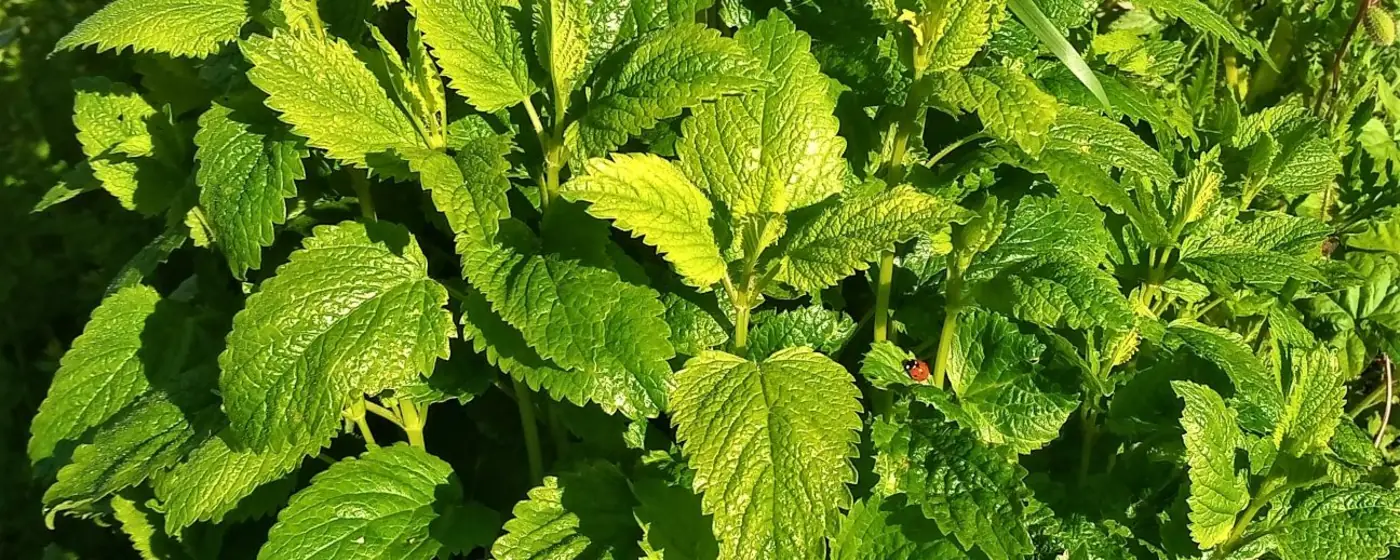
Photo: Lemon balm plant.jpg by Amitchell125 — CC BY-SA 4.0. Cropped and re-encoded.
Frequently asked questions
Can you drink chamomile and lemon balm together?
Yes, and they are often blended: the apple note of chamomile sits well under lemon balm's citrus. We could find no trial of the two together for anxiety, so there is no reason to expect the blend outperforms either herb alone. Every caution that applies to each one separately still applies to the blend.
Can chamomile or lemon balm tea replace an anxiety medication?
No. The trials that found any benefit used concentrated capsules rather than tea, and the effects they measured were small. Never stop a prescribed anxiety medication to try an herbal tea, and never stop a benzodiazepine abruptly. Talk to the clinician who prescribed it.
Which is safer if I have hay fever or a ragweed allergy?
Lemon balm, most likely. Chamomile is in the daisy family, and in one case series most people sensitized to chamomile were also sensitized to mugwort, with many reacting to birch pollen too; a published case report describes hospitalization about half an hour after a cup. Lemon balm is a mint-family plant, so it does not share those allergens, though any plant can trigger an allergy in someone.
Do chamomile capsules work better than chamomile tea?
Capsules are what the trials used, so they are the only form with any human anxiety evidence behind them. Apigenin from chamomile tea is absorbed, and one human study tracked its metabolites in blood and urine, but nobody has compared the amount in a cup with the amount in those capsules, and no trial has tested brewed tea for anxiety. Bear in mind that supplements are not reviewed by the FDA for effectiveness before sale, so a label claim is a claim, not a guarantee.
Can I drink chamomile or lemon balm tea if I take an SSRI or a benzodiazepine?
Ask your pharmacist about your specific medication. Both herbs may deepen the drowsiness from benzodiazepines, sleep aids, and alcohol, though this has not been tested in a trial. Chamomile may also interact with warfarin, cyclosporine, birth control pills, and some liver-metabolized drugs. Neither is a substitute for the prescription.
Which one is more likely to make me drowsy during the day?
Lemon balm has the clearer evidence for it: in one crossover trial, self-rated alertness fell significantly at every measured time point after a 900 mg extract dose, and memory scores dropped. Chamomile is traditionally the sleepier of the two, but a cup of either delivers far less active compound than those capsules did.
References
- A randomized, double-blind, placebo-controlled trial of oral Matricaria recutita (chamomile) extract therapy for generalized anxiety disorder.. Journal of clinical psychopharmacology, 2009. PubMed 19593179 · doi:10.1097/JCP.0b013e3181ac935c
- Short-term open-label chamomile (Matricaria chamomilla L.) therapy of moderate to severe generalized anxiety disorder.. Phytomedicine : international journal of phytotherapy and phytopharmacology, 2016. PubMed 27912871 · doi:10.1016/j.phymed.2016.10.013
- Long-term chamomile (Matricaria chamomilla L.) treatment for generalized anxiety disorder: A randomized clinical trial.. Phytomedicine : international journal of phytotherapy and phytopharmacology, 2016. PubMed 27912875 · doi:10.1016/j.phymed.2016.10.012
- Therapeutic efficacy and safety of chamomile for state anxiety, generalized anxiety disorder, insomnia, and sleep quality: A systematic review and meta-analysis of randomized trials and quasi-randomized trials.. Phytotherapy research : PTR, 2019. PubMed 31006899 · doi:10.1002/ptr.6349
- Medicinal herbs for the treatment of anxiety: A systematic review and network meta-analysis.. Pharmacological research, 2022. PubMed 35378276 · doi:10.1016/j.phrs.2022.106204
- Absorption, distribution, metabolism and excretion of apigenin and its glycosides in healthy male adults.. Free radical biology & medicine, 2022. PubMed 35452808 · doi:10.1016/j.freeradbiomed.2022.04.007
- Apigenin, a component of Matricaria recutita flowers, is a central benzodiazepine receptors-ligand with anxiolytic effects.. Planta medica, 1995. PubMed 7617761 · doi:10.1055/s-2006-958058
- Pharmacological profile of apigenin, a flavonoid isolated from Matricaria chamomilla.. Biochemical pharmacology, 2000. PubMed 10751547 · doi:10.1016/s0006-2952(00)00264-1
- Exploring the Effects of a Calming Herbal Tea Blend on Perioperative Anxiety: A Randomized Clinical Trial.. Journal of medicinal food, 2024. PubMed 39514279 · doi:10.1089/jmf.2024.0170
- Attenuation of laboratory-induced stress in humans after acute administration of Melissa officinalis (Lemon Balm).. Psychosomatic medicine, 2004. PubMed 15272110 · doi:10.1097/01.psy.0000132877.72833.71
- Modulation of mood and cognitive performance following acute administration of Melissa officinalis (lemon balm).. Pharmacology, biochemistry, and behavior, 2002. PubMed 12062586 · doi:10.1016/s0091-3057(02)00777-3
- The effects of Melissa officinalis supplementation on depression, anxiety, stress, and sleep disorder in patients with chronic stable angina.. Clinical nutrition ESPEN, 2018. PubMed 29908682 · doi:10.1016/j.clnesp.2018.04.015
- The effects of melissa officinalis on depression and anxiety in type 2 diabetes patients with depression: a randomized double-blinded placebo-controlled clinical trial.. BMC complementary medicine and therapies, 2023. PubMed 37131158 · doi:10.1186/s12906-023-03978-x
- The effects of lemon balm (Melissa officinalis L.) on depression and anxiety in clinical trials: A systematic review and meta-analysis.. Phytotherapy research : PTR, 2021. PubMed 34449930 · doi:10.1002/ptr.7252
- Bioassay-guided fractionation of lemon balm (Melissa officinalis L.) using an in vitro measure of GABA transaminase activity.. Phytotherapy research : PTR, 2009. PubMed 19165747 · doi:10.1002/ptr.2712
- Anxiolytic effects of a combination of Melissa officinalis and Valeriana officinalis during laboratory induced stress.. Phytotherapy research : PTR, 2006. PubMed 16444660 · doi:10.1002/ptr.1787
- Comparison of the Effects of a Melissa officinalis L. and Valerian Combination With Clonidine on Anxiety, Hemodynamic Changes, and Shivering in Knee Replacement Surgery: A Randomized Controlled Trial.. Journal of perianesthesia nursing : official journal of the American Society of PeriAnesthesia Nurses, 2025. PubMed 41317165 · doi:10.1016/j.jopan.2025.06.015
- Anaphylaxis to camomile: clinical features and allergen cross-reactivity.. Clinical and experimental allergy : journal of the British Society for Allergy and Clinical Immunology, 2000. PubMed 10998021 · doi:10.1046/j.1365-2222.2000.00902.x
- [Anaphylactic reaction to camomile tea].. Der Hautarzt; Zeitschrift fur Dermatologie, Venerologie, und verwandte Gebiete, 2018. PubMed 29737365 · doi:10.1007/s00105-018-4166-x
- A case of anaphylactic reaction to chamomile tea in a patient with mugwort pollinosis.. Allergology international : official journal of the Japanese Society of Allergology, 2019. PubMed 30952586 · doi:10.1016/j.alit.2019.02.011
- Warfarin interaction with Matricaria chamomilla.. CMAJ : Canadian Medical Association journal = journal de l'Association medicale canadienne, 2006. PubMed 16636327 · doi:10.1503/cmaj.051191
- Cyclosporine and herbal supplement interactions.. Journal of toxicology, 2014. PubMed 24527031 · doi:10.1155/2014/145325
- Inhibition by certain plant extracts of the binding and adenylate cyclase stimulatory effect of bovine thyrotropin in human thyroid membranes.. Endocrinology, 1984. PubMed 6745167 · doi:10.1210/endo-115-2-527
- Extracts and auto-oxidized constituents of certain plants inhibit the receptor-binding and the biological activity of Graves' immunoglobulins.. Endocrinology, 1985. PubMed 2985357 · doi:10.1210/endo-116-5-1687
Last reviewed and updated . HelperTea is written by an enthusiast, not a clinician, and is not medically reviewed. How we research and rate evidence. Found an error? Tell us — safety corrections get priority.