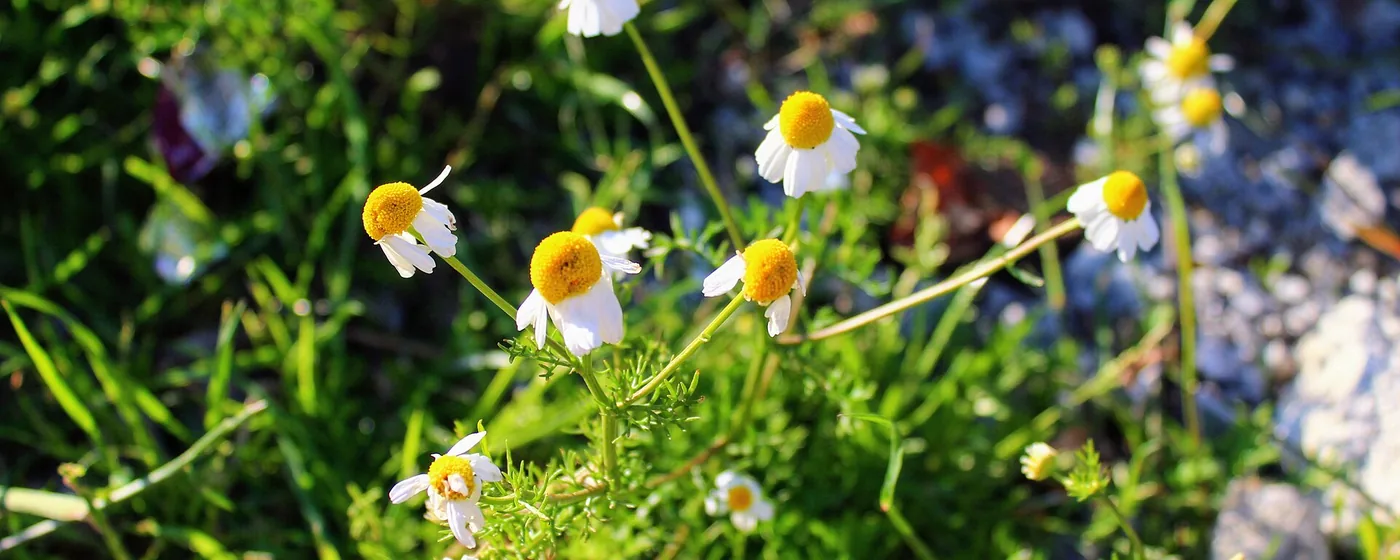
German chamomile is the small, daisy-like flower of Matricaria chamomilla, native to Europe and western Asia. The tea is made from its dried flower heads and contains no caffeine. It is the chamomile in almost every US tea bag, and the species used in almost every clinical study. Roman chamomile, Chamaemelum nobile, is a different plant with a sharper flavor and a much thinner research record.
Brewed properly it tastes the way a hayfield smells after rain: apple-like, gently floral, with a honeyed sweetness that arrives late. Steep it too long or too hot and that sweetness turns bitter and strawy. It takes honey easily, sits well beside vanilla desserts and light pastry, and is pleasant plain.
Most people reach for chamomile at night, hoping it will calm them down or help them sleep. The honest picture is more modest than the box suggests. Concentrated chamomile capsules have shown a small benefit for generalized anxiety disorder in a handful of trials. For sleep, the evidence is thin and contradictory: the one randomized trial in adults with chronic insomnia found no significant improvement in any sleep-diary measure. Its longest-documented use — a settling drink for an upset stomach, going back to ancient Greek and Egyptian medicine — has almost no modern clinical evidence behind it. None of this makes chamomile a bad drink. It is a pleasant, low-risk, caffeine-free tea with a small evidence base. But it is not a harmless herb for everyone: not if you are allergic to ragweed or other daisy-family plants, not if you take warfarin or cyclosporine, and not for a baby under a year old.
Photo: Matricaria chamomilla–IMG 6148 02.jpg by Kızıl — CC BY-SA 4.0. Cropped and re-encoded.
What the evidence says
May modestly reduce generalized anxiety symptoms — in capsules, not tea
In an 8-week double-blind trial, 57 adults with mild-to-moderate generalized anxiety disorder took standardized chamomile extract or placebo; anxiety scores fell significantly further on chamomile, though the margin was slim. In a later program, 179 people took 1,500 mg daily and 58% responded, but randomizing responders to continue or switch to placebo produced no significant difference in relapse. A 2019 meta-analysis found a modest improvement in generalized anxiety on the Hamilton scale, while pooling three trials of ordinary state anxiety showed no difference at all. Every one of these trials used pharmaceutical-grade capsules, not tea.
May slightly improve sleep quality; the trials contradict one another
A 2024 systematic review identified ten trials (772 participants). Its pooled analysis of the five that reported the Pittsburgh Sleep Quality Index found scores fell by about 1.9 points, but the trials disagreed sharply with one another. The same review found no improvement in sleep duration, sleep efficiency, or daytime functioning, though most of the trials that measured it reported fewer night-time awakenings. The one randomized, placebo-controlled trial in 34 adults with chronic insomnia found no significant change in any sleep-diary measure over 28 days. Among 80 postpartum women, two-week benefits had vanished by week four.
The proposed calming mechanism rests on lab and animal work
Apigenin, a flavone in chamomile flowers, competes with benzodiazepines for binding sites in brain tissue and reduced anxiety-like behavior in mice. A second laboratory confirmed the binding but did not reproduce the anxiolytic effect in rats, and found that a benzodiazepine antagonist failed to block apigenin's quieting effect on movement — so whatever is happening may not be GABAergic at all. Neither study shows how much apigenin a brewed cup delivers.
Traditionally taken after meals to settle an upset stomach
Chamomile's oldest recorded use, across Greek, Roman, Egyptian, and later European herbal practice, is for stomach complaints and cramps. Modern support is largely laboratory work on its volatile oil and flavonoids. There is no good human trial of chamomile tea alone for indigestion, and NCCIH concludes that studies of chamomile across its proposed uses have not produced enough reliable evidence to rate its clinical usefulness.
Sources: [10]
One small trial, reported across two papers, found better blood sugar markers
An Iranian team randomized 64 adults with type 2 diabetes to chamomile tea (3 g per 150 mL, three times daily after meals) or plain water for eight weeks, reporting lower HbA1c, fasting insulin, and insulin resistance across two papers drawn from the same 64 participants. Because the control group drank water, participants knew which arm they were in, and that single-blind design cannot separate the tea from the expectation of it. No independent group has replicated this.
How to brew Chamomile Tea
Boil the water, let it stand 30 seconds to settle near 200°F, then pour it over the flowers and cover the cup. Steep 3 to 5 minutes, strain, and drink.
- Keep the cup covered while it steeps; chamomile's aroma comes from volatile oils that leave with the steam.
- Whole dried flower heads beat the dust in cheap tea bags, and they swell, so use a roomy infuser.
- Buy from a supplier that names the species: Matricaria chamomilla, not Chamaemelum nobile.
Safety, side effects & who should avoid it
For most adults, a cup or two of chamomile tea is low risk. Three cautions matter. It can trigger severe allergic reactions in people allergic to ragweed and related plants. It may add to warfarin's bleeding risk, and it has been reported to raise blood levels of cyclosporine. And dried chamomile can carry Clostridium botulinum spores, which makes it a poor choice for babies under a year old.
Who should avoid it
- Anyone allergic to ragweed, mugwort, chrysanthemums, marigolds, daisies, or other Asteraceae plants. Reported reactions to chamomile tea run from itchy palms and swollen eyelids to life-threatening anaphylaxis (PMID 10998021, 30952586).
- People on warfarin or another anticoagulant or antiplatelet medicine, unless their prescriber has cleared it.
- Anyone taking cyclosporine, unless their transplant team has cleared it. Chamomile has been reported to raise cyclosporine blood levels, and cyclosporine has very little margin for error (PMID 24527031).
- Anyone facing surgery, until the surgical team knows; herbal products are often stopped beforehand.
- Infants under 12 months. Dried chamomile can carry Clostridium botulinum spores — one study found them in 7.5% of 200 samples, more often in loose flowers than in tea bags — and steeping water is not hot enough to destroy bacterial spores. A baby's gut can let those spores germinate, which is how infant botulism starts. Chamomile tea is a traditional colic remedy in some countries; it should not be. Chamomile alone has not been shown to help colic anyway (PMID 18068252).
- Older babies and young children, as a remedy, without a pediatrician's advice.
- No one should use brewed chamomile as an eyewash or eye compress; a 2025 review flagged this folk practice for allergic reactions and contamination, and NCCIH notes chamomile can irritate the eyes (PMID 40421213).
Possible side effects
- Uncommon overall. NCCIH lists nausea, dizziness, and allergic reactions, including severe hypersensitivity reactions and anaphylaxis, though most trials watched for side effects passively.
- Immediate allergic reactions — itchy palms, hives, swollen eyelids and lips, throat tightness, anaphylaxis — within about 30 minutes of a single cup (PMID 29737365).
- Drowsiness, usually the point, but notice how it affects you before driving at night.
Medication interactions
- Warfarin and other blood thinners. Chamomile contains natural coumarins, though these are not anticoagulants in the way warfarin is, and the mechanism has never been established. Still, a 70-year-old woman on warfarin was hospitalized with multiple internal hemorrhages after using chamomile tea and body lotion, and a 2020 systematic review lists chamomile tea among products linked to bleeding in people on warfarin. A single case report is not proof of cause, but the consequence is severe enough to take seriously (PMID 16636327, 32478963).
- Cyclosporine. A review of herb-drug interactions reports that chamomile has raised cyclosporine blood concentrations in patients. Cyclosporine has a narrow therapeutic window, so a shift in blood level can mean toxicity or graft rejection. Chamomile's own mechanism has not been pinned down. Do not drink chamomile tea on cyclosporine without medical advice (PMID 24527031).
- Sedatives, sleep medicines, opioids, and alcohol. Additive drowsiness is theoretically possible, per NCCIH, though it has not been shown in trials.
- Hormonal birth control. NCCIH notes chamomile may have some estrogen-like effects, and that preliminary studies suggest taking chamomile alongside birth control pills might reduce their effect. This has not been confirmed in clinical trials, but it is worth knowing about.
- Other drugs metabolized by the liver. NCCIH reports that interactions with some liver-metabolized drugs have been documented; if you take a medicine with a narrow safety margin, ask your pharmacist first.
- Insulin and other glucose-lowering drugs. Given the single small trial reporting lower HbA1c, additive blood-sugar lowering is plausible, though it has not been demonstrated.
Pregnancy & breastfeeding
There is not enough reliable human data to call chamomile safe in pregnancy or while breastfeeding; NCCIH says plainly that little is known. Occasional food amounts have not been shown to cause harm, but daily medicinal use has never been properly studied. Talk to your doctor or midwife first.
How much is too much
No established limit. The diabetes trial used 3 g of flowers per 150 mL, three times daily for eight weeks. The generalized anxiety trials used pharmaceutical-grade capsules at up to 1,500 mg a day, and the insomnia pilot used 270 mg capsules twice daily — none of those is tea. One to three cups a day is the best-studied range.
Taste & pairing
Tasting notes: Apple-like, Floral, Honey-like sweetness, Soothing.
Pairs well with: Honey, Light pastries, Vanilla desserts.
Best time to drink: Before bedtime or during stressful situations.
Frequently asked questions
How long should I steep chamomile tea?
Three to five minutes in water just off the boil, around 200°F, with the cup covered so the aromatic oils don't escape with the steam. Ten minutes gives a stronger, more bitter, hay-like cup. No evidence says a longer steep produces a stronger effect.
How many cups of chamomile tea can I drink a day?
There is no established limit. Most people drink one to three cups, and the diabetes tea trial gave three servings daily for eight weeks without reporting harms — though it was not designed to detect them. If you take a blood thinner or cyclosporine, or you're allergic to ragweed or other daisy-family plants, the right number may be zero.
When should I drink chamomile tea for sleep?
Traditionally 30 to 60 minutes before bed, which also gives your bladder time to catch up. Be clear-eyed about what that buys you: the one randomized trial in adults with chronic insomnia found no significant improvement in how quickly people fell asleep or how long they slept.
Can chamomile tea cause an allergic reaction?
Yes, and this is the risk worth taking seriously. Chamomile is in the daisy family and shares allergens with ragweed, mugwort, and birch pollen. Case reports describe itchy palms, swollen lips and eyelids, throat tightness, and anaphylaxis about half an hour after a cup. Wheezing or facial swelling is a call-911 situation.
Can I give chamomile tea to my baby?
Not under 12 months. Dried chamomile can carry Clostridium botulinum spores — one study found them in about 7.5% of 200 samples — and steeping does not get hot enough to kill spores. In infants under a year, swallowed spores can germinate in the gut and cause infant botulism, a serious illness. Chamomile tea is a traditional colic remedy in some countries, but chamomile alone has never been shown to help colic. Ask a pediatrician before giving any herbal tea to a baby or toddler.
Does chamomile tea work as well as the capsules used in the anxiety studies?
Nobody knows, and there is reason to doubt it. Those trials used pharmaceutical-grade extract standardized for apigenin, at up to 1,500 mg a day. A tea bag holds one to two grams of dried flowers, and only some of the plant's compounds dissolve into hot water.
References
- A randomized, double-blind, placebo-controlled trial of oral Matricaria recutita (chamomile) extract therapy for generalized anxiety disorder.. Journal of clinical psychopharmacology, 2009. PubMed 19593179 · doi:10.1097/JCP.0b013e3181ac935c
- Short-term open-label chamomile (Matricaria chamomilla L.) therapy of moderate to severe generalized anxiety disorder.. Phytomedicine : international journal of phytotherapy and phytopharmacology, 2016. PubMed 27912871 · doi:10.1016/j.phymed.2016.10.013
- Long-term chamomile (Matricaria chamomilla L.) treatment for generalized anxiety disorder: A randomized clinical trial.. Phytomedicine : international journal of phytotherapy and phytopharmacology, 2016. PubMed 27912875 · doi:10.1016/j.phymed.2016.10.012
- Therapeutic efficacy and safety of chamomile for state anxiety, generalized anxiety disorder, insomnia, and sleep quality: A systematic review and meta-analysis of randomized trials and quasi-randomized trials.. Phytotherapy research : PTR, 2019. PubMed 31006899 · doi:10.1002/ptr.6349
- Effects of chamomile (Matricaria chamomilla L.) on sleep: A systematic review and meta-analysis of clinical trials.. Complementary therapies in medicine, 2024. PubMed 39106912 · doi:10.1016/j.ctim.2024.103071
- Preliminary examination of the efficacy and safety of a standardized chamomile extract for chronic primary insomnia: a randomized placebo-controlled pilot study.. BMC complementary and alternative medicine, 2011. PubMed 21939549 · doi:10.1186/1472-6882-11-78
- Effects of an intervention with drinking chamomile tea on sleep quality and depression in sleep disturbed postnatal women: a randomized controlled trial.. Journal of advanced nursing, 2015. PubMed 26483209 · doi:10.1111/jan.12836
- Apigenin, a component of Matricaria recutita flowers, is a central benzodiazepine receptors-ligand with anxiolytic effects.. Planta medica, 1995. PubMed 7617761 · doi:10.1055/s-2006-958058
- Pharmacological profile of apigenin, a flavonoid isolated from Matricaria chamomilla.. Biochemical pharmacology, 2000. PubMed 10751547 · doi:10.1016/s0006-2952(00)00264-1
- Chamomile: A Review of Its Traditional Uses, Chemical Constituents, Pharmacological Activities and Quality Control Studies.. Molecules (Basel, Switzerland), 2022. PubMed 36615326 · doi:10.3390/molecules28010133
- Chamomile tea improves glycemic indices and antioxidants status in patients with type 2 diabetes mellitus.. Nutrition (Burbank, Los Angeles County, Calif.), 2015. PubMed 26437613 · doi:10.1016/j.nut.2015.07.011
- Effectiveness of chamomile tea on glycemic control and serum lipid profile in patients with type 2 diabetes.. Journal of endocrinological investigation, 2014. PubMed 25194428 · doi:10.1007/s40618-014-0170-x
- Anaphylaxis to camomile: clinical features and allergen cross-reactivity.. Clinical and experimental allergy : journal of the British Society for Allergy and Clinical Immunology, 2000. PubMed 10998021 · doi:10.1046/j.1365-2222.2000.00902.x
- A case of anaphylactic reaction to chamomile tea in a patient with mugwort pollinosis.. Allergology international : official journal of the Japanese Society of Allergology, 2019. PubMed 30952586 · doi:10.1016/j.alit.2019.02.011
- [Anaphylactic reaction to camomile tea].. Der Hautarzt; Zeitschrift fur Dermatologie, Venerologie, und verwandte Gebiete, 2018. PubMed 29737365 · doi:10.1007/s00105-018-4166-x
- Reevaluating the safety of chamomile poultices in ophthalmic care.. Frontiers in pharmacology, 2025. PubMed 40421213 · doi:10.3389/fphar.2025.1580586
- Warfarin interaction with Matricaria chamomilla.. CMAJ : Canadian Medical Association journal = journal de l'Association medicale canadienne, 2006. PubMed 16636327 · doi:10.1503/cmaj.051191
- Warfarin and food, herbal or dietary supplement interactions: A systematic review.. British journal of clinical pharmacology, 2020. PubMed 32478963 · doi:10.1111/bcp.14404
- Cyclosporine and herbal supplement interactions.. Journal of toxicology, 2014. PubMed 24527031 · doi:10.1155/2014/145325
- Presence of Clostridium botulinum spores in Matricaria chamomilla (chamomile) and its relationship with infant botulism.. International journal of food microbiology, 2007. PubMed 18068252 · doi:10.1016/j.ijfoodmicro.2007.11.008
Last reviewed and updated . HelperTea is written by an enthusiast, not a clinician, and is not medically reviewed. How we research and rate evidence. Found an error? Tell us — safety corrections get priority.