Short answer
Pour fully boiling water, 212°F (100°C), over 1 teaspoon of dried peppermint, one tea bag, or 8 to 10 lightly bruised fresh leaves per 8 ounces, cover the cup, and steep 5 to 7 minutes before straining. Keep the lid on: menthol is volatile and otherwise leaves with the steam.
Boiling water, a teaspoon of dried leaves per cup, lid on, five to seven minutes. That is the spec, and it matches our peppermint tea page. The step people skip is the lid, and it is the one that changes the cup most.
Peppermint (Mentha × piperita) is a leaf, and what you are brewing for is menthol. Volatile is the word that governs everything below: menthol evaporates readily, which is why an uncovered mug perfumes your kitchen instead of your tea.
What water temperature is right for peppermint tea?
Full boil, 212°F (100°C). Peppermint is not green tea; there are no delicate catechins to scald into astringency, so pour straight off the kettle.
Your water may matter more than the kettle. A laboratory study that brewed peppermint leaves covered at 95°C reported that the water's mineral content changed how much polyphenol was extracted (PubMed). That is a chemistry measurement, not a finding about taste or health, and it does not tell you which water makes a better cup. If your tea tastes flat, filtered water costs little to try, but treat that as preference, not evidence.
How long should you steep peppermint tea?
Five to seven minutes:
- 2 to 3 minutes. Thin. Mint on the nose, not on the tongue.
- 5 to 7 minutes. The standard: full cooling menthol, no harshness.
- 8 to 10 minutes. Past about 8 minutes the tannins take over: darker, more herbaceous, with a tannic grip at the back of the sip.
- Over 10 minutes. Bitter and drying to most palates.
No trial has compared peppermint steep times against any health outcome. That list is convention, not data. Steep on taste.
Why does covering the cup matter?
Because the menthol leaves with the steam.
Peppermint's character sits in a volatile oil fraction. Hot water drives it out of the leaf, and once airborne it follows the steam. Cover the cup and most of it condenses on the lid and drips back. Leave it open and your kitchen gets the tea.
We found no published covered-versus-uncovered comparison for peppermint tea. This is an inference from the chemistry, and a claim about aroma rather than about your stomach. A saucer works.
Fresh peppermint leaves, dried leaves, or a tea bag?
All three make good tea, and none is interchangeable with another by volume: 1 teaspoon of dried leaf, one tea bag, or 8 to 10 fresh leaves per 8 ounces (240 mL).
Fresh leaves
Rounder, sweeter, greener, with a softer cooling hit. Use 8 to 10 leaves per 8 ounces, bruised once with the back of a spoon to open the oil glands. Do not shred them; torn edges tend to release more of the grassy, bitter compounds.
Dried loose leaf
The workhorse. One teaspoon per 8 ounces. Drying concentrates the oil, and cut leaf steeps faster than whole. Store it sealed and away from light: peppermint that smells like hay has lost what you bought it for.
Tea bags
Convenient and respectable. The leaf is milled fine, so it steeps fast and turns bitter fast if you forget it. Bags still deliver real chemistry: an analysis of commercial mint-family teas found one peppermint tea bag's infusion supplied as much as 182 mg of polyphenols (PubMed). That study identified compounds; it did not test whether they do anything for you.
What does over-steeping actually do?
Two things, pulling opposite ways. The volatile oils arrive early and then escape, especially from an open mug, while tannins keep leaching the whole time. So a long steep is not a stronger peppermint tea; it is a fainter mint flavor wrapped in more bitterness. Never stretch the steep to make up for skimping on leaf. If the cup tastes harsh, shorten it. Sweetening treats the symptom.
Can you re-steep peppermint leaves?
Once, and the second cup will be paler and grassier. Peppermint gives up most of what it has on the first pour; it is not a rolled oolong that unfurls over five infusions. Want two cups? Brew a bigger pot, and do not leave wet leaves sitting out between infusions.
How do you make iced peppermint tea?
- Hot brew, then chill. Double strength, 2 teaspoons per 8 ounces, covered, 5 to 7 minutes, poured over a full glass of ice. The melt returns it to normal strength.
- Cold brew. Twice the leaf, covered, 6 to 12 hours in the refrigerator, then strained. Sweeter and softer, with less cooling edge. Keep the jar chilled, not on the counter.
Is brewed peppermint tea the same as peppermint oil capsules?
No, and the distinction matters.
Nearly all of peppermint's clinical reputation for digestion comes from enteric-coated peppermint oil capsules: concentrated essential oil in a shell built to survive stomach acid and dissolve in the intestine, where the antispasmodic effect is wanted. A meta-analysis that identified nine randomized trials (726 patients) found those capsules superior to placebo in its pooled analyses of global irritable bowel syndrome symptoms (5 trials, 392 patients) and abdominal pain (5 trials, 357 patients) (PubMed), and a BMJ meta-analysis of four trials in 392 patients pointed the same way (PubMed). A 2025 umbrella review graded the certainty of that evidence as low to very low (PubMed).
A mug of tea is a different product delivered a different way. It carries a small fraction of that oil, releases it in the stomach rather than the intestine, and has never been tested in a randomized trial for IBS, bloating, or indigestion. The nearest supporting evidence placed concentrated peppermint oil straight into the duodenum of healthy volunteers, where it relaxed smooth muscle (PubMed) — a far larger dose, past the stomach, in people with no symptoms. Peppermint's after-dinner reputation is traditional use: real, and not the same as evidence. There is no established dose for the tea, and any figure quoted in milligrams is borrowed from the capsule literature.
The nausea research has the same gap: a 2025 systematic review of 19 randomized trials tested peppermint essential oil inhalation, not tea (PubMed). Our teas for digestion page compares the rest.
Never put peppermint essential oil in a drink. It is a concentrated extract, not a flavoring; a case report describes an adult who reached hospital comatose and in shock after a high oral dose (PubMed).
Who should skip peppermint tea?
The honest caution first. Peppermint is a recognized heartburn trigger. The standard explanation is that menthol relaxes the lower esophageal sphincter, the valve that keeps stomach contents down; heartburn was the most commonly reported adverse event in the peppermint oil IBS trials (PubMed). The mechanism may be more complicated. When menthol was infused into the esophagus of 11 people with GERD and 13 healthy volunteers, sphincter pressure did not budge, yet the GERD patients reported considerably more discomfort (PubMed). The advice is unchanged. If you have GERD, frequent heartburn, or a hiatal hernia, skip peppermint tea, and never drink it before lying down. More in does peppermint tea make acid reflux worse.
Skip it too if you are allergic to mint or menthol. And do not give strong peppermint tea, peppermint oil, or menthol products to infants or young children. NCCIH advises that peppermint oil should not be applied to the face of infants or young children, because serious side effects may occur if they inhale the menthol; no safe amount of peppermint tea has been established for babies either. Ask a pediatrician.
Separately, herbal monographs caution against concentrated peppermint oil capsules for anyone with gallstones, bile duct obstruction, or significant liver disease. Whether that caution extends to the tea has not been studied; ask your doctor.
Reaching for something else? Each alternative has a string attached:
- Chamomile, the gentlest evening swap. It is in the ragweed and daisy family, so avoid it if you react to ragweed, mugwort, marigolds, or chrysanthemums; anaphylaxis to chamomile tea is documented (PubMed). It also appears in a systematic review of warfarin interactions, so ask a pharmacist before daily use on an anticoagulant (PubMed).
- Ginger, better if nausea is the main problem. It can cause heartburn, abdominal discomfort, and loose stools, more often at higher doses, and it appears in that same warfarin review, so check with a pharmacist before daily use if you take warfarin or another anticoagulant (PubMed).
How do you brew peppermint tea, step by step?
- Measure 1 teaspoon of dried leaf, one tea bag, or 8 to 10 lightly bruised fresh leaves per 8 ounces.
- Bring the water to a full boil.
- Pour it straight over the leaves and cover the cup immediately.
- Steep 5 to 7 minutes; bags at the shorter end, whole dried leaf at the longer end.
- Strain, or lift the bag out. Leaving it in only adds bitterness.
- Wait a few minutes before the first sip. Warm, not scalding.
That last step is not fussiness. In a cohort of 50,045 adults in northeastern Iran, tea drunk at a measured 60°C or hotter was associated with higher risk of esophageal squamous cell carcinoma (PubMed) — observational data from a high-risk region, so an average drinker's absolute risk is far smaller. Cooling is part of the recipe.
The bottom line
Boiling water, 5 to 7 minutes, cup covered, 1 teaspoon of dried leaf or 8 to 10 bruised fresh leaves per 8 ounces. The lid is the step that matters: peppermint's personality is a volatile oil that would rather be in the air than in your mug. Steeping longer buys bitterness, not strength. And brewed peppermint tea is a pleasant, caffeine-free drink with a long tradition behind it, not the enteric-coated oil capsule the IBS research studied. If reflux is part of your picture, brew something else.
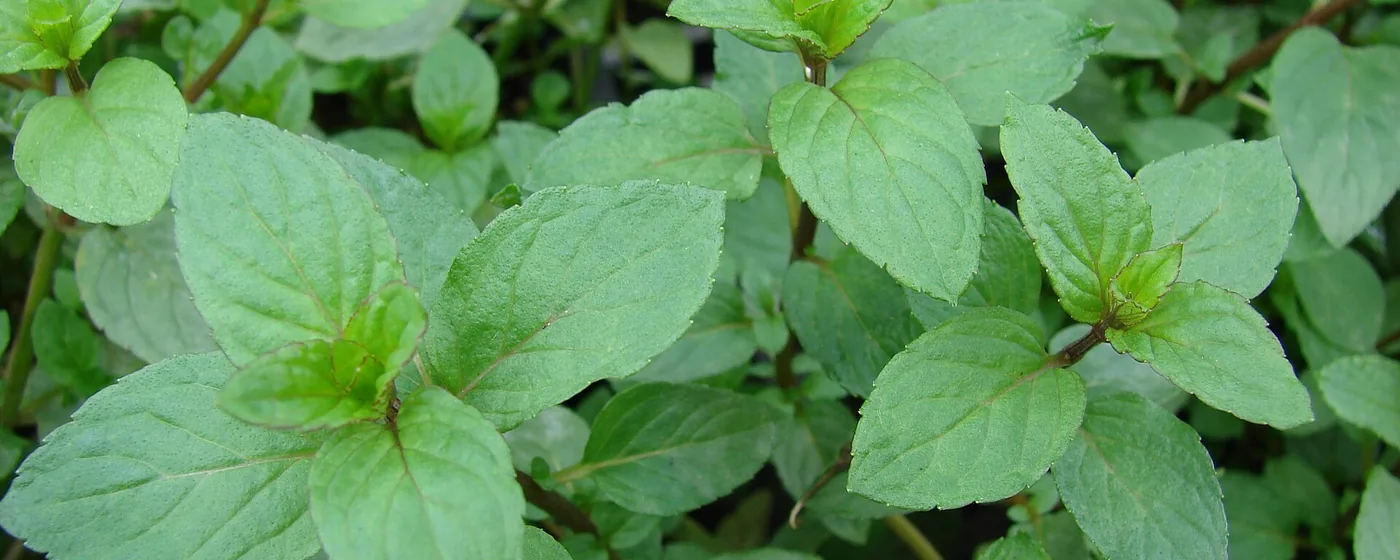
Photo: Starr 070906-8848 Mentha x piperita.jpg by Forest & Kim Starr — CC BY 3.0. Cropped and re-encoded.
Frequently asked questions
Does peppermint tea have caffeine?
No. Peppermint is a mint leaf, not a tea leaf, so there is no caffeine to extract no matter how long you steep it. The exception is a blend: anything that mixes peppermint with green, black, or white tea, or with yerba mate, will contain caffeine. Check the ingredient list on bedtime blends.
How many cups of peppermint tea can you drink in a day?
There is no established limit, and any precise number you see quoted is invented. The clinical research behind peppermint's digestive reputation used oil capsules, inhaled oil, and topical oil, not cups of tea. One to three cups a day is common and sensible. NCCIH says peppermint tea appears to be safe while noting that the long-term safety of consuming large amounts of peppermint leaf is unknown.
Can you drink peppermint tea on an empty stomach?
Most people can. The exception is anyone prone to heartburn, since peppermint is a well-known reflux trigger and an empty stomach is the wrong time to test that. Traditionally it is taken after a meal rather than before one. If you take iron tablets, space them an hour or two apart from any polyphenol-rich infusion.
Is peppermint tea safe for babies and toddlers?
Do not give strong peppermint tea, peppermint oil, or menthol products to infants or young children without asking a pediatrician first. NCCIH advises that peppermint oil should not be applied to the face of infants or young children, because serious side effects may occur if they inhale the menthol. No safe amount of the tea has been established for babies. Concentrated peppermint essential oil should never be swallowed by anyone, at any age.
How long does brewed peppermint tea keep in the refrigerator?
A day or two, covered and chilled. Peppermint's aroma fades fast once brewed, so a two-day-old jug tastes flat even when it is perfectly safe to drink. What you should not do is leave brewed tea or a cold-brew jar on the counter overnight. A plant infusion held at room temperature for eight hours is a food-safety problem, not a brewing method.
Can you brew peppermint with green tea or black tea?
Yes, and Moroccan-style mint tea does exactly that with gunpowder green. Brew to the fussier leaf: green tea wants roughly 175°F (80°C) for 2 to 3 minutes, and seven minutes of boiling water will make it bitter. Steep the green tea first, then add the mint for the last minute or two. Remember the blend now contains caffeine, which peppermint alone does not.
References
- Peppermint oil for the treatment of irritable bowel syndrome: a systematic review and meta-analysis.. Journal of clinical gastroenterology, 2014. PubMed 24100754 · doi:10.1097/MCG.0b013e3182a88357
- Effect of fibre, antispasmodics, and peppermint oil in the treatment of irritable bowel syndrome: systematic review and meta-analysis.. BMJ (Clinical research ed.), 2008. PubMed 19008265 · doi:10.1136/bmj.a2313
- Nutritional Interventions in Adult Patients With Irritable Bowel Syndrome: An Umbrella Review of Systematic Reviews and Meta-analyses of Randomized Clinical Trials.. Nutrition reviews, 2025. PubMed 39110917 · doi:10.1093/nutrit/nuae107
- Effects of intraduodenal application of peppermint oil (WS(R) 1340) and caraway oil (WS(R) 1520) on gastroduodenal motility in healthy volunteers.. Phytotherapy research : PTR, 2003. PubMed 12601675 · doi:10.1002/ptr.1089
- Esophageal Infusion of Menthol Does Not Affect Esophageal Motility in Patients with Gastroesophageal Reflux Disease.. Dysphagia, 2023. PubMed 37728794 · doi:10.1007/s00455-023-10617-7
- Inhaling Peppermint Essential Oil as a Promising Complementary Therapy in the Treatment of Nausea and Vomiting.. Journal of clinical medicine, 2025. PubMed 40725767 · doi:10.3390/jcm14145069
- Determination of water-soluble polyphenolic compounds in commercial herbal teas from Lamiaceae: peppermint, melissa, and sage.. Journal of agricultural and food chemistry, 2007. PubMed 18052102 · doi:10.1021/jf072284d
- The Effect of Water Mineralization on the Extraction of Active Compounds from Selected Herbs and on the Antioxidant Properties of the Obtained Brews.. Foods (Basel, Switzerland), 2021. PubMed 34071300 · doi:10.3390/foods10061227
- A prospective study of tea drinking temperature and risk of esophageal squamous cell carcinoma.. International journal of cancer, 2019. PubMed 30891750 · doi:10.1002/ijc.32220
- A near fatal case of high dose peppermint oil ingestion- Lessons learnt.. Indian journal of anaesthesia, 2012. PubMed 23325948 · doi:10.4103/0019-5049.104585
- [Anaphylactic reaction to camomile tea].. Der Hautarzt; Zeitschrift fur Dermatologie, Venerologie, und verwandte Gebiete, 2018. PubMed 29737365 · doi:10.1007/s00105-018-4166-x
- Warfarin and food, herbal or dietary supplement interactions: A systematic review.. British journal of clinical pharmacology, 2020. PubMed 32478963 · doi:10.1111/bcp.14404
Last reviewed and updated . HelperTea is written by an enthusiast, not a clinician, and is not medically reviewed. How we research and rate evidence. Found an error? Tell us — safety corrections get priority.