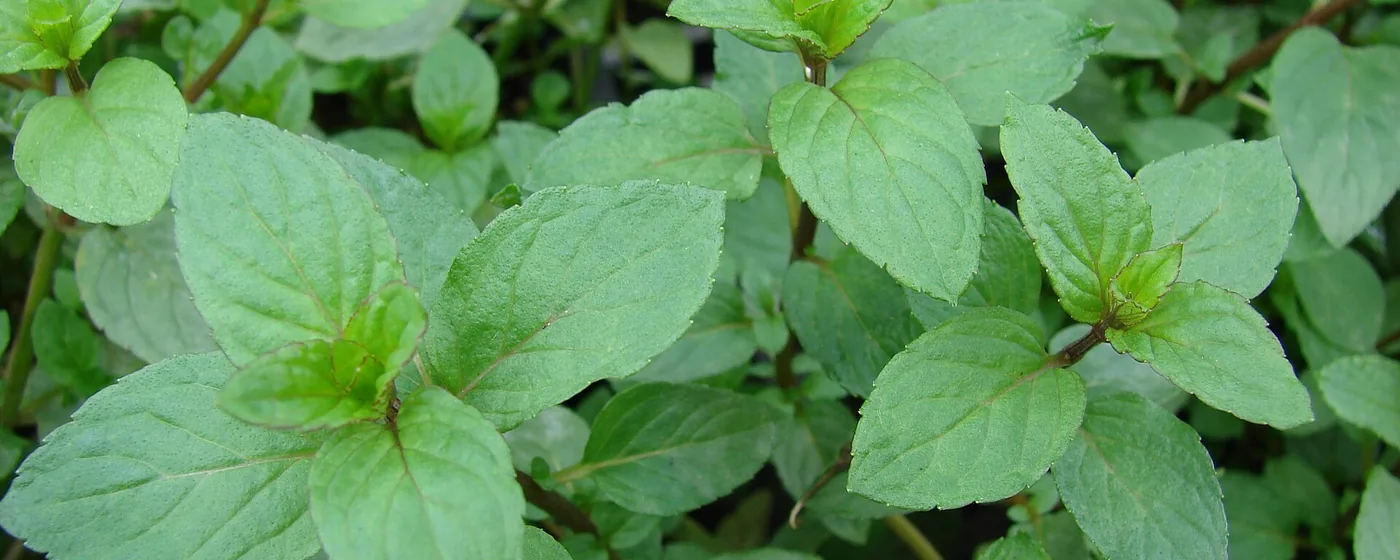
Peppermint tea is an infusion of the leaves of Mentha x piperita, a natural hybrid of watermint and spearmint cultivated around the Mediterranean and across Europe for centuries. The leaves are dense with volatile oils, and the dominant one is menthol, the compound behind that unmistakable cold snap on the tongue and in the back of the throat. Menthol does not actually lower the temperature of anything. It switches on the same nerve receptor your body uses to sense cold, which is why a hot cup can still taste like winter. Peppermint tea contains no caffeine.
In the cup it is bright, clean, and unambiguous. The first sip is faintly sweet and grassy, the finish is cooling and a little peppery, and a soft bitterness sits underneath if you have steeped it hard. It needs nothing added. It is good after a heavy meal, with dark chocolate or lemon desserts.
What it is used for is where honesty matters. Peppermint has a real reputation in digestive medicine, but nearly all of the good clinical research has tested enteric-coated peppermint oil capsules, a concentrated dose engineered to survive the stomach, not a mug of tea. A cup delivers a small fraction of that oil, by a different route. The fair summary: peppermint oil capsules have real but modest evidence behind them for irritable bowel syndrome, and reviewers who have graded that evidence call its certainty low. Peppermint tea, meanwhile, is a pleasant, caffeine-free drink people have reached for after meals for generations, and that tradition has never really been tested. Drinking it because you like it is a good reason.
One distinction runs through this whole page: peppermint tea and peppermint essential oil are not the same product. The tea is a mild beverage. The essential oil is a concentrated extract that is genuinely dangerous to swallow undiluted.
Photo: Starr 070906-8848 Mentha x piperita.jpg by Forest & Kim Starr — CC BY 3.0. Cropped and re-encoded.
What the evidence says
Enteric-coated peppermint oil capsules may modestly improve IBS symptoms and abdominal pain.
Menthol relaxes intestinal smooth muscle in laboratory work, and that is the usual explanation offered for an antispasmodic effect in IBS. A meta-analysis identified nine trials covering 726 patients; in the five trials (392 patients) that reported global symptom improvement, people taking peppermint oil were about twice as likely as those on placebo to say their symptoms had improved, and a similar effect appeared for abdominal pain across five trials (357 patients). A BMJ meta-analysis of four trials in 392 patients pointed the same way, and a Cochrane review of antispasmodics found peppermint oil among the subgroups showing benefit. But the trials are small and mostly old. The economic evaluation of a Dutch randomized trial in 126 patients described only modest quality-of-life gains and a slightly higher share of abdominal pain responders. A 2025 umbrella review of nutritional interventions in IBS graded the certainty of this evidence as low to very low, which is why we rate this moderate rather than strong despite the meta-analyses. And none of it was tested as tea.
Peppermint tea is traditionally taken after meals for bloating, gas, and stomach discomfort.
This is peppermint's oldest use, and there is a plausible mechanism behind it: when concentrated peppermint oil was placed directly into the duodenum of healthy volunteers, it relaxed stomach and duodenal smooth muscle. But that is a far larger dose, delivered past the stomach, in people who did not have bloating in the first place. We found no randomized trials of peppermint tea itself for bloating or indigestion. If a cup after dinner helps you, that is worth something. It is not something research has shown.
Sources: [6]
Inhaling peppermint aroma may take the edge off nausea.
A 2025 systematic review pooled 19 randomized trials of peppermint oil inhalation and reported less nausea after surgery, during chemotherapy, and in pregnancy, though each pooled estimate rested on only about three studies. A meta-analysis of aromatherapy in cancer patients pointed the same way, though it covered several essential oils rather than peppermint alone. One randomized trial of peppermint inhalation after cardiac surgery reported less nausea and vomiting. Another, after oral surgery, used a blend of peppermint, ginger, and lavender, so peppermint's own contribution cannot be separated out. The trials are small and near-impossible to blind, since you can smell peppermint. All of this is inhaled essential oil. Whether the steam off a cup of tea does anything similar has not been tested.
Peppermint oil applied to the forehead may relieve tension-type headache.
In a randomized, double-blind crossover trial, 41 adults treated 164 headache attacks with a 10 percent peppermint oil solution on the forehead and temples, or with placebo. Peppermint oil reduced headache intensity more than placebo within 15 minutes. The same trial included 1,000 mg of acetaminophen and found no statistically significant difference between the two, but a 41-patient crossover is not designed or powered to demonstrate that two treatments are equivalent, so "as good as acetaminophen" claims more than the data support. A later German review treats topical peppermint oil as an established option for tension-type headache. This is oil on skin, not tea.
Peppermint may reduce menstrual cramp pain and premenstrual symptoms.
A 2025 systematic review found five randomized trials covering 499 participants with primary dysmenorrhea or premenstrual syndrome, and reported statistically significant reductions in pain severity. Only three of the five were rated high quality, the trials were small, and the authors concluded that better-designed randomized trials are needed before anyone relies on this.
Sources: [13]
The popular claim that mint tea lowers testosterone or eases unwanted hair growth (hirsutism) traces back to spearmint, not peppermint.
The source is a 2007 study of 21 women with hirsutism who drank mint tea twice daily for five days, after which free testosterone fell. But the tea was spearmint (Mentha spicata), not peppermint. There was no control group, the study ran five days, and hair growth itself was never measured. The authors noted that antiandrogenic effects of both spearmint and peppermint had previously been seen in rats. There is no good human evidence that peppermint tea changes hormone levels, and none that it treats hirsutism.
Sources: [14]
One small trial of peppermint tea itself found a short-term cognitive lift — not a digestive benefit.
Nearly all peppermint research uses the concentrated oil. The rare exception is a 2025 randomized, placebo-controlled trial in which 25 healthy adults drank 200 mL of peppermint tea; the peppermint group performed better on a short computerized cognitive battery and showed more blood flow in the prefrontal cortex, though the blood-flow change did not explain the cognitive change. It was single-blind with 25 people and measured effects over a single session, so treat it as a hint rather than a finding. It says nothing about digestion, and nothing about drinking peppermint tea day after day.
Sources: [18]
How to brew Peppermint Tea
Bring water to a full boil and pour it straight over the leaves. Cover the cup while it steeps: menthol is volatile, and an uncovered mug sends the aroma into the kitchen. Steep 5 to 7 minutes, then strain.
- Cover the cup. The oils carrying the flavor and the cooling effect leave with the steam.
- Past about 8 minutes the tannins take over. If the cup tastes harsh, shorten the steep rather than adding sugar.
- Fresh leaves give a rounder, sweeter cup. Bruise them once with a spoon, then steep 5 to 7 minutes.
- If peppermint gives you heartburn, try chamomile or ginger instead.
- Brew tea from peppermint leaves. Never add peppermint essential oil to a drink: it is a concentrated extract, not a flavoring, and it is not safe to swallow undiluted.
Safety, side effects & who should avoid it
For most adults peppermint tea is a gentle drink, and the main problem is heartburn. NCCIH says peppermint tea appears to be safe, while noting that the long-term safety of consuming large amounts of peppermint leaf is unknown. The stronger cautions on this page apply to concentrated peppermint essential oil, which is a far more potent product than a teacup and is toxic if swallowed in quantity.
Who should avoid it
- People with GERD, frequent heartburn, or a hiatal hernia. Peppermint and menthol are a recognized heartburn trigger, and when menthol was infused into the esophagus, reflux patients reported markedly more discomfort than healthy volunteers.
- Infants and young children, where peppermint essential oil and menthol products are concerned. NCCIH advises that peppermint oil should not be applied to the face of infants or young children, and that menthol should not be inhaled by them, because it may affect their breathing. Concentrated peppermint essential oil should never be swallowed by a child, and bottles should be stored out of sight and reach. No safe amount of peppermint tea has been established for babies. Ask a pediatrician.
- Anyone taking peppermint oil capsules who has gallstones, bile duct obstruction, or significant liver disease. Traditional herbal monographs and many product labels caution against the concentrated oil in these conditions. Whether the caution extends to tea has not been studied. Ask your doctor.
- Anyone with a known allergy to peppermint, mint, or menthol.
- Nobody should swallow undiluted peppermint essential oil, at any age. It is not a stronger cup of tea; it is a poisoning risk.
Possible side effects
- Heartburn and acid reflux, the most commonly reported adverse event in the peppermint oil IBS trials.
- Nausea, abdominal pain, and dry mouth, reported by NCCIH with peppermint oil taken by mouth.
- Skin rash and irritation where peppermint oil is applied, per NCCIH.
- A burning or intensely cooling sensation in the mouth and throat.
- Rarely, allergic reactions: rash, itching of the mouth or throat, or wheezing. Stop and seek medical care.
- Concentrated peppermint essential oil is toxic in overdose. A published case report describes an adult who arrived at hospital comatose and in shock after ingesting a high dose of oral peppermint oil, and who needed mechanical ventilation before recovering. Never drink essential oil. In the United States, if someone swallows essential oil, contact Poison Control at 1-800-222-1222 or use the online tool at poison.org.
Medication interactions
- Drugs cleared by the liver enzyme CYP3A4. In a randomized crossover study of 12 healthy volunteers, 600 mg of peppermint oil raised felodipine exposure to about 140 percent of the water control, roughly a 40 percent increase; the authors described the mechanism as probable but requiring further investigation. That is a supplement dose of oil, not a mug of tea. Still, tell your pharmacist about peppermint oil supplements if you take narrow-margin CYP3A4 drugs such as cyclosporine, tacrolimus, or certain statins like simvastatin.
- Antacids, proton-pump inhibitors, and H2 blockers raise stomach pH and can make enteric-coated peppermint oil capsules dissolve too early, causing heartburn. A capsule problem, not a tea problem.
- Iron supplements. Polyphenol-rich infusions can bind non-heme (plant-source) iron, so separate the tablet and the tea by an hour or two.
- If you take any prescription medicine, tell your doctor or pharmacist before starting peppermint oil supplements. NCCIH's general guidance is to check first, because herbs and medicines can interact in harmful ways.
Pregnancy & breastfeeding
NCCIH says oral peppermint in amounts commonly found in food is likely safe during pregnancy and while breastfeeding, but that little is known about medicinal amounts of peppermint in either situation. There is no research on drinking large quantities of the tea. The NIH Drugs and Lactation Database (LactMed) notes that if peppermint is applied to the nipples for soreness, it should be used after nursing and wiped off before the next feed. LactMed also notes that peppermint has been used with the aim of suppressing milk production, an effect shown in laboratory and animal work at high doses, though no clinical trial has demonstrated it in people. Talk to your doctor or midwife.
How much is too much
No established limit. Trials used oil capsules, inhaled oil, or topical oil rather than tea, so no number of cups per day has ever been studied. One to three cups a day is common and sensible. NCCIH notes that peppermint tea appears to be safe, while the long-term safety of consuming large amounts of peppermint leaf is unknown.
Taste & pairing
Tasting notes: Minty, Cooling, Refreshing, Slightly sweet.
Pairs well with: Dark chocolate, Lemon desserts, Mediterranean dishes.
Best time to drink: After meals or before bedtime.
Frequently asked questions
How long should I steep peppermint tea?
Five to seven minutes in fully boiling water, with the cup covered. Peppermint's actives are volatile oils, so an uncovered mug loses much of the flavor to the air. Past about eight minutes it turns bitter.
When is the best time to drink peppermint tea?
Traditionally after a meal rather than with one. It has no caffeine, so it is also a sound evening drink. If you are prone to reflux, avoid it right before lying down; if you take iron tablets, space them apart.
Does peppermint tea cause heartburn?
It can. Heartburn was the most frequently reported side effect of peppermint oil in the IBS trials. The usual explanation, that menthol relaxes the valve between stomach and esophagus, may not be right: infusing menthol into the esophagus of 11 reflux patients and 13 healthy volunteers did not change that valve's pressure, yet the reflux patients felt considerably more discomfort. Whatever the mechanism, if you have GERD or frequent heartburn it is sensible to skip it.
Is peppermint tea the same as peppermint oil?
No, and the difference matters. Peppermint tea is an infusion of the leaf and delivers a small amount of volatile oil. Peppermint essential oil is a concentrated extract. Almost every clinical benefit described on this page was tested with the oil, in capsules, on skin, or inhaled, not with tea. So were most of the serious risks. Essential oil should never be swallowed undiluted, and a published case report describes an adult who ended up comatose and in shock after a high oral dose.
Is peppermint tea as good as peppermint oil capsules for IBS?
Almost certainly not. The trials used enteric-coated capsules holding a concentrated dose of oil, coated to dissolve in the intestine rather than the stomach, where the antispasmodic effect is wanted. A cup of tea delivers far less oil and has never been tested for IBS.
How many cups of peppermint tea can I drink a day?
There is no established limit, and any precise number you see quoted is invented. The digestive research studied oil capsules, aromatherapy, and topical oil rather than cups of tea; the one small randomized trial of the tea itself looked at short-term cognition, not daily limits. One to three cups a day is common and sensible; NCCIH says the tea appears safe while the long-term safety of large amounts is unknown.
References
- Peppermint oil for the treatment of irritable bowel syndrome: a systematic review and meta-analysis.. Journal of clinical gastroenterology, 2014. PubMed 24100754 · doi:10.1097/MCG.0b013e3182a88357
- Effect of fibre, antispasmodics, and peppermint oil in the treatment of irritable bowel syndrome: systematic review and meta-analysis.. BMJ (Clinical research ed.), 2008. PubMed 19008265 · doi:10.1136/bmj.a2313
- Bulking agents, antispasmodics and antidepressants for the treatment of irritable bowel syndrome.. The Cochrane database of systematic reviews, 2011. PubMed 21833945 · doi:10.1002/14651858.CD003460.pub3
- A trial-based economic evaluation of peppermint oil for the treatment of irritable bowel syndrome.. United European gastroenterology journal, 2021. PubMed 34468079 · doi:10.1002/ueg2.12134
- Nutritional Interventions in Adult Patients With Irritable Bowel Syndrome: An Umbrella Review of Systematic Reviews and Meta-analyses of Randomized Clinical Trials.. Nutrition reviews, 2025. PubMed 39110917 · doi:10.1093/nutrit/nuae107
- Effects of intraduodenal application of peppermint oil (WS(R) 1340) and caraway oil (WS(R) 1520) on gastroduodenal motility in healthy volunteers.. Phytotherapy research : PTR, 2003. PubMed 12601675 · doi:10.1002/ptr.1089
- Inhaling Peppermint Essential Oil as a Promising Complementary Therapy in the Treatment of Nausea and Vomiting.. Journal of clinical medicine, 2025. PubMed 40725767 · doi:10.3390/jcm14145069
- Effects of aromatherapy on nausea and vomiting in patients with cancer: A systematic review and meta-analysis of randomized controlled trials.. Complementary therapies in clinical practice, 2024. PubMed 38330531 · doi:10.1016/j.ctcp.2024.101838
- The effect of aromatherapy with peppermint essential oil on nausea and vomiting after cardiac surgery: A randomized clinical trial.. Complementary therapies in clinical practice, 2020. PubMed 32891278 · doi:10.1016/j.ctcp.2020.101199
- Effect of aromatherapy with peppermint, ginger, and lavender on postoperative nausea severity after oral surgery under general anaesthesia: A single-blind randomized controlled trial.. Complementary therapies in medicine, 2025. PubMed 40154579 · doi:10.1016/j.ctim.2025.103169
- [Effectiveness of Oleum menthae piperitae and paracetamol in therapy of headache of the tension type].. Der Nervenarzt, 1996. PubMed 8805113 · doi:10.1007/s001150050040
- [Peppermint oil in the acute treatment of tension-type headache].. Schmerz (Berlin, Germany), 2016. PubMed 27106030 · doi:10.1007/s00482-016-0109-6
- The Effects of Peppermint on Menstrual Disorders: A Systematic Review of Randomized Controlled Trials.. Iranian journal of nursing and midwifery research, 2025. PubMed 41311590 · doi:10.4103/ijnmr.ijnmr_283_23
- Effect of spearmint (Mentha spicata Labiatae) teas on androgen levels in women with hirsutism.. Phytotherapy research : PTR, 2007. PubMed 17310494 · doi:10.1002/ptr.2074
- Esophageal Infusion of Menthol Does Not Affect Esophageal Motility in Patients with Gastroesophageal Reflux Disease.. Dysphagia, 2023. PubMed 37728794 · doi:10.1007/s00455-023-10617-7
- Evaluation of peppermint oil and ascorbyl palmitate as inhibitors of cytochrome P4503A4 activity in vitro and in vivo.. Clinical pharmacology and therapeutics, 2002. PubMed 12235445 · doi:10.1067/mcp.2002.126409
- A near fatal case of high dose peppermint oil ingestion- Lessons learnt.. Indian journal of anaesthesia, 2012. PubMed 23325948 · doi:10.4103/0019-5049.104585
- A Randomized Placebo-Controlled Clinical Trial Exploring the Short-Term Cognitive and Cerebrovascular Effects of Consuming Peppermint Tea: A Mediation Study.. Human psychopharmacology, 2025. PubMed 40189738 · doi:10.1002/hup.70005
Last reviewed and updated . HelperTea is written by an enthusiast, not a clinician, and is not medically reviewed. How we research and rate evidence. Found an error? Tell us — safety corrections get priority.