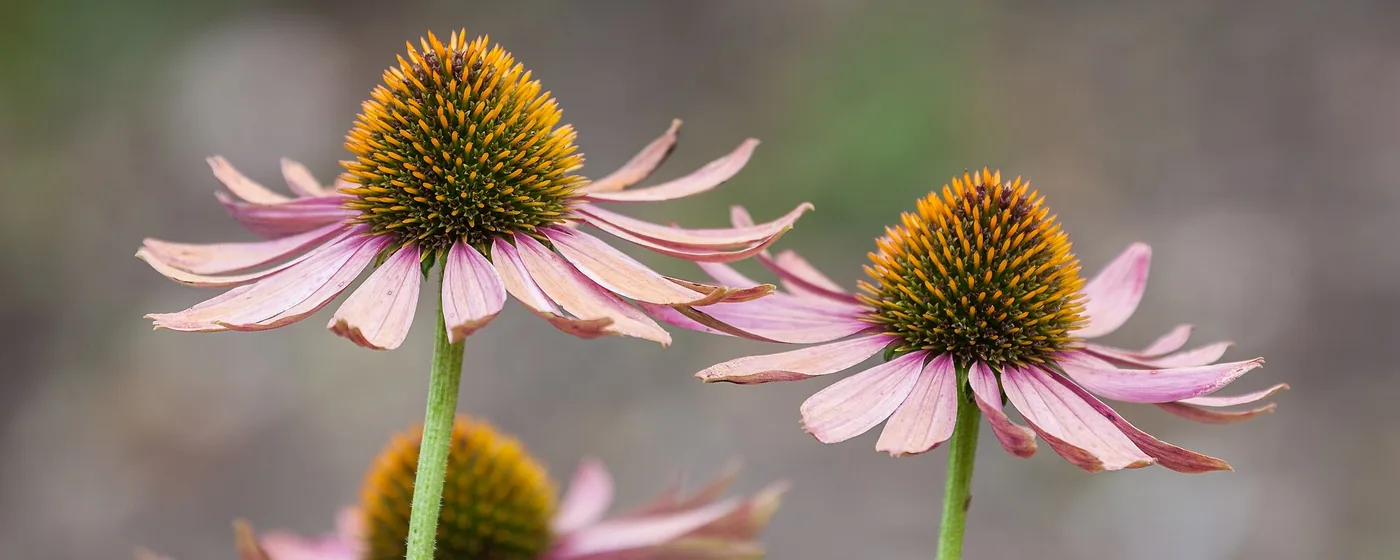
Echinacea tea is a caffeine-free infusion made from purple coneflower (Echinacea purpurea), a prairie plant native to central and eastern North America. Depending on the blend, a cup may hold root, leaves, flowers, or all three — a distinction that matters, since each part carries different compounds. Indigenous peoples of North America used it for mouth sores, colds, and snakebite long before European settlers adopted it; its reputation as a packaged cold remedy is a twentieth-century development.
In the cup it is earthy and faintly floral, with a peppery bite and a slightly bitter, drying finish. Root-heavy blends often leave a tingling, numbing sensation on the tongue — a normal taste effect of the plant's alkamides. Tingling that spreads, or any swelling, itching, or throat tightness, is a different thing entirely, and a reason to stop. Because you are extracting woody root, echinacea wants boiling water and a long, covered steep. Honey and lemon soften the earthiness.
What it is good for is a harder question than the marketing suggests. Echinacea has been tested in dozens of randomized trials, unusual for an herb, and the results are underwhelming and inconsistent. A Cochrane review of 24 trials found no convincing evidence that it shortens a cold once one starts, and only a small, statistically fragile hint that it might slightly lower the odds of catching one. Nearly all that research used concentrated capsules and tinctures; the tea itself has been formally tested essentially once, in a small and weak study. So it is a warming drink with a long history and interesting chemistry — not a reliable defense against a cold, and for people with ragweed or daisy-family allergies, not a risk-free one.
Photo: Echinacea purpurea, Jardín Botánico, Múnich, Alemania, 2013-09-08, DD 01.jpg by Diego Delso — CC BY-SA 3.0. Cropped and re-encoded.
What the evidence says
Echinacea may slightly reduce the chance of catching a cold, but no single trial has shown it.
A 2014 Cochrane review of 24 double-blind trials (4,631 people) found no statistically significant difference in any of its 12 prevention comparisons. A post-hoc pooling of those results suggested a 10% to 20% relative risk reduction, which the reviewers themselves called of questionable clinical relevance. The review covered single-herb preparations made from different species and plant parts by different extraction methods; as far as the published record goes, none of it tested a tea.
Sources: [1]
Echinacea has not been clearly shown to shorten a cold once it has started, and the trials disagree with each other.
Of the seven Cochrane treatment trials reporting cold duration, only one beat placebo, and the reviewers declined to pool them because the studies differed so much. The largest single trial randomized 719 people aged 12 to 80 at cold onset and found a non-significant 0.53-day shortening (95% CI -1.25 to 0.19 days); its authors noted that higher-than-expected variability limited their power to detect small benefits. An earlier 2007 meta-analysis did report a 1.4-day reduction, and Cochrane allowed that a weak benefit from some products remains possible. The fair summary is that any effect, if it exists, is small enough that well-run trials keep failing to find it.
In children the evidence conflicts, and the best-controlled trial found more rashes than placebo.
A double-blind trial followed 407 children aged 2 to 11 through 707 colds: no difference in duration (median 9 days) or severity, but rash occurred during 7.1% of echinacea-treated colds versus 2.7% on placebo (p=0.008). A 2025 meta-analysis of nine trials in roughly 3,170 children reported a small reduction in illness duration, fewer infections, and less antibiotic use — but also more adverse events (RR 1.38, 95% CI 1.08 to 1.78) and funnel-plot evidence of bias, which its authors attributed largely to heterogeneity between studies. They concluded the safety profile 'remains unclear.'
Echinacea tea specifically, as opposed to capsules and tinctures, has barely been studied.
One published trial tested a tea: 95 adults drank a commercial blend, 5 to 6 cups on the first day of symptoms tapering to 1 cup by day 5, then filled out a questionnaire from memory two weeks later. It reported faster symptom relief than placebo. It was small, the tea was a multi-herb blend rather than echinacea alone, and the outcome was recalled rather than recorded — so it cannot carry much weight. Echinacea's constituents (alkamides, cichoric acid and other caffeic acid derivatives, polysaccharides) span different chemical classes, and the Cochrane reviewers note that products sold as echinacea differ appreciably in composition depending on plant material and extraction method. What a hot-water infusion actually delivers has not been published.
Echinacea compounds change how immune cells behave in the lab, but that has not translated into clinical benefit.
In cell and animal studies, echinacea's alkamides, caffeic acid derivatives, flavonoids, and polysaccharides increase macrophage and natural killer cell activity, stimulate cytokine production, and show antiviral activity against viruses including influenza, rhinovirus, and herpes simplex. That is preclinical work. It does not establish that drinking the tea does anything measurable to a human immune system, and compound content varies enormously by species, plant part, and extraction.
Traditionally used by Indigenous peoples of North America for mouth sores, colds, and snakebite.
A systematic review of echinacea's safety records that Echinacea species were 'traditionally used by the Indian tribes for a variety of ailments, including mouth sores, colds and snake-bites.' Of those uses, only the cold use has ever been put through controlled trials, where it has performed poorly. The mouth-sore and snakebite uses have never been tested clinically. Long use tells you a plant is familiar, not that it works.
Sources: [9]
How to brew Echinacea Tea
Boil water fully and pour it over the dried herb. Cover the cup while it steeps. Strain after 10 to 15 minutes — the long steep pulls compounds from the woody root.
- Root needs the full 15 minutes; mostly leaf and flower is done in 5 to 7.
- Check the label for the species and plant part. Products sold as 'echinacea' vary widely in what is actually in them, so one brand's cup is not another's.
- A tingling tongue is normal with root blends. Itching, hives, swelling of the lips or throat, or wheezing are not — stop drinking it and seek medical care immediately.
Safety, side effects & who should avoid it
Short-term use of echinacea products carries a relatively good safety profile, and the usual complaints are stomach upset and rash. The real concern is allergy: reactions in people with hay fever, asthma, or eczema have included acute asthma attacks and, rarely, anaphylaxis — sometimes on a first-ever dose. Bear in mind that nearly all of this safety data comes from capsules, tinctures, and standardized extracts; the tea itself has barely been studied. Echinacea is not a substitute for a flu shot, and it is not a reason to delay medical care.
Who should avoid it
- Anyone allergic to the Asteraceae (daisy) family: ragweed, chrysanthemums, marigolds, feverfew.
- People with asthma, eczema, or hay fever. In an Australian series, 20 of 100 atopic people who had never taken echinacea already had positive skin-prick tests to it, and atopic people were over-represented among those who reacted.
- Anyone who has reacted to echinacea before, including a rash.
- People on immunosuppressants or with a transplanted organ. No human interaction studies exist; NCCIH describes the concern as theoretical and advises asking your provider first.
- People with lupus, rheumatoid arthritis, multiple sclerosis, or another autoimmune condition. The concern is theoretical, drawn from echinacea's effects on immune cells in the lab, but it is one for your doctor.
- People with liver disease or on liver-stressing drugs. NIH LiverTox rates echinacea a 'possible rare cause of clinically apparent liver injury' (likelihood score D), while noting that in controlled trials echinacea by itself has not been linked to liver injury.
- Children under 12 without a pediatrician's say-so. The best-controlled pediatric trial found no benefit and significantly more rash, and severe allergic reactions to echinacea have been reported in children as young as 2.
- Anyone reaching for it instead of medical care. Symptoms lasting more than 10 days, a fever above 103°F (39.4°C) or one that keeps climbing, shortness of breath, chest pain, or a severe or worsening sore throat need a clinician, not a teapot.
Possible side effects
- Stomach upset: abdominal pain, nausea, digestive discomfort. Along with rash, the most commonly reported effect.
- Rash and itching: 7.1% of echinacea-treated colds in a 407-child trial, versus 2.7% on placebo.
- Allergic reactions from hives and angioedema to acute asthma and, rarely, anaphylaxis. Of 51 Australian adverse-event reports, 26 suggested IgE-mediated hypersensitivity (4 anaphylaxis, 12 acute asthma, 10 urticaria or angioedema). Four people were hospitalized, and four reacted after their first known exposure.
- Rarely, hepatitis with jaundice in isolated case reports, appearing roughly one to four weeks after starting and resolving after stopping. Unexplained fatigue, nausea, abdominal pain, or dark urine means stop and get liver tests.
Medication interactions
- Caffeine and other CYP1A2 substrates. In 12 volunteers, eight days of Echinacea purpurea root (400 mg four times daily) cut caffeine's oral clearance by about a quarter, from 6.6 to 4.9 L/h — meaning caffeine lingers longer. A separate 12-person study using 28 days of E. purpurea found no significant effect on CYP1A2, CYP2D6, CYP2E1, or CYP3A4, though its authors said echinacea's interaction potential merited further study. Tell your pharmacist if you take theophylline.
- CYP3A4 substrates. The same eight-day study found echinacea shifted liver and gut CYP3A in opposite directions, raising midazolam's systemic clearance 34% while increasing its oral availability. Net effects on any given CYP3A4 drug are unpredictable.
- Immunosuppressants — cyclosporine, tacrolimus, azathioprine. No human interaction studies exist; get your specialist's sign-off.
- Do not assume tea is exempt. Those studies used 1.6 g of powdered root daily, and nobody has published what a cup of infused root tea delivers, so the comparison cannot be made. If you take a drug with a narrow therapeutic window, ask a pharmacist before drinking it regularly.
Pregnancy & breastfeeding
A prospective study of 206 pregnant women, 112 of them exposed in the first trimester, found no increase in major malformations versus matched controls — reassuring but small. NCCIH notes limited data suggesting possible safety for up to seven days in the first trimester, and says little is known about use while breastfeeding. A published safety review concluded that use during pregnancy and lactation 'would appear to be ill-advised' given how little data exists. Talk to your doctor or midwife first.
How much is too much
No established limit. The one published tea trial used 5 to 6 cups on the first day of symptoms, tapering to 1 cup by day 5 and stopping at five days; extract trials typically dosed 5 to 10 days. Continuous long-term use has not been studied, and because products sold as echinacea differ appreciably in species, plant part, and preparation, the dose in any given cup is unknown. Treat it as a short-course drink, not a daily habit.
Taste & pairing
Tasting notes: Floral, Slightly spicy, Earthy.
Pairs well with: Honey, Lemon.
Best time to drink: At first signs of illness or for prevention.
Frequently asked questions
How long should I steep echinacea tea?
Ten to fifteen minutes in boiling water, covered, if the blend contains chopped root. Mostly leaf and flower needs only 5 to 7.
When should I start drinking it if I feel a cold coming on?
The trials reporting any benefit began within a day or two of symptoms, so start early. But the largest, best-designed trials found no meaningful shortening, so temper your expectations.
How many cups of echinacea tea can I drink in a day?
No established upper limit. The one published tea trial used 5 to 6 cups on the first day, tapering to a single cup by day 5. Past that, you're past the evidence.
Can I drink echinacea tea every day to prevent colds?
There isn't a good reason to. No prevention trial found a significant reduction in colds, and the pooled 10% to 20% hint came from a post-hoc analysis the reviewers called of questionable clinical relevance. Trials dosed echinacea for days to weeks, not months, so the safety of continuous daily use is simply unknown.
When should I skip the tea and call a doctor?
If cold symptoms run past 10 days, if your fever climbs above 103°F (39.4°C) or keeps rising, or if you develop shortness of breath, chest pain, or a severe or worsening sore throat. Also stop immediately and get emergency care for hives, swelling of the lips or throat, or wheezing after drinking it.
Is echinacea tea safe if I'm allergic to ragweed?
No — skip it. Echinacea sits in the Asteraceae family alongside ragweed, chrysanthemums, and marigolds. Allergy specialists reviewing the Australian adverse-event reports found that people with atopy were over-represented among those who reacted, and that some people who had never taken echinacea already tested positive to it on skin-prick testing, which points to cross-reactivity with related plants. Reported reactions include hives, acute asthma, and anaphylaxis, sometimes on a first-ever dose.
Is echinacea tea as effective as echinacea capsules or tinctures?
Nobody knows, and the tea has less evidence behind it, not more. Nearly every trial used a concentrated extract, and hot water pulls out some constituents more readily than others. Since the concentrated forms mostly failed anyway, the difference may be academic.
References
- Echinacea for preventing and treating the common cold.. The Cochrane database of systematic reviews, 2014. PubMed 24554461 · doi:10.1002/14651858.CD000530.pub3
- Echinacea for treating the common cold: a randomized trial.. Annals of internal medicine, 2010. PubMed 21173411 · doi:10.7326/0003-4819-153-12-201012210-00003
- Evaluation of echinacea for the prevention and treatment of the common cold: a meta-analysis.. The Lancet. Infectious diseases, 2007. PubMed 17597571 · doi:10.1016/S1473-3099(07)70160-3
- Efficacy and safety of echinacea in treating upper respiratory tract infections in children: a randomized controlled trial.. JAMA, 2003. PubMed 14657066 · doi:10.1001/jama.290.21.2824
- Efficacy and safety of Echinacea purpurea in treating upper respiratory infections and complications of otitis media in children: Systematic review and meta-analysis.. Clinical nutrition ESPEN, 2025. PubMed 40311928 · doi:10.1016/j.clnesp.2025.04.025
- The efficacy of echinacea compound herbal tea preparation on the severity and duration of upper respiratory and flu symptoms: a randomized, double-blind placebo-controlled study.. Journal of alternative and complementary medicine (New York, N.Y.), 2000. PubMed 10976979 · doi:10.1089/10755530050120691
- Echinacea purpurea: Pharmacology, phytochemistry and analysis methods.. Pharmacognosy reviews, 2015. PubMed 26009695 · doi:10.4103/0973-7847.156353
- Phytochemistry, Mechanisms, and Preclinical Studies of Echinacea Extracts in Modulating Immune Responses to Bacterial and Viral Infections: A Comprehensive Review.. Antibiotics (Basel, Switzerland), 2024. PubMed 39452214 · doi:10.3390/antibiotics13100947
- The safety of herbal medicinal products derived from Echinacea species: a systematic review.. Drug safety, 2005. PubMed 15853441 · doi:10.2165/00002018-200528050-00003
- Adverse reactions associated with echinacea: the Australian experience.. Annals of allergy, asthma & immunology : official publication of the American College of Allergy, Asthma, & Immunology, 2002. PubMed 11814277 · doi:10.1016/S1081-1206(10)63591-0
- The effect of echinacea (Echinacea purpurea root) on cytochrome P450 activity in vivo.. Clinical pharmacology and therapeutics, 2004. PubMed 14749695 · doi:10.1016/j.clpt.2003.09.013
- In vivo assessment of botanical supplementation on human cytochrome P450 phenotypes: Citrus aurantium, Echinacea purpurea, milk thistle, and saw palmetto.. Clinical pharmacology and therapeutics, 2004. PubMed 15536458 · doi:10.1016/j.clpt.2004.07.007
- Pregnancy outcome following gestational exposure to echinacea: a prospective controlled study.. Archives of internal medicine, 2000. PubMed 11074744 · doi:10.1001/archinte.160.20.3141
Last reviewed and updated . HelperTea is written by an enthusiast, not a clinician, and is not medically reviewed. How we research and rate evidence. Found an error? Tell us — safety corrections get priority.