Elderberry tea is a deep purple infusion made from the dried, ripe berries of the European elder (Sambucus nigra), a hedgerow tree found across Europe and much of the temperate world. It is caffeine-free, and it tastes the way it looks: dark and sweet-tart, somewhere between blackcurrant and cranberry, with an earthy, almost wine-like finish and a tannic edge if you brew it long.
Elder has a long record of use in European folk medicine. For centuries the berries went into syrups and teas for feverish colds and coughs, while the flowers were brewed to encourage sweating during a fever. That history is why the plant was eventually studied. But nearly all the modern research used concentrated syrups and standardized extracts rather than tea, and the results conflict. Three small placebo-controlled trials reported that elderberry shortened cold or flu symptoms, two of them sharing a lead author. A later, more rigorously designed trial in emergency-room patients with laboratory-confirmed influenza found no benefit. Nobody has tested a cup of tea.
An honest frame, then. Elderberry tea is a pleasant caffeine-free berry drink with a long traditional link to colds, a plausible but unproven antiviral story, and a dose far weaker than anything given in a trial. It is not a treatment for influenza and not a substitute for vaccination, antivirals, or a doctor's assessment. It also carries a hazard most herbal teas do not: raw or unripe berries, and the leaves, bark, stems, and roots, contain compounds that release cyanide. NCCIH states that cooking eliminates this toxin, and that large quantities of the toxin may cause serious illness. Here, preparation is not a matter of taste but of safety.
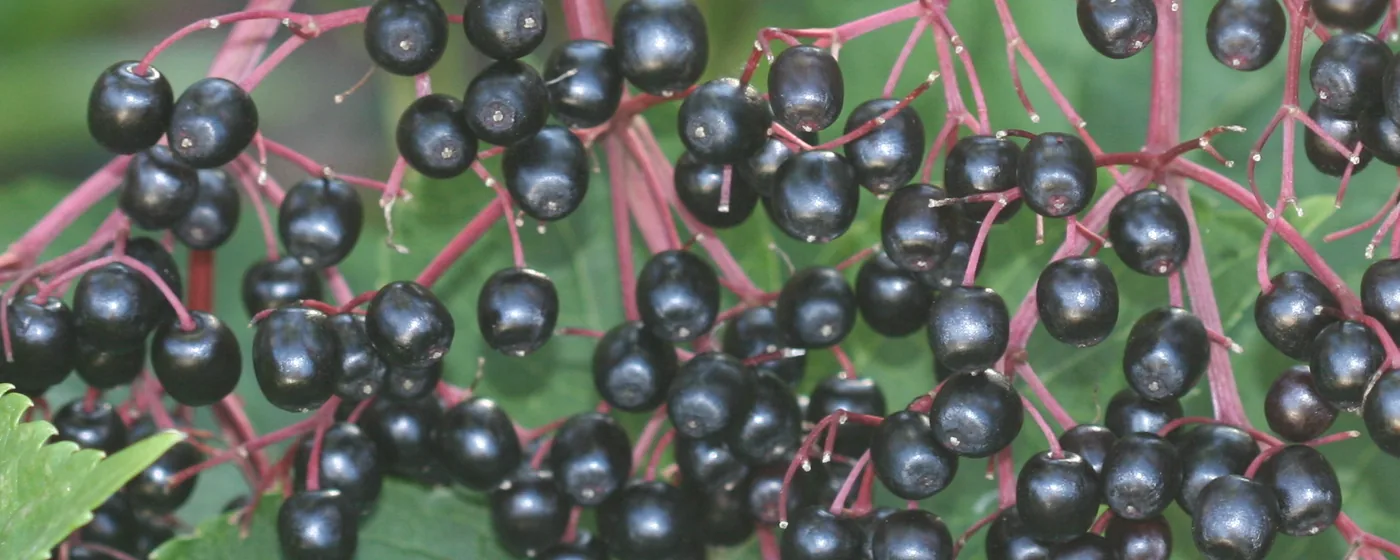
Photo: Elder berries (Sambucus nigra) - Flickr - S. Rae.jpg by S. Rae from Scotland, UK — CC BY 2.0. Cropped and re-encoded.
What the evidence says
Elderberry syrups and extracts may shorten cold and flu symptoms, but the trials contradict each other.
Three small placebo-controlled trials reported benefit: a 1995 study run during an influenza B outbreak; a 2004 trial in 60 adults given 15 mL of syrup four times daily, who reported symptom relief about four days sooner; and a 2016 trial in 312 air travelers, which found shorter, milder colds but no significant drop in how many people got sick. The first two share a lead author. A 2018 meta-analysis of randomized trials pooled just 180 participants in total and reported a large effect; its own title says elderberry 'effectively treats' upper respiratory symptoms, which is a strong claim to rest on 180 people. It also predates the most rigorous trial available: a 2020 study of 87 emergency-room patients with PCR-confirmed influenza, powered above 0.90 to detect a two-day benefit, which found none.
No published clinical trial appears to have tested elderberry brewed as a tea.
The trials all used concentrated preparations: 15 mL of syrup or extract, about 5.7 g, two to four times daily. A mug brewed from a teaspoon or two of dried berries is a much smaller and unmeasured dose. Whether it does anything at all is simply unknown.
In laboratory dishes, an elderberry extract slowed influenza viruses. What that means for a person drinking tea is unclear.
In the 1995 study, a standardized elderberry extract inhibited replication of ten influenza strains in canine kidney cells. Which compounds are responsible is not settled: reviews point to phenolics such as anthocyanins, but the same extract also contains lectins. Concentrations applied directly to cells in a dish are not what reaches your bloodstream from a cup of tea.
Ripe elderberries are rich in anthocyanins, and the plant's cyanide-releasing compounds are concentrated in the leaves and unripe fruit. Ripe berries still need cooking.
Total anthocyanin content of ripe European elderberries ran roughly 630 to 4,300 mg per kg in one analysis, and rises as the fruit ripens while the cyanogenic glycoside sambunigrin falls. In a study comparing elder leaves, flowers, and berries, the berries held the lowest cyanogenic glycoside levels of the three parts tested. A 2024 method paper detected prunasin in the leaves of American elderberry, a different species, but not in the fruit samples it analyzed. Lower is not zero, and 'not detected' is not 'absent': NCCIH still warns against raw elderberries, ripe or unripe. This is chemistry, not a health claim.
Elderberry extract raised inflammatory cytokine production in isolated human immune cells, which is a reason for caution as much as enthusiasm.
Monocytes from 12 healthy donors were exposed to commercial black elderberry preparations and produced more IL-1 beta, TNF-alpha, IL-6, and IL-8, with TNF-alpha rising roughly 45-fold in the preparation that had the largest effect. This is cell-culture work with no human follow-up. Nobody knows whether drinking tea does anything similar inside a person, but it is one reason to check with your clinician before using elderberry if you take immunosuppressants.
Sources: [10]
Elder has been used for centuries in European folk medicine for feverish colds, coughs, and sore throat.
Elderflower and elderberry run through European herbal traditions as teas and syrups for respiratory and febrile complaints, the flowers used to encourage sweating during fever. Historical use is not evidence of effect. That same tradition also carefully separated the elder's edible parts from its poisonous ones.
Sources: [6]
How to brew Elderberry Tea
Bring the water to a rolling boil, add the berries, and hold a gentle covered simmer for 10 to 15 minutes, then strain. Heating is what makes elder fruit safe to consume: NCCIH states that cooking eliminates the cyanide-producing toxin found in raw fruit. No official standard sets a minimum simmer time for home-brewed tea, so err longer rather than shorter. Traditional elderberry syrup recipes simmer the fruit for 30 to 45 minutes.
- Use only dried, ripe elderberries sold as food or tea. Never leaves, bark, stems, roots, or raw berries, ripe or unripe.
- Simmer; do not just steep. Pouring hot water over berries in a mug and letting it cool is not cooking.
- Commercial tea bags are made from already-processed fruit; follow the package instructions.
- Strain well and discard the berries rather than eating them.
- Add honey or lemon after brewing. Never give honey to a child under one year.
- If you forage, be certain of the species. Red-berried elder (Sambucus racemosa) and dwarf elder (Sambucus ebulus) are not food plants, and other toxic shrubs share the same hedgerows. If you are not sure, do not use it.
Safety, side effects & who should avoid it
Tea made by simmering dried, ripe elderberries is generally well tolerated by healthy adults, though it has never been formally studied. Raw or unripe berries, and the leaves, bark, stems, and roots, contain cyanide-producing compounds. NCCIH says these can cause nausea, vomiting, and severe diarrhea, that cooking eliminates the toxin, and that large quantities of the toxin may cause serious illness. If someone becomes ill after eating or drinking any part of an elder plant, contact Poison Control (1-800-222-1222 in the US) or seek emergency care.
Who should avoid it
- Anyone brewing elder leaves, bark, stems, or roots, or using raw or unripe berries. NCCIH says these parts contain poisonous cyanide-producing substances that can cause nausea, vomiting, and severe diarrhea, and that cooking eliminates the toxin.
- Anyone using foraged elder without certain identification; toxic look-alikes and non-food elder species share the same habitats.
- Children, unless a pediatrician says otherwise. There is no established dose for children, and NCCIH gives no guidance on pediatric use. Never give honey to a child under one year.
- People with autoimmune conditions such as rheumatoid arthritis or lupus. Ask your doctor first.
- People taking immunosuppressant drugs, including transplant recipients.
- Anyone with a known allergy to elder or related plants.
- Anyone who would use it instead of medical care. Elderberry is not a treatment for influenza or COVID-19, and it is not a substitute for flu vaccination or a prescribed antiviral. NCCIH says there is insufficient evidence to know whether elderberry helps with COVID-19 symptoms. Seek care for high fever, trouble breathing, chest pain, dehydration, or symptoms that are getting worse.
Possible side effects
- Improperly prepared elder, including raw or unripe berries and anything containing leaves, bark, stems, or roots, can cause nausea, vomiting, cramping, severe diarrhea, weakness, and dizziness. NCCIH notes that large quantities of the toxin may cause serious illness. Call Poison Control or seek medical attention.
- Mild stomach upset or loose stools, particularly with strong brews.
- Allergic reactions are uncommon but possible: rash, itching, and rarely difficulty breathing. Stop and get medical help.
- In the 2020 influenza trial, an exploratory post hoc analysis, which was not the question the trial was designed to answer, found that patients who took elderberry without oseltamivir recovered about two days later than those on placebo alone. This could be chance, but it is not reassuring.
Medication interactions
- Immunosuppressants and biologics (tacrolimus, cyclosporine, corticosteroids, TNF inhibitors): a theoretical opposition of effect, based on laboratory cytokine data in cultured cells. No human studies exist. Ask the prescriber.
- Diabetes medications (insulin, sulfonylureas, metformin): a theoretical additive blood-sugar-lowering effect. Elder extract released insulin from cultured beta cells, increased glucose uptake in cultured fat cells, and lowered blood glucose in diabetic rats. There is no human data, and no evidence that tea does the same.
- Diuretics and blood pressure medications: elder has a traditional diuretic reputation. The interaction is theoretical and unstudied.
- Antivirals such as oseltamivir: elderberry has no proven added benefit, and in one exploratory analysis, taking it without oseltamivir tracked with slower recovery. Never substitute it for a prescribed antiviral.
- CYP enzymes: two in vitro screens tested black elderberry preparations and did not flag them as clinically relevant inhibitors of CYP3A, CYP1A2, or CYP2D6, unlike grapefruit juice, which strongly inhibited CYP3A in the same experiment. In vitro screens are not proof of safety in people. NCCIH advises talking to your health care provider before combining any herbal product with medicine.
Pregnancy & breastfeeding
NCCIH says little is known about whether elderberry is safe during pregnancy or while breastfeeding, and no trials have looked. Cooked elderberry in ordinary food amounts has long been eaten without reports of harm, but medicinal amounts have not been studied, and raw fruit should be avoided entirely. Ask your doctor or midwife before using it.
How much is too much
No established limit, because no dosing study of elderberry tea exists. For context only, and not as a recommendation: trials gave 15 mL of concentrated syrup or extract two to four times daily, which is far more concentrated than tea. Treat the tea as a food, keep servings modest, and stop if you get stomach upset.
Taste & pairing
Tasting notes: Fruity, Sweet-tart, Berry-like.
Pairs well with: Honey, Lemon.
Best time to drink: At first signs of illness or for prevention.
Frequently asked questions
How long should you steep elderberry tea?
Longer than most herbal teas, and with the heat still on. Dried elderberries are dense fruit, not delicate leaves, so simmer them covered for 10 to 15 minutes at a boil (212 F / 100 C). Longer does no harm. That heat matters for more than flavor: NCCIH states that cooking eliminates the cyanide-producing toxin found in raw elder fruit.
Can elderberry tea be poisonous?
Tea from dried, ripe berries that have been simmered is generally well tolerated. Elder becomes dangerous when the wrong part is used, or when the berries are raw or unripe. NCCIH is explicit: raw or unripe elderberries, and other parts of the elder tree such as the leaves and stem, contain poisonous cyanide-producing substances that can cause nausea, vomiting, and severe diarrhea; cooking eliminates this toxin, and large quantities of the toxin may cause serious illness. If someone gets sick after consuming elder, call Poison Control (1-800-222-1222 in the US) or seek emergency care.
Should you drink elderberry tea every day, or only when you are sick?
No good evidence supports either, but daily preventive use has the least. Every trial treated people who were already ill or already traveling. In the 2016 air-traveler study, supplementation began before the flight and did not significantly reduce how many people caught colds, though those who did get sick had shorter, milder ones.
How many cups of elderberry tea can you drink in a day?
There is no established limit, because nobody has studied it. Keep servings modest; stomach upset is usually the first sign of overdoing it. If you are pregnant or breastfeeding, take immunosuppressants or diabetes medication, or are thinking of giving it to a child, ask a clinician first.
What is the difference between elderberry tea and elderflower tea?
Same plant, different part. Elderflower tea is pale and floral; elderberry tea is dark, tannic, and sweet-tart. Traditionally the flowers were used for fever and the berries for colds. In one study comparing elder leaves, flowers, and berries, the berries held the lowest cyanogenic glycoside levels of the three parts tested, but raw berries still need cooking.
References
- Black elderberry (Sambucus nigra) supplementation effectively treats upper respiratory symptoms: A meta-analysis of randomized, controlled clinical trials.. Complementary therapies in medicine, 2018. PubMed 30670267 · doi:10.1016/j.ctim.2018.12.004
- Elderberry Supplementation Reduces Cold Duration and Symptoms in Air-Travellers: A Randomized, Double-Blind Placebo-Controlled Clinical Trial.. Nutrients, 2016. PubMed 27023596 · doi:10.3390/nu8040182
- Randomized study of the efficacy and safety of oral elderberry extract in the treatment of influenza A and B virus infections.. The Journal of international medical research, 2004. PubMed 15080016 · doi:10.1177/147323000403200205
- Inhibition of several strains of influenza virus in vitro and reduction of symptoms by an elderberry extract (Sambucus nigra L.) during an outbreak of influenza B Panama.. Journal of alternative and complementary medicine (New York, N.Y.), 1995. PubMed 9395631 · doi:10.1089/acm.1995.1.361
- Elderberry Extract Outpatient Influenza Treatment for Emergency Room Patients Ages 5 and Above: a Randomized, Double-Blind, Placebo-Controlled Trial.. Journal of general internal medicine, 2020. PubMed 32929634 · doi:10.1007/s11606-020-06170-w
- Elderberry (Sambucus nigra L.): an ethnopharmacological, phytochemical and biological review for a prospective nutraceutical plant.. Inflammopharmacology, 2026. PubMed 41665742 · doi:10.1007/s10787-025-02017-0
- Near-Infrared Spectroscopy as a Rapid Screening Method for the Determination of Total Anthocyanin Content in Sambucus Fructus.. Sensors (Basel, Switzerland), 2020. PubMed 32887485 · doi:10.3390/s20174983
- The higher the better? Differences in phenolics and cyanogenic glycosides in Sambucus nigra leaves, flowers and berries from different altitudes.. Journal of the science of food and agriculture, 2016. PubMed 27734518 · doi:10.1002/jsfa.8085
- A Novel UHPLC-MS/MS Based Method for Isomeric Separation and Quantitative Determination of Cyanogenic Glycosides in American Elderberry.. Metabolites, 2024. PubMed 39057683 · doi:10.3390/metabo14070360
- The effect of Sambucol, a black elderberry-based, natural product, on the production of human cytokines: I. Inflammatory cytokines.. European cytokine network, 2001. PubMed 11399518
- The traditional plant treatment, Sambucus nigra (elder), exhibits insulin-like and insulin-releasing actions in vitro.. The Journal of nutrition, 2000. PubMed 10613759 · doi:10.1093/jn/130.1.15
- Elderberry (L.) Fruit Extract Alleviates Oxidative Stress, Insulin Resistance, and Inflammation in Hypertrophied 3T3-L1 Adipocytes and Activated RAW 264.7 Macrophages.. Foods (Basel, Switzerland), 2019. PubMed 31398785 · doi:10.3390/foods8080326
- Effect of Elderberry (Sambucus nigra L.) Extract Supplementation in STZ-Induced Diabetic Rats Fed with a High-Fat Diet.. International journal of molecular sciences, 2016. PubMed 28025494 · doi:10.3390/ijms18010013
- Application of Cryopreserved Human Intestinal Mucosa and Cryopreserved Human Enterocytes in the Evaluation of Herb-Drug Interactions: Evaluation of CYP3A Inhibitory Potential of Grapefruit Juice and Commercial Formulations of Twenty-Nine Herbal Supplements.. Drug metabolism and disposition: the biological fate of chemicals, 2020. PubMed 32719085 · doi:10.1124/dmd.120.000033
- In vitro inhibition of human CYP1A2, CYP2D6, and CYP3A4 by six herbs commonly used in pregnancy.. Phytotherapy research : PTR, 2013. PubMed 23843424 · doi:10.1002/ptr.5037
Last reviewed and updated . HelperTea is written by an enthusiast, not a clinician, and is not medically reviewed. How we research and rate evidence. Found an error? Tell us — safety corrections get priority.