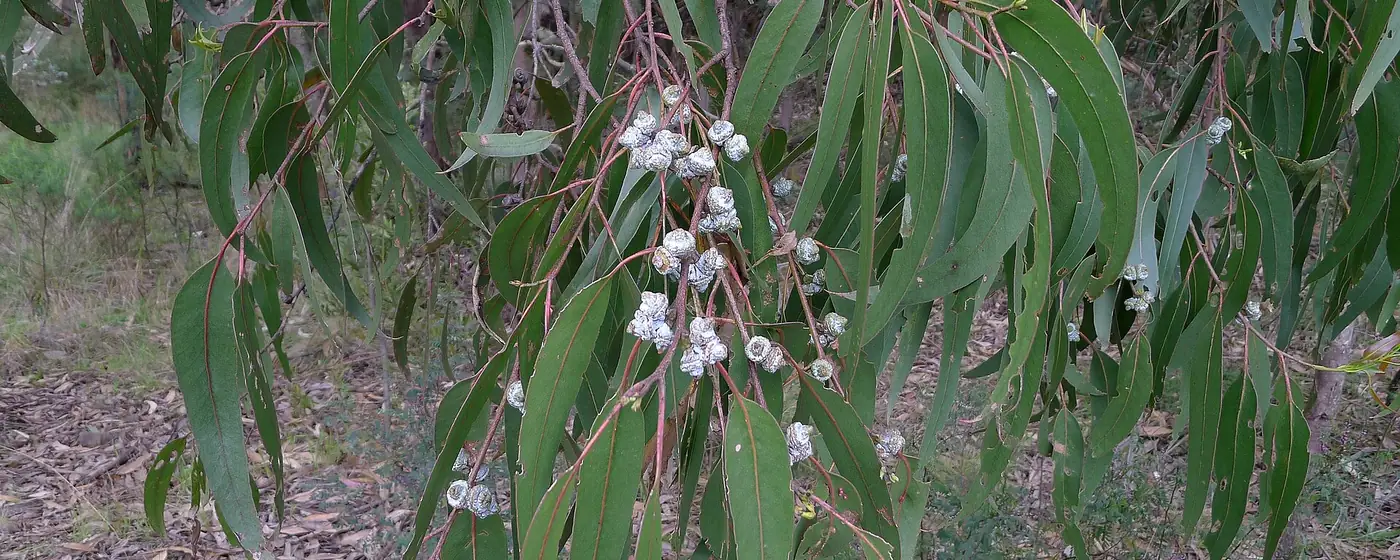
Eucalyptus tea is a hot-water infusion of the dried leaves of Eucalyptus globulus, the blue gum tree, an Australian native now grown across the Mediterranean, South America, and California. It is not tea in the botanical sense and contains no caffeine. Its character comes from the leaf's essential oil, dominated by 1,8-cineole, better known as eucalyptol. If you have ever opened a jar of chest rub, you already know the smell.
In the cup it is bracing rather than comforting. The aroma arrives first: sharp, cooling, faintly camphorous, closer to a pine forest than to peppermint, though the two share a menthol-like lift. The liquor is pale gold and thin-bodied, with a resinous, bitter finish. Honey and lemon soften a flavor most people find frankly medicinal. Almost nobody drinks eucalyptus tea for pleasure. It is a tea you reach for when your head feels full.
That reach is old. Eucalyptus leaf has been used for generations, first in Australia and later in European herbal practice, as a steam and a tisane for congestion and coughs. What is worth knowing before you brew a cup is that almost none of the modern research studied the tea. The randomized trials people cite were run on capsules of purified eucalyptol at pharmaceutical doses, or on rubs and inhalations. Whether a leaf infusion does anything comparable has never been tested.
And one warning outranks any benefit on this page: eucalyptus essential oil is toxic to swallow. It has caused seizures, coma, and death. The tea is made from leaves. Never from the oil.
Photo: Eucalyptus globulus subsp. pseudoglobulus.jpg by John Tann from Sydney, Australia — CC BY 2.0. Cropped and re-encoded.
What the evidence says
Purified eucalyptol capsules improved COPD and asthma symptoms. That is not tea.
In a six-month double-blind trial, 242 adults with COPD took 200 mg cineole or placebo three times daily and had fewer, milder exacerbations. A 247-patient asthma trial found modest gains, and a 32-person trial cut oral prednisolone by about a third. Several of these trials share investigators. A systematic review of herbal treatments for asthma concluded that no recommendations could be made from the evidence available.
Eucalyptus leaf tea has never been tested in a published clinical trial.
The literature offers trials of cineole capsules, oil inhalations and nebulizations, chest rubs, and head-lice lotions, but no controlled study of drinking a leaf infusion. Cineole is volatile and only slightly water-soluble, and nobody has measured how much of it ends up in a mug. There is no basis for assuming a cup of tea delivers anything like the doses used in the capsule trials.
No published human clinical trials found for this use.
The closest published evidence is a chest rub, not a drink, and the study was tiny.
In a single-blind crossover study, 12 people with chronic bronchitis cleared lung mucus faster in the first hour after an aromatic ointment was rubbed on the chest. The ointment combined camphor, menthol, and eucalyptol, so eucalyptus cannot be credited on its own. Twelve people is a very small sample, the effect had faded within five hours, and nothing was drunk or inhaled from a cup. Whether steam rising off a mug does anything at all has not been studied.
Sources: [6]
A standardized terpene distillate outperformed placebo in bronchitis, but it is a manufactured drug, not eucalyptus.
In a 676-person randomized trial, myrtol standardized, a distillate containing alpha-pinene, limonene, and 1,8-cineole, sped recovery from acute bronchitis compared with placebo. It is often cited as evidence for eucalyptus. It is not. It is a pharmaceutical preparation of isolated terpenes given at fixed doses, and 1,8-cineole is only one of its several components.
Sources: [5]
Eucalyptus oil inhibits some bacteria in a dish, unremarkably among essential oils.
In one in-vitro study, eucalyptus oil was among three ointment ingredients that inhibited Gram-positive bacteria including MRSA, though larch turpentine was the more active ingredient. In a separate screen of ten essential oils against E. coli, eucalyptus ranked among the least effective. Both used concentrated oil against bacteria in a dish, not tea in a person.
Eucalyptus leaf extracts lowered blood sugar in diabetic rodents. That is a reason for caution, not a benefit.
Diabetic mice fed eucalyptus had less hyperglycemia, and a water extract of the leaf triggered insulin release from cultured beta cells. Two later rodent studies pointed the same way, though both used ethanol-based extracts rather than a water infusion, which is what tea is. No human trial exists and the doses dwarf a cup. The practical takeaway is a caution for people on diabetes medication, not a reason to drink it.
Eucalyptus leaf is rich in polyphenols. That is chemistry, not a benefit.
When researchers boiled eleven plants traditionally used for blood sugar, eucalyptus leaf yielded more phenolic compounds than the other ten. Yet in the same study, antioxidant activity did not track with the effect on glucose diffusion. A beaker is far from a person.
Sources: [12]
How to brew Eucalyptus Tea
Bring water to a full boil and pour it over the dried leaf. Cover the cup while it steeps, because the aromatic compounds are volatile and drift off with the steam. Then strain.
- Use dried leaf only. Never add eucalyptus essential oil to a drink or brew tea from it. Swallowed eucalyptus oil has caused seizures, coma, and death, and the toxic dose is small and unpredictable.
- Cover the cup. Cineole evaporates readily, and an uncovered mug loses much of what you brewed it for.
- Start with one teaspoon; a stronger brew is harsher, not more effective. Honey and lemon soften the edge.
Safety, side effects & who should avoid it
No clinical trial has ever looked at eucalyptus leaf tea, so nothing about it is established, including its safety. It has a long history of household use and is not known to cause serious harm in ordinary amounts, but that is tradition rather than evidence. Eucalyptus essential oil is a different matter entirely, and this part is not in doubt: swallowing it is genuinely poisonous, and it has caused seizures, coma, and death. Children are at greatest risk. If anyone swallows eucalyptus oil, or a product containing it, call Poison Control right away (1-800-222-1222 in the US) or your local emergency number. Do not try to make the person vomit.
Who should avoid it
- Anyone tempted to substitute the essential oil for the leaf. Swallowing the oil has caused vomiting, drowsiness, loss of coordination, seizures, coma, and, in a published adult case involving roughly 15 mL, death, with corrosive injury to the mouth, airway, and gut found at autopsy. Among 109 poisoned children, marked depression of consciousness was expected above 5 mL of undiluted oil, and milder effects at 2-3 mL. But reported toxic doses vary widely between case series, and some children who swallowed far more had no symptoms at all. Treat that unpredictability as a reason to call Poison Control after any ingestion, not as reassurance.
- Infants and young children. Eucalyptus oil has been a leading cause of poisoning hospitalizations among Australian children under five, usually via home vaporizers left at floor level. European regulators do not permit eucalyptus oil preparations to be taken by mouth below age 12, and prohibit them entirely below 30 months because of the risk of laryngospasm. Do not give the tea to babies or toddlers.
- Children with any history of seizures, febrile or otherwise. European regulators list this as an outright contraindication for eucalyptus oil products, and swallowed eucalyptus oil is a documented cause of seizures.
- Young children, for topical eucalyptus too. A 6-year-old girl became unconscious, with slurred speech and ataxia, after a eucalyptus-oil remedy was applied to her skin. Never apply eucalyptus oil to the face or nostrils of an infant or young child.
- Anyone allergic to eucalyptus or other myrtle-family (Myrtaceae) plants.
- People on insulin or oral glucose-lowering drugs, and those taking narrow-therapeutic-index medicines cleared by CYP3A4, without asking a pharmacist first.
Possible side effects
- Nausea, vomiting, or stomach upset, especially from a strong brew
- Burning or numbing in the mouth and throat from the cineole
- Diarrhea
- Headache or dizziness
- Allergic skin rash; contact allergy is documented
- Drowsiness, a signal to stop
Medication interactions
- CYP3A4 substrates: 1,8-cineole is rapidly metabolized by human CYP3A4 and is an unusually efficient substrate for it. It could in principle compete with statins, some benzodiazepines, and certain immunosuppressants. No human interaction study exists.
- Enzyme induction: in rats, high oral doses of 1,8-cineole induced CYP2B and CYP3A enzymes and worsened chemically induced liver injury. Induction can make some drugs less effective.
- Diabetes medications (insulin, sulfonylureas, metformin): eucalyptus leaf extracts lowered blood glucose in rodent and cell models. Additive glucose lowering is plausible but unstudied in people, so monitor if you drink it regularly.
- Sedatives, opioids, and alcohol: not documented at tea strength, but eucalyptus oil in overdose depresses the central nervous system.
- Camphor-containing rubs: these pair eucalyptus oil with camphor, the more acutely dangerous ingredient. A 15-month-old who swallowed 70 mL of such an ointment had prolonged seizures. Never take them by mouth.
Pregnancy & breastfeeding
There is no reliable human safety data for eucalyptus tea in pregnancy or breastfeeding, and no clinical trials of the tea at all. Because nothing about it has been studied, no one can honestly tell you whether it is safe. Eucalyptus essential oil should never be swallowed by anyone, pregnant or not. Ask your doctor or midwife before drinking the tea.
How much is too much
There is no established limit, because no clinical trial has tested eucalyptus leaf tea. That means no studied dose and no studied safe ceiling. The capsule trials used 200 mg of isolated cineole three times daily, which tells you nothing useful about an infusion. If you drink it during a cold, keeping to one or two cups a day is common practice rather than a tested limit. Note that European regulators restrict oral eucalyptus oil preparations to people aged 12 and over.
Taste & pairing
Tasting notes: Menthol-like, Cooling, Camphoraceous.
Pairs well with: Honey, Lemon.
Best time to drink: When experiencing congestion.
Frequently asked questions
How long should I steep eucalyptus tea?
Five to ten minutes in freshly boiled water, with the cup covered, since cineole is volatile and escapes with the steam. Longer mostly extracts tannins and turns it bitter.
Can I add eucalyptus essential oil to my tea to make it stronger?
No, and this is the most important line on this page. The oil is toxic when swallowed. Case reports describe vomiting, ataxia, seizures, and unconsciousness after a few milliliters, and one adult died after swallowing about 15 mL. Brew from dried leaves only. If someone swallows the oil, call Poison Control (1-800-222-1222 in the US) or your local emergency number right away, and do not try to make them vomit.
Is eucalyptus tea safe for children?
Not for babies and toddlers, and there is no established safe dose for older children. Eucalyptus oil has been a leading cause of poisoning hospitalizations in Australian children under five, and European regulators bar oral eucalyptus oil preparations below age 12, with an outright ban below 30 months and for any child with a history of seizures. Nobody has studied the tea in children. Ask a pediatrician.
How many cups of eucalyptus tea can I drink per day?
There is no established limit, because no study has tested it. During a cold, one or two cups a day is common practice, but that is convention, not a tested safe ceiling.
Eucalyptus tea vs. peppermint tea for congestion: which works better?
Neither has been tested as a tea for congestion, so nobody can honestly tell you. Peppermint is gentler on the palate, and far more is known about it.
References
- Concomitant therapy with Cineole (Eucalyptole) reduces exacerbations in COPD: a placebo-controlled double-blind trial.. Respiratory research, 2009. PubMed 19624838 · doi:10.1186/1465-9921-10-69
- Patients with asthma benefit from concomitant therapy with cineole: a placebo-controlled, double-blind trial.. The Journal of asthma : official journal of the Association for the Care of Asthma, 2012. PubMed 22978309 · doi:10.3109/02770903.2012.717657
- Anti-inflammatory activity of 1.8-cineol (eucalyptol) in bronchial asthma: a double-blind placebo-controlled trial.. Respiratory medicine, 2003. PubMed 12645832 · doi:10.1053/rmed.2003.1432
- Herbal interventions for chronic asthma in adults and children: a systematic review and meta-analysis.. Primary care respiratory journal : journal of the General Practice Airways Group, 2010. PubMed 20640388 · doi:10.4104/pcrj.2010.00041
- Efficacy and tolerability of myrtol standardized in acute bronchitis. A multi-centre, randomised, double-blind, placebo-controlled parallel group clinical trial vs. cefuroxime and ambroxol.. Arzneimittel-Forschung, 2000. PubMed 10994153 · doi:10.1055/s-0031-1300276
- Effect of aromatics on lung mucociliary clearance in patients with chronic airways obstruction.. Journal of alternative and complementary medicine (New York, N.Y.), 2003. PubMed 12804077 · doi:10.1089/10755530360623356
- In vitro Antibacterial and Antifungal Activity of a Skin Ointment and Its Active Pharmaceutical Ingredients Larch Turpentine, Turpentine Oil, and Eucalyptus Oil.. Skin pharmacology and physiology, 2025. PubMed 39778547 · doi:10.1159/000543158
- In vitro antibacterial activity of antibiotics and plant essential oils against Escherichia coli MTCC443 supported through the molecular docking and pharmacokinetics study.. Biotechnology and applied biochemistry, 2024. PubMed 38627930 · doi:10.1002/bab.2583
- Antihyperglycemic actions of Eucalyptus globulus (Eucalyptus) are associated with pancreatic and extra-pancreatic effects in mice.. The Journal of nutrition, 1998. PubMed 9868176 · doi:10.1093/jn/128.12.2319
- Antihyperglycemic effect of crude extracts of some Egyptian plants and algae.. Journal of medicinal food, 2014. PubMed 24404976 · doi:10.1089/jmf.2013.0068
- Effect of standardized Eucalyptus globulus leaf extract on brain oxidative stress and aberrant neurochemistry of fructose-streptozotocin-induced diabetic rats.. Nigerian journal of physiological sciences : official publication of the Physiological Society of Nigeria, 2023. PubMed 38243358 · doi:10.54548/njps.v38i1.10
- Antioxidant activity and glucose diffusion relationship of traditional medicinal antihyperglycemic plant extracts.. International journal of molecular and cellular medicine, 2013. PubMed 24551809
- Oxidation of 1,8-cineole, the monoterpene cyclic ether originated from eucalyptus polybractea, by cytochrome P450 3A enzymes in rat and human liver microsomes.. Drug metabolism and disposition: the biological fate of chemicals, 2001. PubMed 11159812
- Pretreatment with 1,8-cineole potentiates thioacetamide-induced hepatotoxicity and immunosuppression.. Archives of pharmacal research, 2004. PubMed 15357008 · doi:10.1007/BF02980149
- Clinical effects and management of eucalyptus oil ingestion in infants and young children.. The Medical journal of Australia, 1995. PubMed 7651249 · doi:10.5694/j.1326-5377.1995.tb124516.x
- Eucalyptus oil poisoning in childhood: 41 cases in south-east Queensland.. Journal of paediatrics and child health, 1993. PubMed 8240865 · doi:10.1111/j.1440-1754.1993.tb00537.x
- Eucalyptus oil poisoning among young children: mechanisms of access and the potential for prevention.. Australian and New Zealand journal of public health, 1997. PubMed 9270157 · doi:10.1111/j.1467-842x.1997.tb01703.x
- Topical eucalyptus oil poisoning.. The Australasian journal of dermatology, 1998. PubMed 9838728 · doi:10.1111/j.1440-0960.1998.tb01488.x
- Unusual cause of seizure.. Pediatric emergency care, 1996. PubMed 8858658
- Eucalyptus oil poisoning.. Archives of disease in childhood, 1980. PubMed 7436478 · doi:10.1136/adc.55.5.405
- Fatal Eucalyptus Oil Poisoning in an Adult Male: A Case Report With Comprehensive Autopsy and Histopathological Findings.. Cureus, 2025. PubMed 40432665 · doi:10.7759/cureus.83053
- Unintentional exposure of young children to camphor and eucalyptus oils.. Paediatrics & child health, 2001. PubMed 20084213 · doi:10.1093/pch/6.2.80
Last reviewed and updated . HelperTea is written by an enthusiast, not a clinician, and is not medically reviewed. How we research and rate evidence. Found an error? Tell us — safety corrections get priority.