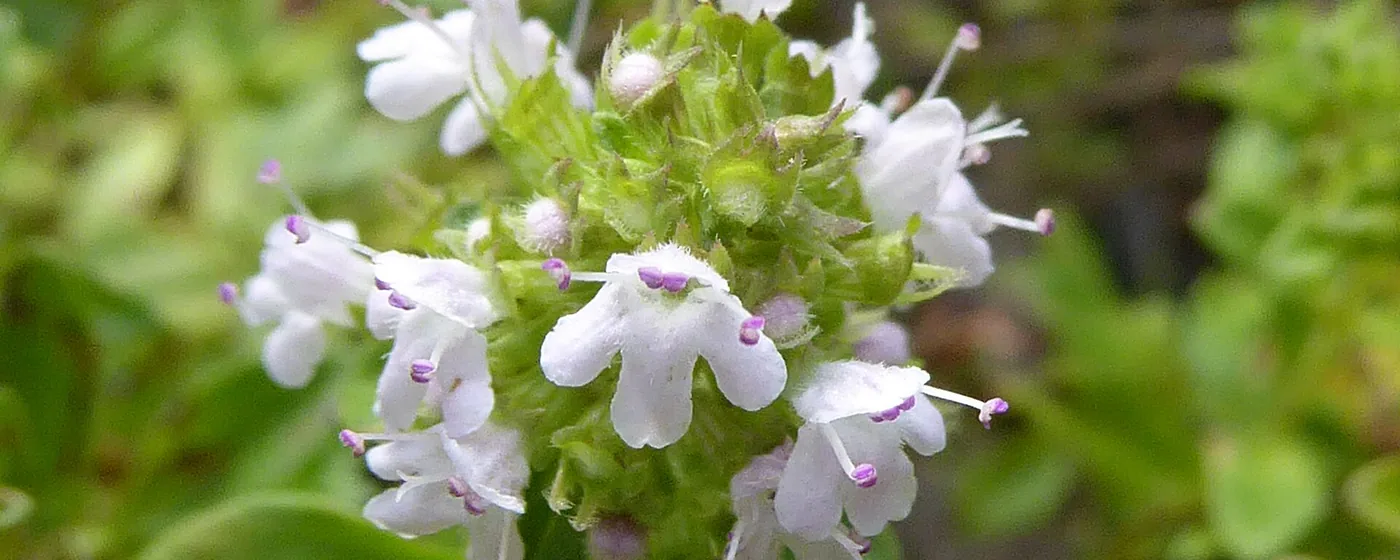
Thyme tea is a hot-water infusion of the leaves of Thymus vulgaris, the woody Mediterranean shrub that ends up in roast chicken and bouquet garni. Brewed on its own it is savory rather than sweet: warm, herbaceous, faintly minty, with a whisper of clove and a dry, resinous finish. It is caffeine-free. The aroma comes from thymol and carvacrol, the volatile compounds of thyme's essential oil. Hot water pulls out only a small share of them, along with water-soluble polyphenols such as rosmarinic acid and flavonoids. A cup of thyme tea and a bottle of thyme oil are not the same substance in different packaging.
What is it actually used for? Coughs, overwhelmingly. Thyme was the standard European folk remedy for a chesty cold, and the European Medicines Agency's herbal committee still lists thyme preparations for productive coughs associated with colds, classified as traditional use rather than proven use. The trials people cite when recommending thyme are real, but they tested concentrated thyme extract combined with ivy leaf or primrose root, given as syrup or tablets. We could find no placebo-controlled trial of a mug of thyme infusion.
So, honestly: thyme tea is a comfort measure with an old reputation and a thin evidence base. Warmth, steam and honey soothe an irritated throat, and there are plausible mechanisms by which thyme's compounds relax smooth muscle. None of that has been shown for the tea itself in people. Drink it because it tastes good when you are sick, not instead of getting a stubborn cough looked at.
Photo: Thymus vulgaris Paludi 04.jpg by Syrio — CC BY-SA 4.0. Cropped and re-encoded.
What the evidence says
Concentrated thyme extract, combined with ivy leaf or primrose root, reduced coughing fits in adults with acute bronchitis in two placebo-controlled trials.
Two placebo-controlled trials, each randomizing 361 adults with acute bronchitis, gave thyme fixed-combined with ivy leaf or primrose root for about 11 days. Coughing fits fell 67 to 69 percent from baseline versus 48 to 51 percent on placebo. An uncontrolled study of 730 pharmacy customers on thyme/ivy drops reported similar improvement. Both trials were run on a single manufacturer's product, thyme was never tested alone, and these are concentrated extracts, not tea. So this tells you something about a cough syrup, and close to nothing about a teapot.
Thyme tea itself has never been tested against placebo for cough. Its use is traditional.
The European Medicines Agency's herbal committee classifies thyme as a traditional-use medicine for productive coughs, a category that exists precisely because clinical trial evidence is insufficient. We could find no controlled trial of a thyme infusion, as opposed to a concentrated extract.
No published human clinical trials found for this use.
Thymol and carvacrol kill bacteria and fungi in a laboratory dish. That does not mean drinking thyme tea fights an infection.
In a veterinary laboratory study, thyme oil, thymol and carvacrol inhibited all 100 bacterial and fungal isolates taken from dogs with ear infections, including drug-resistant ones, at 146 to 292 micrograms per milliliter against gram-positive bacteria. Those are direct-contact concentrations of essential oil on a culture plate, not what a brewed leaf delivers to your blood or airways. Separately, when researchers ran mass spectrometry on a water extract of thyme leaves, the constituents they identified were flavonoids and chlorogenic-class compounds; thymol was not among them.
Thyme preparations may ease menstrual cramps, but the human evidence is thin, comes from one setting, and did not test tea.
A single-blind trial of 120 Iranian students with primary dysmenorrhea compared a commercial liquid preparation the authors called Shirazi thyme, dosed by the spoonful four times a day, against ibuprofen, and found similar pain reduction. There was no placebo arm, so neither treatment was shown to beat doing nothing, and menstrual pain responds strongly to placebo. Note also that in Iran the name Shirazi thyme is often used for Zataria multiflora, a different plant from Thymus vulgaris, so it is not certain the trial tested the same herb in your teacup. A 2026 review of six thyme studies could not pool them statistically and noted all clinical data came from Iranian women of reproductive age. In the laboratory, a water extract of thyme leaves inhibited oxytocin-driven contractions in isolated mouse uterus, which is a plausible mechanism and not a human result.
Thyme tea "boosts the immune system."
This is a marketing phrase, not a finding. No human trial has shown that thyme tea prevents colds, shortens them, or changes any meaningful measure of immune function. Thyme contains antioxidant polyphenols and its oil is antimicrobial in a dish, but neither establishes an effect after you swallow an infusion.
No published human clinical trials found for this use.
How to brew Thyme Tea
Bring water to a full rolling boil and pour it straight over the thyme. Keep the cup covered while it steeps: the aromatics are volatile, and the smell rising off an uncovered mug is what you wanted in the tea.
- Fresh thyme is milder by volume. Use roughly three times as much fresh as dried, and bruise the sprigs.
- Honey and lemon are the traditional partners. Never give honey to a child under 12 months.
- As a gargle, let it cool to warm, then swish and spit.
- Use culinary thyme, not ornamental plantings or thyme that may have been sprayed.
Safety, side effects & who should avoid it
Thyme tea is a food-grade herb in hot water, well tolerated in normal amounts. The main risks are allergy in mint-family-sensitive people, and thyme essential oil, which should never be swallowed. Consumer drug references additionally caution against medicinal amounts of thyme in people with bleeding disorders, people heading into surgery, and people with hormone-sensitive conditions.
Who should avoid it
- Anyone allergic to thyme or other mint-family (Lamiaceae) plants: oregano, marjoram, basil, sage, mint, lavender. European regulators call this a contraindication to thyme medicines.
- Anyone tempted to swallow thyme essential oil, or add drops to hot water as "tea." It is far more concentrated in thymol, and phenolics of this class are toxic in quantity.
- Young children given thyme as a medicine rather than a seasoning. European regulators restrict most thyme cough preparations to ages 12 and up, a few to children over 4.
- Anyone whose cough brings fever, breathlessness, chest pain or blood, or lasts over a week. That needs a clinician.
- People with a bleeding disorder, and anyone within two weeks of scheduled surgery. Consumer drug references advise stopping medicinal thyme two weeks beforehand, on the theory that it may slow blood clotting. The theory rests on laboratory work, not on human bleeding events, but the advice costs you nothing to follow.
- People with hormone-sensitive conditions such as breast, uterine or ovarian cancer, endometriosis or uterine fibroids, if they are considering thyme in medicinal amounts. In a laboratory screen of over 150 herbs, thyme extract was among those that bound the estrogen receptor in cultured human breast cancer cells and behaved as an estrogen agonist there (PMID 9492350). Nobody has shown that drinking thyme tea does anything hormonal in a person, but consumer drug references treat this as a reason for caution, and so do we.
- Pregnant or breastfeeding people using thyme medicinally rather than as a seasoning (see below).
Possible side effects
- Stomach upset, nausea or heartburn, the effect most consistently listed for thyme preparations.
- Allergic reactions: itchy mouth, rash, hives, swelling. Uncommon, likelier if you react to oregano or sage.
- Dizziness, listed by consumer drug references among the effects reported after taking thyme by mouth.
- A drying, astringent mouthfeel from very strong or long-steeped infusions.
- Contact rash on the hands, occasionally reported in people handling large quantities of fresh thyme.
Medication interactions
- No drug interaction with thyme tea has been documented in humans, and no clinical interaction study exists. "No known interaction" means "not studied."
- Blood thinners and antiplatelet drugs (warfarin, apixaban, clopidogrel, aspirin): herbal references list a theoretical bleeding caution, extrapolated from laboratory work rather than any human case. Ask your pharmacist before drinking strong thyme tea daily, and see the surgery note above.
- Estrogen therapy, including hormone replacement and estrogen-containing contraceptives: because thyme extract showed estrogen-receptor activity in cell culture, drug references suggest medicinal thyme could in theory interfere. Untested in people.
- Anticholinergic and cholinergic medications: drug references list a theoretical interaction in both directions. Again, extrapolated from laboratory data, with no human reports.
- Herbal cough syrups such as Bronchipret already contain concentrated thyme extract; thyme tea stacks the same herb.
- Never swallow thymol-containing mouthwashes or essential oils in quantity: a large-volume ingestion of thymol/menthol/eucalyptol mouthwash caused anion-gap metabolic acidosis, multi-organ failure and death in a published case report (PMID 14984634).
Pregnancy & breastfeeding
Thyme as a kitchen seasoning is a food and is not a concern. Thyme tea in medicinal amounts has never been studied in pregnancy or lactation, and one laboratory study found aqueous thyme extract relaxed isolated (nonpregnant, mouse) uterine muscle, so its effect on a pregnant uterus is unknown rather than reassuringly neutral. Never take thyme oil internally while pregnant, and talk to your doctor or midwife before drinking thyme tea regularly.
How much is too much
No established limit. Traditional practice uses about 1-2 g of dried thyme, roughly a teaspoon, per cup, up to three cups a day, for around a week during a cough. No trial has tested any dose.
Taste & pairing
Tasting notes: Herbaceous, Minty, Slightly floral.
Pairs well with: Honey, Lemon.
Best time to drink: When experiencing respiratory symptoms.
Frequently asked questions
How long should I steep thyme tea?
Five to ten minutes in boiling water, covered. Five gives a light, savory cup; ten a stronger, greener, more medicinal one. Past ten minutes you mainly add tannic bitterness, because the volatile compounds you want leave as steam.
Does thyme tea actually stop a cough?
Nobody knows. The two placebo-controlled trials people cite, 361 adults each, tested concentrated thyme extract combined with ivy leaf or primrose root, not tea. European regulators class thyme's cough indication as traditional use. Expect comfort, not a cure.
How many cups a day is safe, and what are the side effects?
No established limit, because it has not been studied. Traditional use is a teaspoon of dried thyme per cup, up to three cups a day, for about a week. Side effects are usually mild: stomach upset, heartburn, dizziness, an astringent mouthfeel from strong brews. If you take a blood thinner, have a bleeding disorder or a hormone-sensitive condition, are pregnant, or have surgery coming up, check with a pharmacist before making thyme tea a daily habit.
Is thyme essential oil the same as thyme tea?
No, and confusing the two is genuinely dangerous. Essential oil is a steam-distilled concentrate, largely thymol and carvacrol. Adding drops to hot water does not make tea; it makes a dose of phenolic compounds your gut was never meant to receive.
When is the best time of day to drink it?
Whenever your symptoms are worst. It is caffeine-free, so evening and bedtime are fine, and many people reach for it at night when a cough is most disruptive. No evidence suggests timing matters.
References
- Efficacy and tolerability of a fluid extract combination of thyme herb and ivy leaves and matched placebo in adults suffering from acute bronchitis with productive cough. A prospective, double-blind, placebo-controlled clinical trial.. Arzneimittel-Forschung, 2006. PubMed 17063641 · doi:10.1055/s-0031-1296767
- Evaluation of efficacy and tolerability of a fixed combination of dry extracts of thyme herb and primrose root in adults suffering from acute bronchitis with productive cough. A prospective, double-blind, placebo-controlled multicentre clinical trial.. Arzneimittel-Forschung, 2007. PubMed 17966760 · doi:10.1055/s-0031-1296656
- Effectiveness and tolerability of the thyme/ivy herbal fluid extract BNO 1200 for the treatment of acute cough: an observational pharmacy-based study.. Current medical research and opinion, 2021. PubMed 34340607 · doi:10.1080/03007995.2021.1960493
- Antimicrobial activity of thyme oil, oregano oil, thymol and carvacrol against sensitive and resistant microbial isolates from dogs with otitis externa.. Veterinary dermatology, 2019. PubMed 31566822 · doi:10.1111/vde.12794
- Thyme ([Lamiaceae]) Leaves Inhibit Contraction of the Nonpregnant Mouse Uterus.. Journal of medicinal food, 2020. PubMed 32758061 · doi:10.1089/jmf.2020.0076
- The impact of a novel herbal Shirazi Thymus Vulgaris on primary dysmenorrhea in comparison to the classical chemical Ibuprofen.. Journal of research in medical sciences : the official journal of Isfahan University of Medical Sciences, 2012. PubMed 23798928
- Evaluating the Therapeutic Effects ofon Primary Dysmenorrhea Adolescent and Young Girls (Qualitative Evidence Synthesis).. Pediatric health, medicine and therapeutics, 2026. PubMed 41987844 · doi:10.2147/PHMT.S569992
- Fatal large-volume mouthwash ingestion in an adult: a review and the possible role of phenolic compound toxicity.. Journal of intensive care medicine, 2003. PubMed 14984634 · doi:10.1177/0885066602250783
- Estrogen and progestin bioactivity of foods, herbs, and spices.. Proceedings of the Society for Experimental Biology and Medicine. Society for Experimental Biology and Medicine (New York, N.Y.), 1998. PubMed 9492350 · doi:10.3181/00379727-217-44247
Last reviewed and updated . HelperTea is written by an enthusiast, not a clinician, and is not medically reviewed. How we research and rate evidence. Found an error? Tell us — safety corrections get priority.