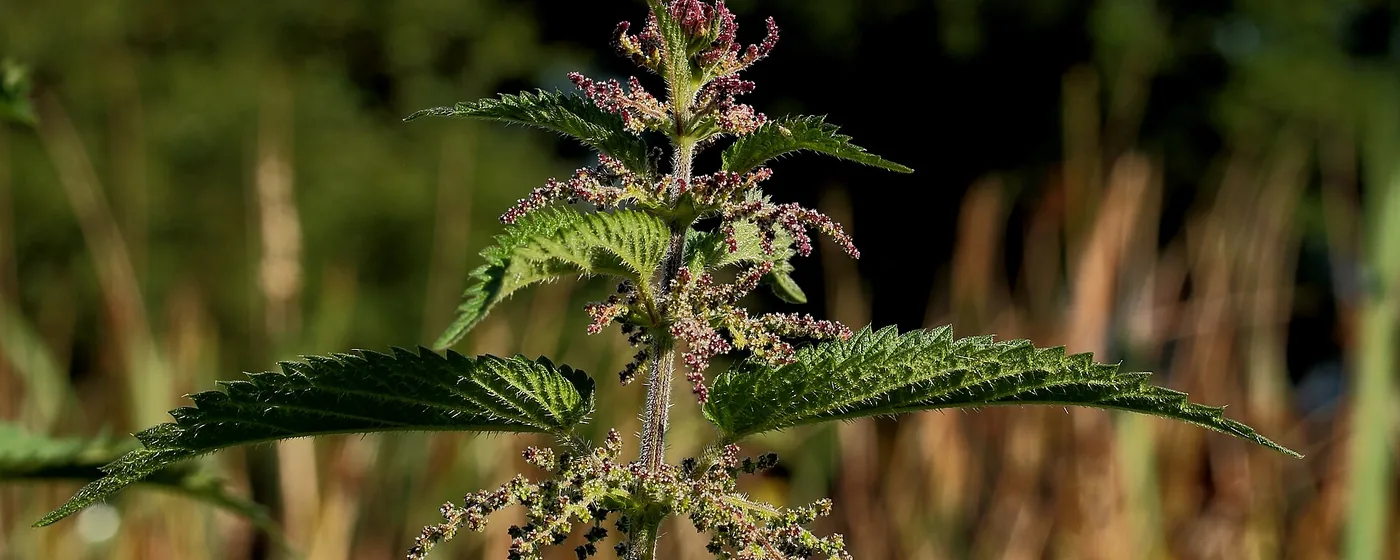
Nettle tea is an infusion of the dried leaves of stinging nettle (Urtica dioica), a weedy perennial that grows in ditches, hedgerows, and disturbed soil across Europe, Asia, and North America. Fresh nettle earns its name: the leaves and stems carry fine hollow hairs that inject irritant chemicals when you brush against them. Drying, freezing, and cooking disable those hairs, which is why nettle has been eaten as a pot herb and drunk as a tea for centuries without anyone getting stung by their mug.
In the cup, nettle is unapologetically green. It brews to a deep olive-gold and tastes roughly the way steeped spinach or chard tastes: earthy, mineral, faintly grassy, with a soft hay-like sweetness underneath and a mild drying finish from its tannins. People expecting a floral herbal tea are often surprised. People who like a savory, broth-adjacent drink take to it immediately. A squeeze of lemon lifts the vegetal edge; a little honey rounds off the mineral note. There is no caffeine in it.
So what is nettle tea actually for? Honestly, mostly tradition. European folk medicine used it as a spring tonic, as a remedy for aching joints, and as a mild diuretic to flush the urinary tract. Europe's herbal medicines committee licenses nettle leaf tea for those last two purposes, and does so explicitly on the basis of long-standing use rather than clinical proof. The modern research is thinner than most product labels suggest: nearly every trial used concentrated capsules rather than a brewed cup, and much of the best-known work studied nettle root, a chemically different preparation from the leaf in your teapot.
Photo: Brandnetel, Urtica dioica, Locatie, Famberhorst.jpg by Dominicus Johannes Bergsma — CC BY-SA 4.0. Cropped and re-encoded.
What the evidence says
Nettle leaf extract may lower fasting blood sugar in people with type 2 diabetes.
A 2019 review pooled eight randomized trials in 401 adults and found fasting blood sugar fell by about 18 mg/dL, but insulin, insulin resistance, and HbA1c showed no significant improvement, the trials disagreed with each other enormously, and two of the eight were rated poor quality. The largest single trial gave 500 mg of leaf extract three times daily for three months to 92 people already on diabetes medication. All of these used concentrated capsules, so whether a brewed cup affects blood sugar is unknown.
Nettle root extract, which is not the same thing as nettle leaf tea, may modestly ease the urinary symptoms of an enlarged prostate.
In a six-month randomized, placebo-controlled trial of 620 men, nettle root extract improved International Prostate Symptom Scores from 19.8 to 11.8, versus 19.2 to 17.7 on placebo, with no change in PSA. A 12-week trial in 60 men found a smaller improvement. Both used root extract taken as a pill, not a tea. Two cautions on the larger trial: it is a single-author, single-center study, and it has not been independently replicated. Root and leaf contain different compounds, no trial has tested leaf tea for prostate symptoms, and these symptoms need a diagnosis before self-treatment.
Nettle is traditionally taken for hay fever, but the human evidence is old, small, and mixed.
The most-cited study, from 1990, randomized 98 people to freeze-dried nettle leaf or placebo for one week. Only 69 finished; nettle beat placebo on a single global rating, while the daily symptom diaries showed just a slight difference. A later trial of nettle root randomized 74 patients but only 40 finished: symptoms improved, and placebo improved just as much. In laboratory tests, nettle extract inhibited histamine H1 receptors and mast cell tryptase, a plausible mechanism, though that work was done in a dish rather than a person, and by researchers at a supplement company.
Nettle is traditionally used for minor joint aches. No trial has tested nettle tea for this, and the one trial of nettle by itself applied the fresh sting to the skin rather than drinking it.
Two placebo-controlled trials of oral supplements reported benefit in knee and hip osteoarthritis, but neither isolates nettle. One randomized 92 patients to a rosehip, nettle, and devil's claw drink or placebo; it beat placebo on pain, though the drop in painkiller use was only a non-significant trend, and its authors worked for the company that makes the product. The other randomized 81 patients to a fish oil, vitamin E, and nettle capsule or placebo, and did significantly cut painkiller use. In both, nettle was one ingredient among several, so nothing can be pinned on the nettle. Separately, a 27-patient crossover trial had people sting a painful thumb joint with fresh nettle leaf daily for a week; that beat a look-alike placebo leaf on pain and disability scores. It tests nettle on the skin, not in a cup. European regulators accept nettle leaf tea for minor joint pain purely as a traditional use, capped at four weeks.
Nettle leaves are nutrient-dense and contain antioxidant compounds, but that has been shown in the leaf and the test tube, not in a brewed cup.
Analyses of nettle leaves find flavonoids such as rutin and kaempferol, phenolic acids, amino acids, carotenoids, and vitamin A, which is where the nourishing spring tonic reputation comes from. In test tubes, nettle extract inhibited COX-1, COX-2, and prostaglandin D2 synthase; in rats it reduced a marker of oxidative muscle damage. But all of that describes the leaf itself, not the water you strain off it, and we could find no study measuring how much of that nutrition actually crosses into a brewed cup. If you are drinking nettle for nourishment, eating the cooked greens is the surer route.
Nettle leaf tea is traditionally used to increase urine output and flush the urinary tract.
This is one of only two uses Europe's herbal medicines committee accepts for nettle leaf tea, and it accepts it on the basis of centuries of documented use, not clinical trials. No good human study has measured how much extra urine nettle tea actually produces. Some of any effect is presumably the water itself, since the traditional dose means drinking several cups of hot liquid a day.
No published human clinical trials found for this use.
How to brew Nettle Tea
Bring water to a full rolling boil and pour it over the dried leaf. Cover the cup or pot: nettle needs 10 to 15 minutes to draw much out of the tough leaf, and a lid keeps the water hot enough to keep working. Strain and drink.
- Nettle rewards patience. Under five minutes gives you weak green water; color and flavor deepen between minutes eight and twelve.
- It will not turn bitter the way black tea does if you forget it. A twenty-minute steep is just stronger and more astringent.
- Dried nettle does not sting. Drying, freezing, and heat disable the stinging hairs, so there is no sting left to neutralize.
- Nettle is traditionally a diuretic, so most people prefer it in the morning or afternoon rather than right before bed.
- If you forage, wear gloves, pick young tops before the plant flowers, be certain of your identification, and avoid roadsides.
Safety, side effects & who should avoid it
Nettle leaf has a long record of safe use as food and drink, no reported cases of liver injury, and side effects usually limited to mild stomach upset or an itchy rash. The cautions that matter are for people on warfarin or diabetes medication, and anyone whose heart or kidney condition means restricting fluids.
Who should avoid it
- Anyone told to restrict fluids because of severe heart or kidney disease. European regulators call this an outright contraindication for nettle leaf, since it is used to increase urine output.
- Anyone with a known allergy to nettle or related plants in the Urticaceae family.
- Children under 12: safety has not been established, and European regulators do not recommend it for them.
- People who are pregnant or breastfeeding (see below).
- Anyone self-treating urinary or prostate symptoms a clinician has not evaluated. Those can also come from infection, bladder disease, or prostate cancer, and delaying diagnosis is the real risk.
- Anyone whose urinary symptoms come with fever, painful urination, spasms, or blood in the urine. See a clinician, not a diuretic tea.
- Anyone whose joint pain comes with swelling, redness, or fever. European regulators say to see a doctor in that case. A hot, swollen, red joint can mean a joint infection or gout, both of which need prompt treatment, not a four-week trial of tea.
Possible side effects
- Mild gastrointestinal complaints: nausea, vomiting, or diarrhea. Frequency is not known.
- Skin reactions including itching, rash, and hives.
- Increased urination, the intended traditional effect, which can be inconvenient in the evening.
- Headache and abdominal discomfort, reported with nettle extracts.
- Handling the fresh plant causes a stinging rash (contact urticaria) lasting hours. Dried, cooked, or brewed nettle does not sting.
- Nettle contains tannins, which may reduce absorption of iron taken at the same time.
- No overdose case has been reported, and NIH LiverTox rates stinging nettle an unlikely cause of clinically apparent liver injury, its lowest risk category.
Medication interactions
- Warfarin (Coumadin) and other vitamin K antagonists: nettle leaf is a vitamin K-rich green, with USDA data putting blanched nettle greens near 500 mcg per 100 g, comparable to spinach. Vitamin K is fat-soluble and transfers poorly into hot water, so a cup likely delivers far less than a serving of greens, and no formal interaction study exists. Tell whoever manages your INR before starting or stopping nettle.
- Diabetes medications (insulin, sulfonylureas such as glyburide, metformin): randomized trials found nettle extract lowered fasting glucose in people already taking these drugs, so combining them could push blood sugar too low. Monitor, and ask your prescriber first.
- Diuretics such as furosemide or hydrochlorothiazide: nettle is traditionally used to increase urine output, so effects could add together and raise the risk of dehydration or electrolyte loss.
- Lithium: anything that increases urine output can in principle shift lithium levels, and lithium has a narrow safety margin. Unstudied with nettle, but worth a call to your prescriber.
- Blood pressure medications: nettle has shown blood-pressure-lowering and natriuretic effects in animals, with no human data either way. Watch for lightheadedness.
- Iron supplements: separate them from nettle tea by a couple of hours, since tannins bind iron.
- Europe's herbal medicines committee lists 'none reported' under interactions for nettle leaf. That means none have been documented, not that none exist; very few interaction studies have been done.
Pregnancy & breastfeeding
Skip it unless your own clinician says otherwise. Safety in pregnancy and breastfeeding has not been established, no reproductive-toxicity or genotoxicity testing has been done, and European regulators explicitly recommend against use during pregnancy and lactation for lack of data. Nettle circulates in pregnancy folklore as an iron-rich tonic; there is no clinical evidence it works for that. Talk to your doctor or midwife first.
How much is too much
No established safe limit for indefinite daily use. The closest official figure: Europe's herbal medicines committee sets the traditional dose at 2-4 g of dried leaf per cup, three to six times daily (8-12 g total), and caps continuous use at four weeks for minor joint pain, or two to four weeks for minor urinary complaints. That is a bound on short-term traditional use, not proof that long-term daily drinking is safe. The same regulators note that tests of reproductive toxicity, genotoxicity, and carcinogenicity have never been performed on nettle leaf, so the long-term picture is genuinely unknown rather than reassuring.
Taste & pairing
Tasting notes: Earthy, Herbaceous, Similar to spinach.
Pairs well with: Honey, Lemon.
Best time to drink: Throughout the day.
Frequently asked questions
How long should I steep nettle tea?
Ten to fifteen minutes in freshly boiled water, with a lid on. Nettle leaf is tough and fibrous, and a three-minute steep gives you a pale, watery cup. Unlike black or green tea, nettle does not turn harshly bitter over a long infusion, so twenty minutes is not a mistake, just stronger and more astringent.
How many cups of nettle tea can I drink a day?
European regulators describe the traditional dose as 2-4 g of dried leaf per cup, three to six times daily, with continuous use capped at four weeks for joint pain and two to four weeks for urinary complaints. That is the upper bound of a traditional regimen, not a proven safe ceiling. One to three cups a day sits well inside that range. No research establishes what is safe daily for years, so mention a long-term habit at your next checkup, especially if you take warfarin, diabetes medication, or diuretics.
When is the best time of day to drink nettle tea?
Morning or afternoon suits most people, since nettle is traditionally a mild diuretic and a late cup may have you up at night. It is caffeine-free, so it will not keep you awake on its own. If it upsets your stomach, drink it with food. Keep it a couple of hours apart from iron supplements, since its tannins can reduce iron absorption.
Does nettle tea actually help with hay fever?
Maybe a little, but the evidence is weak and none of it tested tea. A 1990 trial of freeze-dried nettle leaf in 98 people found it beat placebo on one overall rating after a week, while the symptom diaries showed only a slight edge and 29 people dropped out. A later trial of nettle root found symptoms improved, but placebo improved just as much, and only 40 of the 74 patients finished. None of that makes it a substitute for an antihistamine or nasal steroid.
Is nettle leaf tea the same as the nettle root people take for prostate symptoms?
No, and the difference matters. The trials showing improved urine flow and prostate symptom scores, including a 620-man randomized study, all used nettle root extract taken as a pill. Root and leaf come from the same plant but contain different compounds. Nettle tea is made from the leaf, and no trial has tested it for prostate symptoms. Get urinary trouble evaluated before self-treating, since the same symptoms can come from infection or prostate cancer.
Is nettle tea safe during pregnancy, or if I take warfarin?
For pregnancy and breastfeeding: safety has not been established, and European regulators recommend against it for lack of data, despite nettle's folk reputation as a pregnancy tonic. Ask your doctor or midwife. For warfarin: nettle leaf is a vitamin K-rich green, roughly on par with spinach by weight, and vitamin K works directly against warfarin. Little of it probably reaches the water in a brewed tea, and no interaction study exists, but neither is a reason to guess. Tell the clinician who manages your INR.
References
- The effect of nettle (Urtica dioica) supplementation on the glycemic control of patients with type 2 diabetes mellitus: A systematic review and meta-analysis.. Phytotherapy research : PTR, 2019. PubMed 31802554 · doi:10.1002/ptr.6535
- Improved glycemic control in patients with advanced type 2 diabetes mellitus taking Urtica dioica leaf extract: a randomized double-blind placebo-controlled clinical trial.. Clinical laboratory, 2013. PubMed 24273930 · doi:10.7754/clin.lab.2012.121019
- Urtica dioica for treatment of benign prostatic hyperplasia: a prospective, randomized, double-blind, placebo-controlled, crossover study.. Journal of herbal pharmacotherapy, 2005. PubMed 16635963
- Urtica Dioica Root Extract on Clinical and Biochemical Parameters in Patients with Benign Prostatic Hyperplasia, Randomized Controlled Trial.. Pakistan journal of biological sciences : PJBS, 2020. PubMed 32981268 · doi:10.3923/pjbs.2020.1338.1344
- Randomized, double-blind study of freeze-dried Urtica dioica in the treatment of allergic rhinitis.. Planta medica, 1990. PubMed 2192379 · doi:10.1055/s-2006-960881
- Efficacy of Supportive Therapy of Allergic Rhinitis by Stinging Nettleroot extract: a Randomized, Double-Blind, Placebo- Controlled, Clinical Trial.. Iranian journal of pharmaceutical research : IJPR, 2017. PubMed 29844782
- Nettle extract (Urtica dioica) affects key receptors and enzymes associated with allergic rhinitis.. Phytotherapy research : PTR, 2009. PubMed 19140159 · doi:10.1002/ptr.2763
- A Rosa canina - Urtica dioica - Harpagophytum procumbens/zeyheri Combination Significantly Reduces Gonarthritis Symptoms in a Randomized, Placebo-Controlled Double-Blind Study.. Planta medica, 2017. PubMed 28614869 · doi:10.1055/s-0043-112750
- Phytalgic, a food supplement, vs placebo in patients with osteoarthritis of the knee or hip: a randomised double-blind placebo-controlled clinical trial.. Arthritis research & therapy, 2009. PubMed 20015358 · doi:10.1186/ar2891
- Randomized controlled trial of nettle sting for treatment of base-of-thumb pain.. Journal of the Royal Society of Medicine, 2000. PubMed 10911825 · doi:10.1177/014107680009300607
- The role of urtica dioica (urticaceae) in the prevention of oxidative stress caused by tourniquet application in rats.. The Tohoku journal of experimental medicine, 2005. PubMed 15718813 · doi:10.1620/tjem.205.215
- Stinging Nettle (L.): Nutritional Composition, Bioactive Compounds, and Food Functional Properties.. Molecules (Basel, Switzerland), 2022. PubMed 36014458 · doi:10.3390/molecules27165219
Last reviewed and updated . HelperTea is written by an enthusiast, not a clinician, and is not medically reviewed. How we research and rate evidence. Found an error? Tell us — safety corrections get priority.