Short answer
Yes — licorice root tea raises blood pressure if you drink enough. Glycyrrhizin blocks a kidney enzyme, causing sodium retention and potassium loss. In a randomized trial, 100 mg of glycyrrhizic acid daily (as licorice, not tea) raised systolic pressure about 3 mmHg in two weeks. Avoid it if you have hypertension, heart or kidney disease.
Glycyrrhizin, the compound that makes licorice root sweet, does something no other common tea ingredient does: it disables the enzyme your kidneys use to keep cortisol away from the receptor that controls sodium and potassium. That is ordinary pharmacology, not an allergy or a rare reaction. Nobody can tell you exactly how much is too much, because a cup's glycyrrhizin depends on the root, the amount, and the steep, and it is never on the box. What the record shows: the threshold is lower than people assume, and some drinkers who reached an emergency department were having a few cups a day.
Why does licorice root tea raise blood pressure?
Glycyrrhizin becomes glycyrrhetinic acid in the gut, which blocks an enzyme called 11-beta-hydroxysteroid dehydrogenase type 2. That enzyme's job in the kidney is to inactivate cortisol before it reaches the mineralocorticoid receptor. Block it, and cortisol, which circulates far more abundantly than aldosterone, switches the receptor on in aldosterone's place.
The kidney then holds sodium and water and dumps potassium. Blood pressure climbs, plasma potassium falls, and the body suppresses its own renin and aldosterone. Clinicians call this pseudohyperaldosteronism: it looks like an aldosterone-producing tumor, except aldosterone is low PubMed PubMed.
On our evidence scale, the claim that licorice raises blood pressure and lowers potassium is rated strong: it rests on randomized human trials plus meta-analyses that pool them. Two things are worth saying plainly. The strong evidence describes a harm, not a benefit. And those trials used licorice confectionery, extracts, or purified glycyrrhizic acid — not brewed tea. That the tea does the same rests on the mechanism above, on the fact that the tea delivers glycyrrhizin, and on a run of case reports in people who drank it.
How much licorice root tea does it take to matter?
Start with a 2024 randomized crossover trial. Twenty-eight healthy young adults took licorice containing 100 mg of glycyrrhizic acid a day, or a control, for two weeks each. The trial was randomized but not blinded, which is worth knowing when the main outcome is home blood pressure. The World Health Organization had called 100 mg daily unlikely to cause adverse effects. It did: systolic home blood pressure rose about 3 mmHg, renin fell roughly 30 percent and aldosterone 45 percent, and the authors concluded the safe limit may need reconsidering PubMed.
An earlier study had volunteers eat 50 to 200 g of licorice daily for two to four weeks. Systolic pressure rose 3.1 to 14.4 mmHg, in a straight line with dose, and the full effect had arrived by two weeks. Responses spread along a normal distribution, so there is no clean line dividing sensitive people from the rest PubMed.
Pooled data agree. Across 18 studies (337 participants) taking at least 100 mg of glycyrrhizic acid daily, systolic pressure rose a mean 5.45 mmHg and plasma potassium fell 0.33 mmol/L PubMed. A 2024 meta-analysis of eight randomized trials attributed the rise to glycyrrhizic acid rather than licorice's flavonoids, which showed no significant effect on blood pressure PubMed.
None of those trials used brewed tea, and no product declares its glycyrrhizin content. More root, a longer steep, or a simmered decoction extract more, as our notes on brewing licorice root tea explain. You are dosing blind.
Has anyone actually been hospitalized after drinking licorice tea?
Yes. The reports name the tea.
- A man in his 50s drank three to four cups daily for three months and presented with uncontrolled hypertension, weakness and low potassium PubMed.
- A healthy 43-year-old drinking two to two and a half liters daily for eight weeks developed severe hypokalemia, muscle breakdown and focal weakness PubMed.
- A 79-year-old man who drank it daily for 18 months was found incidentally to have a potassium of 1.8 mmol/L, no symptoms PubMed.
- A 52-year-old reached intensive care with hypertensive crisis, hypokalemia and muscle breakdown PubMed; CMAJ reported another licorice-tea hypertensive emergency PubMed.
- A woman who drank five to six glasses a day for only two days developed torsades de pointes, a life-threatening arrhythmia PubMed; so did a 95-year-old with kidney disease who ate licorice candy and drank the tea PubMed.
- A 2025 report describes hypokalemia in a patient whose licorice came from an herbal tea blend PubMed.
The caution vendors leave out: case reports are a biased sample, showing what can happen, never how often. But NIH's LiverTox states that deaths from hypermineralocorticoidal effects have been reported in patients taking high doses of oral licorice in teas, or as extracts in capsules or tablets.
Who should never drink licorice root tea?
NCCIH is blunt: even small amounts of glycyrrhizin from licorice root products have been linked to severe adverse effects in people who consume a lot of salt, in people with hypertension, and in people with heart or kidney conditions. It lists irregular heartbeat and cardiac arrest among the harms, especially with large amounts or long-term use. For the groups below, the safe amount is none without medical advice.
- High blood pressure, heart disease, heart failure, or any irregular heartbeat
- Kidney disease, reduced kidney function, liver disease, or cirrhosis
- Low blood potassium, or any reason to be watching it
- Anyone on diuretics, digoxin, corticosteroids, spironolactone, blood pressure drugs, stimulant laxatives, or a QT-prolonging drug
- Adults over 40, whom the FDA has singled out as more vulnerable to licorice-induced arrhythmia
- Anyone on a high-salt diet, which NCCIH says raises the risk
- Children, who have less margin for a potassium shift
- Anyone pregnant, trying to conceive, or breastfeeding
Pregnancy gets its own line. Glycyrrhizin also inhibits the placental version of the same enzyme, the barrier shielding a fetus from maternal cortisol. In a Finnish cohort of 378 children examined near age 12, those whose mothers consumed 500 mg or more of glycyrrhizin weekly scored about seven points lower on IQ testing than children whose mothers consumed little or none PubMed. One cohort cannot prove causation, but the mechanism is coherent. NCCIH also states that consuming licorice in large amounts during pregnancy is unsafe and can raise the risk of delivery before 38 weeks, and NIH's LiverTox describes licorice as an abortifacient that should not be used during pregnancy. Avoid it in pregnancy; breastfeeding is unstudied.
What are the red-flag symptoms?
Get emergency care for fainting, palpitations, a racing or irregular heartbeat, chest pain, severe weakness or inability to move a limb, or cola-colored urine. Those signal dangerously low potassium, an unstable rhythm, or muscle breakdown. The FDA's own advice to heavy licorice consumers is narrower: if you develop an irregular heart rhythm or muscle weakness, stop and contact your healthcare provider. Call your doctor within a day or two as well for new muscle cramping, swelling of the ankles, hands or face, a persistent headache, unexplained fatigue, or constipation — recognized features of the low-potassium, fluid-retaining state licorice produces.
The trap is that the two changes that matter most, rising blood pressure and falling potassium, often cause nothing you would notice: the 79-year-old with a potassium of 1.8 mmol/L felt fine PubMed. Nor is quitting an instant fix: one woman who took 225 mg of glycyrrhizin daily for three years arrived with a blood pressure of 230/110 mmHg and eye and kidney damage, and needed six months of treatment before her blood pressure, potassium, and urine protein normalized PubMed.
Is DGL a safer alternative?
DGL means deglycyrrhizinated licorice: the glycyrrhizin has been taken out. No glycyrrhizin, no enzyme blockade, and the blood pressure and potassium problem largely goes with it. That is why DGL tablets, not tea, are the form taken long-term.
Two caveats. DGL's benefits are not well established; it is sold on tradition and a few small studies, which is why our licorice root tea page rates the heartburn use as traditional rather than proven. And DGL is a supplement, not a licensed medicine: one published case of licorice-induced pseudohyperaldosteronism describes a patient who for years took large quantities of a product the authors report as DGL PubMed. DGL is the safer choice, not a guaranteed inert one. And it is sold as tablets, not loose tea: if your ingredient list says licorice root, assume glycyrrhizin is in the cup.
What should I drink instead for a sore throat?
Licorice does have human trial evidence behind a sore throat use, but look closely at what that evidence is: a licorice solution gargled before surgery, plus one trial of a multi-herb tea blend in which licorice was one ingredient. Brewed licorice root tea on its own has not been tested against placebo for an everyday sore throat, so you would be trading a documented cardiovascular risk for an unproven benefit. On our list of teas for a sore throat, slippery elm and marshmallow root coat the throat the same way, without glycyrrhizin. The evidence for each is limited, and because both are mucilage herbs, take oral medicines at least an hour before the tea or wait two hours after.
| Licorice root tea | Slippery elm tea | |
|---|---|---|
| What the evidence supports | Moderate, for a gargled licorice extract before surgery PubMed. The one pharyngitis trial used a multi-herb blend, not licorice alone PubMed. The brewed tea by itself: untested. | Limited. Also an ingredient in that same blend; we found no trial of slippery elm tea on its own PubMed. |
| How fast it acts | Immediate coating; the blend beat placebo five minutes after the first cup. Blood pressure effects build over one to two weeks. | Immediate; relief lasts minutes, not days. |
| Taste | Intensely sweet, woody, faintly medicinal. | Bland, faintly sweet, slightly slippery. |
| Caffeine | None. Brew at 212°F, 5–10 minutes. | None. Brew at 212°F, 5–10 minutes. |
| Who should avoid | Everyone on the list above. | No known blood pressure or potassium effect. Its mucilage can slow absorption of oral medicines: take them at least an hour before, or two hours after. Pregnancy: unstudied. |
The bottom line
Licorice root tea raises blood pressure and lowers potassium, dose-dependently, starting at intakes once assumed safe. An occasional cup is unlikely to hurt a healthy adult with normal blood pressure, but nobody can name a guaranteed-safe dose: glycyrrhizin content is unlabeled, and sensitivity varies from person to person. Daily drinking is a bad idea for anyone, and if you have hypertension, heart disease, kidney disease, low potassium, or you are pregnant or take a diuretic, digoxin, or a corticosteroid, the right amount is zero. Glycyrrhizin is cumulative; candy, blended teas, and supplements draw on one budget. If you drink it regularly and notice an irregular heartbeat, unusual weakness, or new swelling, stop and call your doctor.
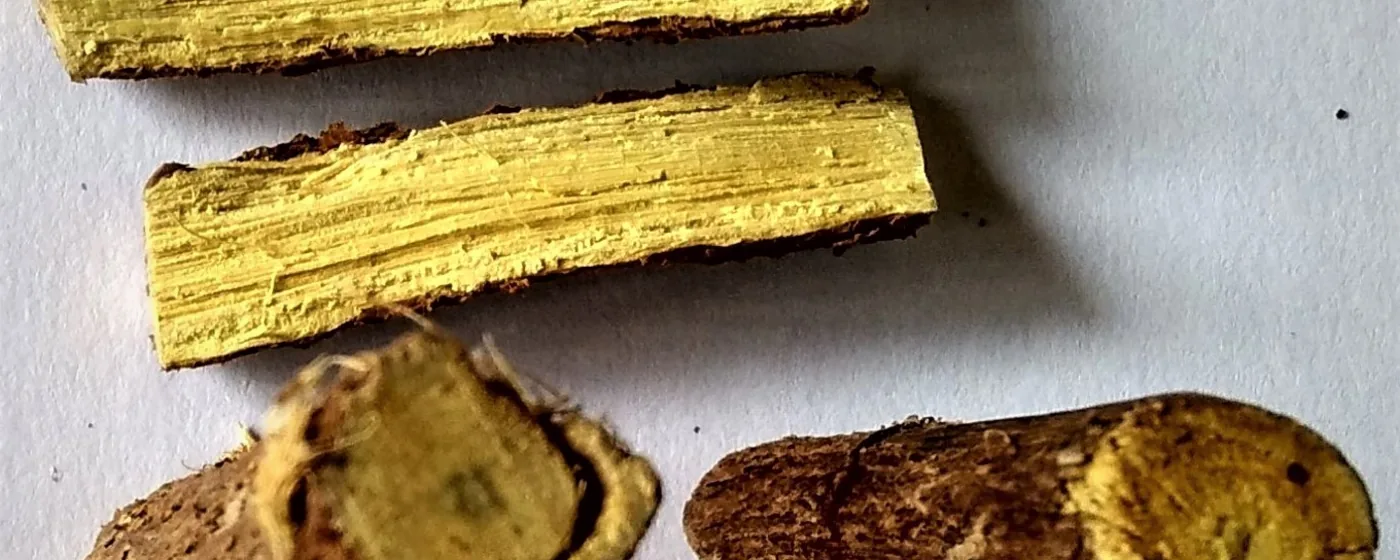
Photo: Sections of liquorice root.jpg by Salil Kumar Mukherjee — CC BY-SA 4.0. Cropped and re-encoded.
Frequently asked questions
How long does it take for blood pressure to come back down after stopping licorice tea?
Not overnight. The effect builds over one to two weeks and unwinds over weeks. In one published case, a woman who took 225 mg of glycyrrhizin daily for three years arrived with a blood pressure of 230/110 mmHg plus eye and kidney damage; she needed antihypertensive drugs for six months after stopping before her blood pressure, potassium, and urine protein normalized (PMID 29538199). If your blood pressure has been high, do not assume that quitting the tea fixes it. Get it rechecked.
Can licorice root tea be used to raise low blood pressure?
It gets suggested for chronically low blood pressure or lightheadedness on standing, on the logic that glycyrrhizin makes you retain sodium. No randomized trial has tested licorice tea as a treatment for low blood pressure, so this is mechanism, not evidence. And the same action that raises pressure also drops potassium, which can destabilize heart rhythm. Doctors who treat low blood pressure have prescription options that deliver a known dose with monitoring. Do not self-treat with licorice tea.
Does licorice root tea interfere with blood pressure medication?
Yes, in two ways. It pushes blood pressure up, working against ACE inhibitors, ARBs, calcium channel blockers, and beta blockers. It also directly opposes spironolactone and eplerenone at the exact receptor those drugs are meant to block. Thiazide and loop diuretics are a particular problem, because they lower potassium too. Low potassium in turn raises the danger of digoxin toxicity and of QT-prolonging medicines. If you take anything for blood pressure or heart rhythm, ask a pharmacist before drinking this tea, or simply skip it.
Is the licorice in a throat or detox tea blend enough to raise blood pressure?
Possibly, and the box will not tell you. Licorice root is a common background sweetener in throat, cough, 'detox', and traditional Chinese herbal blends, often several ingredients down the list. A 2025 case report describes hypokalemia in a patient whose licorice exposure came from a licorice-containing herbal tea (PMID 40672027). An occasional cup of a blend is unlikely to be what hurts you; several cups a day for weeks, stacked on top of black licorice candy, is a different question. Read the ingredient list.
Can licorice tea make blood tests look like an adrenal tumor?
It can send you down that diagnostic path. High blood pressure plus low potassium plus suppressed renin is the pattern of primary aldosteronism, or Conn's syndrome. The distinguishing feature is aldosterone: in licorice-induced pseudohyperaldosteronism it is low or suppressed, while a true aldosterone-producing tumor drives it high (PMID 39753286, PMID 34362360). Published cases were solved only when someone finally asked about tea and candy. Tell whoever orders the test what you drink.
Can licorice tea drop my potassium without any symptoms?
Yes, and this is the most under-appreciated part. In pooled human trial data, mean plasma potassium fell by 0.33 mmol/L across 18 studies (PMID 28660884). A 79-year-old man who drank licorice tea daily for 18 months was found to have a potassium of 1.8 mmol/L, a dangerous level, discovered incidentally with no symptoms attributable to it (PMID 32791684). Feeling fine is not evidence that your electrolytes are fine.
References
- A low dose of daily licorice intake affects renin, aldosterone, and home blood pressure in a randomized crossover trial.. The American journal of clinical nutrition, 2024. PubMed 38246526 · doi:10.1016/j.ajcnut.2024.01.011
- Liquorice-induced rise in blood pressure: a linear dose-response relationship.. Journal of human hypertension, 2001. PubMed 11494093 · doi:10.1038/sj.jhh.1001215
- The association between consistent licorice ingestion, hypertension and hypokalaemia: a systematic review and meta-analysis.. Journal of human hypertension, 2017. PubMed 28660884 · doi:10.1038/jhh.2017.45
- Effects of Licorice Functional Components Intakes on Blood Pressure: A Systematic Review with Meta-Analysis and NETWORK Toxicology.. Nutrients, 2024. PubMed 39519602 · doi:10.3390/nu16213768
- Liquorice-induced pseudohyperaldosteronism: a rare cause for severe hypertension.. BMJ case reports, 2025. PubMed 39753286 · doi:10.1136/bcr-2024-263140
- A life-threatening case of pseudo-aldosteronism secondary to excessive liquorice ingestion.. BMC endocrine disorders, 2021. PubMed 34362360 · doi:10.1186/s12902-021-00816-4
- [Pseudohyperaldosteronism with severe hypokalaemia and focal paresis triggered by licorice tea].. Ugeskrift for laeger, 2021. PubMed 33570024
- Severe asymptomatic hypokalemia associated with prolonged licorice ingestion: A case report.. Medicine (Baltimore), 2020. PubMed 32791684 · doi:10.1097/MD.0000000000021094
- Hypertensive emergency induced by licorice tea.. CMAJ : Canadian Medical Association journal, 2019. PubMed 31133605 · doi:10.1503/cmaj.180550
- [An Unusual Case of Rhabdomyolysis].. Praxis (Bern 1994), 2021. PubMed 34231379 · doi:10.1024/1661-8157/a003683
- Polymorphic ventricular tachycardia (Torsades de pointes) due to licorice root tea.. Turk Kardiyoloji Dernegi arsivi : Turk Kardiyoloji Derneginin yayin organidir, 2013. PubMed 23703562 · doi:10.5543/tkda.2013.72547
- Close Call From a Sweet Twist: A Case of Licorice-Induced Torsades De Pointes.. Cureus, 2023. PubMed 36843745 · doi:10.7759/cureus.34126
- A Case of Hypokalemia Caused by the Consumption of Licorice-Containing Herbal Tea.. Cureus, 2025. PubMed 40672027 · doi:10.7759/cureus.86154
- How Much Is Too Much? Exploring Pseudohyperaldosteronism in Glycyrrhizic Acid Toxicity From Chronic Licorice Root Consumption.. Cureus, 2021. PubMed 34422484 · doi:10.7759/cureus.16454
- Hypertensive crisis with 2 target organ impairment induced by glycyrrhizin: A case report.. Medicine (Baltimore), 2018. PubMed 29538199 · doi:10.1097/MD.0000000000010073
- Maternal Licorice Consumption During Pregnancy and Pubertal, Cognitive, and Psychiatric Outcomes in Children.. American journal of epidemiology, 2017. PubMed 28158597 · doi:10.1093/aje/kww172
- Efficacy of topical agents for prevention of postoperative sore throat after single lumen tracheal intubation: a Bayesian network meta-analysis.. Canadian journal of anaesthesia = Journal canadien d'anesthesie, 2020. PubMed 32820466 · doi:10.1007/s12630-020-01792-4
- Safety and efficacy of a traditional herbal medicine (Throat Coat) in symptomatic temporary relief of pain in patients with acute pharyngitis: a multicenter, prospective, randomized, double-blinded, placebo-controlled study.. Journal of Alternative and Complementary Medicine, 2003. PubMed 12804082 · doi:10.1089/10755530360623400
Last reviewed and updated . HelperTea is written by an enthusiast, not a clinician, and is not medically reviewed. How we research and rate evidence. Found an error? Tell us — safety corrections get priority.