Earl Grey is not an herb. It is ordinary black tea from the Camellia sinensis plant, usually an Indian or Chinese blend, scented with oil pressed from the rind of the bergamot orange (Citrus bergamia), a sour citrus grown mostly in Calabria, in southern Italy. That is the whole recipe. The tea is named for Charles Grey, a British prime minister of the 1830s, though the stories about how the blend reached him are folklore. Because the base is real tea, Earl Grey contains caffeine.
In the cup it is a brisk, faintly malty black tea with a high, perfumed citrus note on top. Bergamot smells like neither lemon nor orange exactly; it lands between the two, with an edge of orange blossom. Brewed well, the citrus lifts the tannins. Brewed too long, the tannins turn hard and drying, and the bergamot tips over into something soapy. It is the traditional partner to scones and citrus desserts, and it takes milk better than most people expect.
What is it actually good for? Mostly pleasure, and a moderate lift of alertness. Research on Earl Grey specifically barely exists. Almost everything you will read is extrapolated from studies of plain black tea, or from trials of concentrated bergamot fruit extracts that have little in common with the trace of rind oil in a tea bag. Black tea's caffeine and L-theanine have shown small short-term effects on attention in a handful of trials. Past that the evidence thins quickly, and a few published case reports are a reminder that tea and bergamot oil are not entirely inert in extreme amounts.
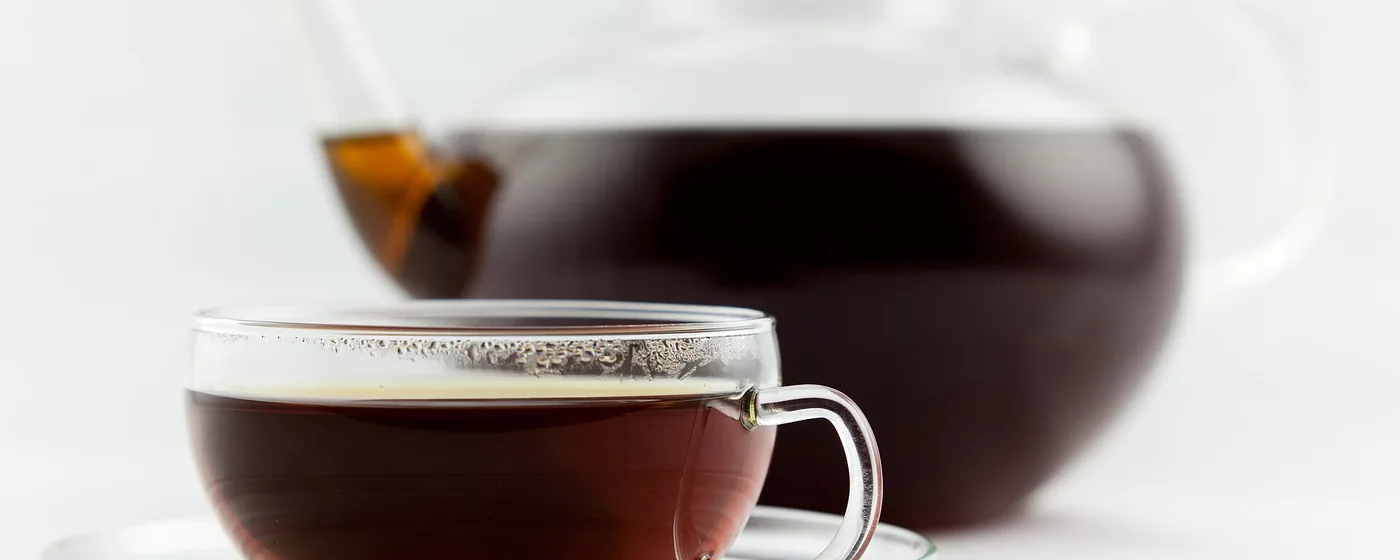
Photo: Frisch aufgebrühter EarlGrey Tee.jpg by soultea.de/André Helbig — CC BY-SA 3.0. Cropped and re-encoded.
What the evidence says
The caffeine and L-theanine in black tea may modestly improve attention in the short term. Effects on self-reported alertness are less consistent.
One paper reported two double-blind crossover studies in which adults drank black tea or a placebo tea matched for color and taste; black tea improved task-switching accuracy and self-rated alertness in both. Two further double-blind crossover trials tested the isolated compounds. One compared L-theanine plus caffeine against placebo and found better task switching, but subjective alertness and intersensory attention did not improve significantly. The other gave caffeine and L-theanine alone and in combination, and its authors concluded only that the combination has a different pharmacological profile from caffeine alone — not that it outperforms it. All were small, single-dose studies in healthy adults, and the black tea study was carried out by a tea manufacturer's research group.
People who drink more tea tend to have slightly lower rates of cardiovascular death in observational studies. This is an association, not proof, and the black-tea-specific signal is weaker still.
A review pooling 39 prospective cohort publications linked each extra daily cup of tea to about 4% lower cardiovascular mortality, and rated its own strength of evidence low to moderate. A dose-response meta-analysis of 21 studies covering about 1.3 million people found roughly 3% lower cardiovascular mortality per extra daily cup, and graded the whole body of evidence low; in its subgroup analysis, the 8% reduction seen with black tea was not statistically significant. A third meta-analysis, of 18 prospective cohorts, likewise found no significant association between black tea and cardiovascular mortality (relative risk 0.88, 95% confidence interval 0.77 to 1.01). Tea drinkers also differ from non-drinkers in diet, income, and smoking, and none of these studies can separate the tea from the person drinking it.
Black tea may lower blood pressure by a very small amount. Trials have not shown a reliable effect on cholesterol or triglycerides.
A dose-response meta-analysis of 13 randomized trials found black tea reduced systolic pressure by about 1.0 mmHg and diastolic by about 0.6 mmHg — statistically significant, but too small to matter clinically. A separate review of 14 randomized trials that assigned 798 people to green tea, black tea, or a control found no significant effect on blood pressure, total cholesterol, LDL, HDL, or triglycerides, and judged the trials underpowered and too short to settle the question.
A concentrated bergamot fruit extract lowered cholesterol in one small trial, but that tells you nothing about drinking Earl Grey.
A study of a branded whole-fruit Citrus bergamia ingredient paired cell-culture work with one double-blind, placebo-controlled trial: 50 healthy adults with moderately raised cholesterol took 400 mg a day of the extract or a placebo for 12 weeks, and total cholesterol, LDL, and triglycerides fell in the extract group. That is a single small trial of a concentrated, polyphenol-rich extract of the whole fruit. Earl Grey carries only a trace of rind oil, added for aroma — a different part of the fruit, at a dose so much smaller that the comparison does not hold.
Sources: [9]
Bergamot aroma has been tested for anxiety with mixed results, and those trials used inhaled essential oil, not tea.
One randomized trial assigned 109 patients awaiting ambulatory surgery to inhaled bergamot essential oil or to water vapor, and reported a greater drop in pre-operative anxiety with bergamot. A double-blind trial in 37 children and adolescents receiving stem cell infusions found the opposite: those given inhaled bergamot oil reported more anxiety and more nausea an hour afterward. Both are small, the outcomes are subjective, and a distinctive scent is nearly impossible to blind.
Earl Grey is traditionally drunk as an afternoon pick-me-up and a gentler alternative to coffee.
For two centuries Earl Grey has been the standard mid-afternoon cup: enough caffeine to sharpen the end of a working day, not enough to wreck the evening. No clinical literature examines it as a coffee substitute, and nothing suggests the bergamot contributes beyond flavor and aroma.
No published human clinical trials found for this use.
How to brew Earl Grey
Pour water at a full boil straight over the leaves in a warmed pot or mug. Cover it while it steeps, so the bergamot aroma does not leave with the steam. Pull the leaves or bag at 3 to 4 minutes.
- Steep time matters most. Lab work on tea infusions shows leaf grade, bag material, water volume, steep time, and even agitation all measurably change the caffeine and polyphenol reaching your cup.
- Soapy instead of bright? You over-steeped. Try three minutes flat.
- Milk blunts the tannic edge; lemon amplifies the bergamot; sugar mostly hides it.
Safety, side effects & who should avoid it
For most healthy adults, Earl Grey in normal amounts is about as safe as any black tea, and caffeine is the main thing to watch. The bergamot oil is a flavoring in tiny quantities, but it is not entirely inert. The rarer problems reported with tea — fluoride excess, oxalate-related kidney injury, one case of bergamot intoxication — come from drinking extreme amounts over long periods, not from a few cups a day.
Who should avoid it
- Anyone told by a clinician to limit caffeine — for certain heart rhythm disorders, poorly controlled high blood pressure, or severe insomnia.
- People whose anxiety or panic symptoms caffeine reliably worsens.
- People with acid reflux, GERD, or peptic ulcers, and people with migraine or chronic headaches. MedlinePlus lists all of these among reasons to limit or avoid caffeine.
- Children and adolescents, who are more sensitive to caffeine and need medical guidance about it.
- Anyone taking oral iron for iron-deficiency anemia, around the time they take the tablets. One published case describes a young woman with iron-deficiency anemia who did not respond to oral iron until she stopped her long-standing habit of drinking large quantities of tea.
- Anyone asked to abstain from caffeine before a cardiac stress test using adenosine or dipyridamole, which caffeine blunts — usually 12 to 24 hours beforehand.
- People who have had calcium oxalate kidney stones, or who have reduced kidney function, should be cautious about very large daily volumes of black tea, which is high in oxalate. A published case report describes a middle-aged man who developed oxalate-related kidney failure after drinking very large amounts of iced tea.
- Anyone drinking Earl Grey in extreme quantities. A Lancet case report titled 'Earl Grey tea intoxication' describes an adult man with muscle cramps, muscle twitching, and blurred vision attributed to heavy Earl Grey consumption; the report implicates bergamot's furanocoumarins. It is a single, unreplicated case.
Possible side effects
- Caffeine effects at higher intakes: restlessness, shakiness, insomnia, headache, dizziness, fast heart rate, dehydration, anxiety — plus dependence and withdrawal headaches if a heavy habit stops abruptly.
- Stomach upset or reflux, especially on an empty stomach; black tea is tannic and mildly acidic.
- Reduced absorption of non-heme (plant-source) iron when tea is drunk with meals or iron supplements.
- Tooth staining with heavy long-term use, as with coffee or red wine.
- Fluoride accumulation with very heavy, long-term drinking. Tea plants concentrate fluoride from the soil, and NCCIH notes that tea contains it. Ordinary intakes are not a concern, but excessive black tea drinking over years has caused skeletal fluorosis, a bone disease marked by pain and fractures. In a published review of non-endemic skeletal fluorosis cases where the fluoride source was identified, 11 of 19 involved high consumption of black tea and/or fluoride toothpaste. A separate case report describes a 53-year-old woman with a metatarsal fracture and a lumbar spine bone-density T-score of +11, traced to excessive tea and toothpaste use.
- Phototoxicity, with a caveat: bergamot oil contains bergapten (5-methoxypsoralen), and a dermatology report describes two patients who developed blistering burns after bergamot aromatherapy oil reached their skin — in one case only as evaporated oil in a sauna — followed by ultraviolet exposure. That risk belongs to the oil on skin, not to drinking the tea.
Medication interactions
- Caffeine is cleared mainly by the liver enzyme CYP1A2. Inhibitors of CYP1A2, including fluvoxamine and ciprofloxacin, slow that clearance, so a normal number of cups can feel like far more.
- Narrow-margin CYP1A2 substrates such as theophylline and clozapine are sensitive to big swings in tea or coffee intake, and to starting or stopping smoking.
- Stimulant medications, pseudoephedrine, and other caffeine sources stack with tea's caffeine and can cause a racing heart, tremor, or raised blood pressure.
- Oral iron supplements and iron-rich meals: tea tannins bind non-heme iron. Separate them by one to two hours.
- A theoretical bergamot caution: in human liver microsomes and intestinal fractions, bergamottin and related furanocoumarins — the class behind the grapefruit juice effect — inhibited CYP3A4, which metabolizes statins, some calcium channel blockers, and immunosuppressants. That is test-tube data, not people drinking tea. If you take a CYP3A4-sensitive drug, ask your pharmacist.
Pregnancy & breastfeeding
Caffeine crosses the placenta and passes into breast milk. MedlinePlus lists pregnancy and breastfeeding among the reasons to limit or avoid caffeine, though it does not name a milligram limit; about 200 mg a day from all sources is the ceiling commonly cited in the US. Bergamot oil at flavoring levels has not been studied in pregnancy. Talk to your doctor or midwife.
How much is too much
No established limit exists for Earl Grey specifically. MedlinePlus states that for most people it is not harmful to consume up to 400 mg of caffeine a day, counting all sources; an 8 oz cup of black tea supplies roughly 30 to 70 mg depending on leaf and steep time, so four to six cups sits inside that. Cohort studies typically describe one to four cups daily.
Taste & pairing
Tasting notes: Citrus, Floral, Bold, Bergamot.
Pairs well with: Scones, Citrus desserts, Afternoon tea foods.
Best time to drink: Morning or afternoon.
Frequently asked questions
How long should I steep Earl Grey tea?
Three to four minutes in fully boiling water (212°F / 100°C), then remove the leaves or bag. Black tea keeps releasing tannins after the flavor compounds have finished extracting, so a longer steep mostly adds bitterness. If it tastes soapy rather than brightly citrusy, over-steeping is usually why. Cover the cup as it brews — the bergamot aroma escapes with the steam.
How much caffeine is in a cup of Earl Grey?
Roughly 30 to 70 mg per 8 oz cup, about a third to half of a typical cup of brewed coffee. There is no single correct number: analytical work on tea infusions found leaf grade, bag material, water volume, steep time, and even agitation each measurably changed the caffeine reaching the cup.
Can I drink Earl Grey before bed?
Probably not, if you are caffeine-sensitive. Caffeine has a half-life of several hours in most adults, so even a late-afternoon cup can still be circulating at bedtime, and trouble sleeping is among the most common effects of too much of it. Decaffeinated Earl Grey keeps most of the bergamot character.
Does Earl Grey lower cholesterol the way bergamot supplements do?
There is no good reason to think so, and you should be skeptical of any page implying it does. The cholesterol trial used a concentrated bergamot fruit extract — one 12-week double-blind study gave 50 healthy adults with moderately raised cholesterol 400 mg a day of a branded whole-fruit extract, and total cholesterol, LDL, and triglycerides fell. Earl Grey contains a trace of rind oil added for aroma: a different part of the fruit, at a dose so much smaller that the comparison does not hold. Meanwhile, a review of 14 randomized trials of green and black tea found no significant effect on cholesterol or triglycerides at all.
How many cups of Earl Grey a day is too many?
For a healthy adult, four to six cups generally keeps you under the 400 mg of daily caffeine that MedlinePlus describes as not harmful for most people — though sensitivity varies, and coffee counts toward the same total. Truly excessive amounts are a different matter. A Lancet case report describes an adult man with muscle cramps, muscle twitching, and blurred vision attributed to heavy Earl Grey drinking, and very heavy long-term black tea consumption has been linked to skeletal fluorosis and, in one case report, to oxalate-related kidney failure. These are rare reports at extreme intakes, not risks of a normal daily cup.
Is Earl Grey safe during pregnancy?
Ordinary amounts are generally considered acceptable, but caffeine is the part to manage, and this is a question for your doctor or midwife rather than a website. MedlinePlus lists pregnancy among the reasons to limit or avoid caffeine, since it crosses the placenta; about 200 mg a day from all sources is the figure commonly cited in the US. Bergamot oil at flavoring levels has not been studied in pregnancy.
References
- Black tea improves attention and self-reported alertness.. Appetite, 2010. PubMed 21172396 · doi:10.1016/j.appet.2010.12.011
- L-theanine and caffeine improve task switching but not intersensory attention or subjective alertness.. Appetite, 2010. PubMed 20079786 · doi:10.1016/j.appet.2010.01.003
- The effects of L-theanine, caffeine and their combination on cognition and mood.. Biological psychology, 2007. PubMed 18006208 · doi:10.1016/j.biopsycho.2007.09.008
- Dose-Response Relation between Tea Consumption and Risk of Cardiovascular Disease and All-Cause Mortality: A Systematic Review and Meta-Analysis of Population-Based Studies.. Advances in nutrition (Bethesda, Md.), 2020. PubMed 32073596 · doi:10.1093/advances/nmaa010
- [A dose-response meta-analysis on the relationship between daily tea intake and cardiovascular mortality based on the GRADE system].. Zhonghua xin xue guan bing za zhi, 2021. PubMed 34034384 · doi:10.3760/cma.j.cn112148-20200726-00592
- Tea consumption and mortality of all cancers, CVD and all causes: a meta-analysis of eighteen prospective cohort studies.. The British journal of nutrition, 2015. PubMed 26202661 · doi:10.1017/S0007114515002329
- The effect of black tea supplementation on blood pressure: a systematic review and dose-response meta-analysis of randomized controlled trials.. Food & function, 2020. PubMed 33237083 · doi:10.1039/d0fo02122a
- Short-Term Tea Consumption Is Not Associated with a Reduction in Blood Lipids or Pressure: A Systematic Review and Meta-Analysis of Randomized Controlled Trials.. The Journal of nutrition, 2020. PubMed 33188386 · doi:10.1093/jn/nxaa295
- Effect of Citrus bergamia extract on lipid profile: A combined in vitro and human study.. Phytotherapy research : PTR, 2023. PubMed 37312672 · doi:10.1002/ptr.7897
- The anxiolytic effect of aromatherapy on patients awaiting ambulatory surgery: a randomized controlled trial.. Evidence-based complementary and alternative medicine : eCAM, 2013. PubMed 24454517 · doi:10.1155/2013/927419
- Inhalation aromatherapy in children and adolescents undergoing stem cell infusion: results of a placebo-controlled double-blind trial.. Psycho-oncology, 2010. PubMed 22383266 · doi:10.1002/pon.1898
- Earl Grey tea intoxication.. Lancet (London, England), 2002. PubMed 11988248 · doi:10.1016/S0140-6736(02)08436-2
- Accidental bullous phototoxic reactions to bergamot aromatherapy oil.. Journal of the American Academy of Dermatology, 2001. PubMed 11511848 · doi:10.1067/mjd.2001.116226
- Design, synthesis and evaluation of furanocoumarin monomers as inhibitors of CYP3A4.. Organic & biomolecular chemistry, 2006. PubMed 16604230 · doi:10.1039/b601096b
- Assessment of CYP1A2 activity in clinical practice: why, how, and when?. Basic & clinical pharmacology & toxicology, 2005. PubMed 16128905 · doi:10.1111/j.1742-7843.2005.pto_973160.x
- Excessive tea consumption can inhibit the efficacy of oral iron treatment in iron-deficiency anemia.. Haematologica, 1995. PubMed 8647516
- Factors affecting the caffeine and polyphenol contents of black and green tea infusions.. Journal of agricultural and food chemistry, 2001. PubMed 11714326 · doi:10.1021/jf010759+
- Non-endemic skeletal fluorosis: Causes and associated secondary hyperparathyroidism (case report and literature review).. Bone, 2021. PubMed 33418099 · doi:10.1016/j.bone.2021.115839
- Skeletal fluorosis due to excessive tea and toothpaste consumption.. Osteoporosis international : a journal established as result of cooperation between the European Foundation for Osteoporosis and the National Osteoporosis Foundation of the USA, 2010. PubMed 20936399 · doi:10.1007/s00198-010-1428-6
- A case of iced-tea nephropathy.. The New England journal of medicine, 2015. PubMed 25830441 · doi:10.1056/NEJMc1414481
Last reviewed and updated . HelperTea is written by an enthusiast, not a clinician, and is not medically reviewed. How we research and rate evidence. Found an error? Tell us — safety corrections get priority.