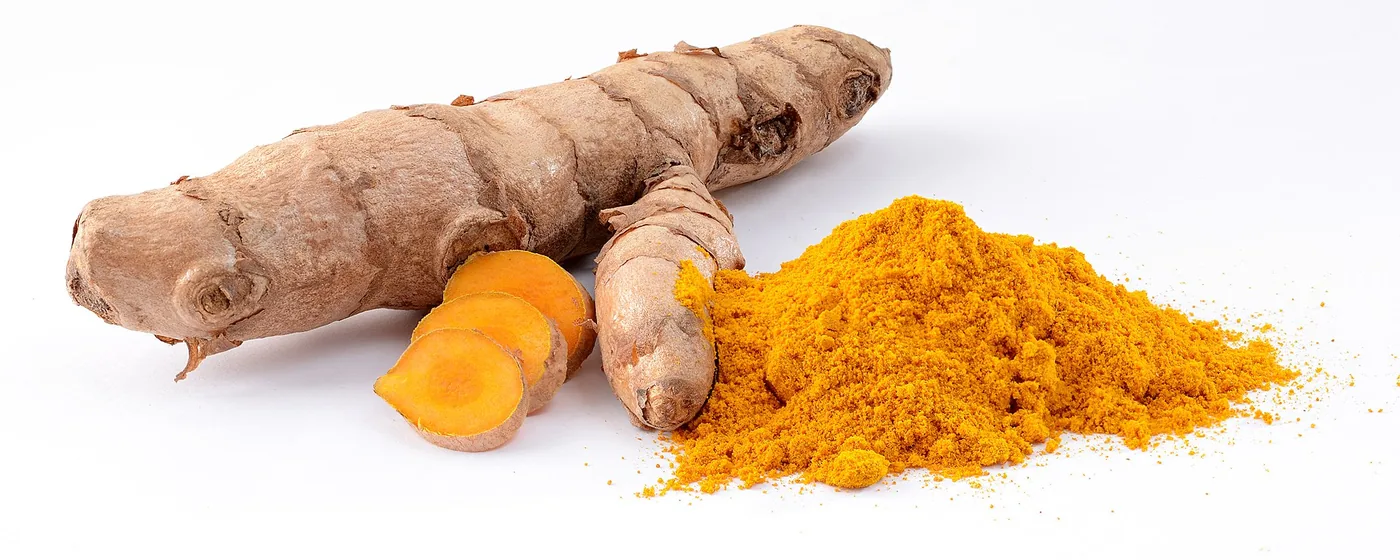
Turmeric tea is an infusion of the rhizome of Curcuma longa, a knobby ginger relative grown across India and Southeast Asia. Cut it open and it is a startling orange. Brewed, it makes a cloudy golden cup: earthy, resinous, faintly bitter, with a dry peppery warmth at the back of the throat. It is not a delicate tea, and most people soften it with ginger, lemon, honey, or milk, which is how it becomes the drink many know as golden milk.
Turmeric's headline compounds are the curcuminoids, and curcumin is the most studied. One fact should frame everything else you read: curcumin barely dissolves in water, and the little you swallow is broken down quickly in the gut wall and liver. Dried turmeric root is only a few percent curcuminoids to begin with. So a cup of tea delivers a small, unmeasured amount of the compound the research is actually about. Nearly every trial cited for turmeric used a concentrated extract, standardized for curcuminoids and often paired with piperine or a fat carrier to force absorption.
That gap applies to every claim below. The best evidence for turmeric sits in knee osteoarthritis, where extracts modestly reduced pain in short trials of mixed quality. Nobody has tested the tea. The drink is also not risk-free: curcumin prompts the gallbladder to contract, NIH LiverTox reports that turmeric appears to have become the most common cause of clinically apparent herbal liver injury in the United States, turmeric is unusually high in the water-soluble oxalate that matters if you form kidney stones, and anyone taking a blood thinner should ask a doctor first. Turmeric tea is a warming, interesting drink with a long traditional pedigree. Treat it as a drink, not as a dose.
Photo: Curcuma longa roots.jpg by Simon A. Eugster — CC BY-SA 3.0. Cropped and re-encoded.
What the evidence says
Turmeric extracts standardized for curcuminoids may modestly reduce knee osteoarthritis pain and improve physical function.
A 2021 meta-analysis of 16 randomized trials in 1,810 adults found turmeric extracts beat placebo for knee pain and physical function, performed about as well as NSAIDs, and caused roughly 12% fewer adverse events than NSAIDs. Its authors rated the overall risk of bias moderate, found heavy statistical heterogeneity, and flagged genuine uncertainty about the true effect; the trials ran 16 weeks or less. A separate review of seven curcuminoid trials, all of them conducted in Asia, likewise found a benefit over placebo but less pain relief than ibuprofen. A broader review of dietary supplements placed curcumin among the products with large short-term effects on osteoarthritis pain while grading the overall quality of the evidence very low. Every one of these trials used extracts or capsules. None used tea.
Curcumin is poorly absorbed, so a cup of tea likely delivers far less than the doses used in trials.
Curcumin is fat-soluble, poorly water-soluble, and cleared quickly, keeping blood levels low after ordinary oral doses. In a small human study, volunteers given 2 g of plain curcumin had serum levels that were undetectable or very low; adding 20 mg of piperine raised them sharply, though from a near-zero baseline. This is why supplement makers reach for piperine, liposomes, and phospholipid complexes. Steeping changes none of it, and nobody has measured blood curcumin after a cup of tea.
Curcumin supplements may lower C-reactive protein, a blood marker of inflammation, in people with knee osteoarthritis.
A 2025 meta-analysis of 21 randomized trials in 1,705 knee osteoarthritis patients found significantly lower CRP and TNF-alpha with curcumin than placebo. Only the CRP result held up consistently under sensitivity analysis, and ESR, IL-6, IL-1 beta and PGE-2 showed no significant difference. A lower CRP is a laboratory number, not a symptom you feel, and these trials used curcumin supplements rather than tea.
Sources: [6]
In one trial, curcumin capsules performed about as well as omeprazole for functional dyspepsia, but the trial had no placebo group.
A Thai randomized, double-blind trial assigned 206 adults with functional dyspepsia to curcumin, omeprazole, or both; 151 completed. All three groups improved at 28 and 56 days, with no significant differences detected between them and no serious adverse events. Two cautions. Because there was no placebo arm, the trial cannot separate a treatment effect from the natural course of the condition. And a failure to detect a difference between three improving groups is not the same as proving they are equivalent, which this trial was not designed to do. The curcumin dose was 2 g a day, given as two 250 mg capsules four times daily.
Sources: [7]
Curcumin makes the gallbladder contract, which is more useful as a caution than as a benefit.
In a randomized crossover study of 12 healthy volunteers, single oral doses of 20, 40 and 80 mg of curcumin shrank gallbladder volume by roughly 34%, 51% and 72% within two hours. Turmeric's traditional reputation as a digestive bitter fits this effect. But if you have gallstones or a blocked bile duct, prompting the gallbladder to squeeze is exactly what you want to avoid. The study was tiny and enrolled only healthy people.
Sources: [8]
Turmeric products can cause clinically apparent liver injury, occasionally severe.
NIH LiverTox places turmeric in its top likelihood category, calling it a well-documented cause of clinically apparent liver injury, and states that turmeric appears to have become the most common cause of herbal liver injury in the United States. In ten adjudicated cases from the US Drug-Induced Liver Injury Network, the injury was hepatocellular in nine, five people were hospitalized, and one died of acute liver failure; latency was typically one to four months. Seven of the ten carried the HLA-B*35:01 allele, far above the rate in population controls, which suggests susceptibility is partly genetic. Most implicated products were concentrated, absorption-enhanced supplements, several combined with black pepper, though LiverTox notes cases with plain ground turmeric and even with turmeric herbal teas. This is a registry and case-series signal, not a rate. Nobody knows how often it happens per person who drinks the tea.
Sources: [9]
Turmeric is high in water-soluble oxalate and may raise kidney-stone risk in people who already form them.
In an 8-week crossover trial, 11 healthy adults took supplemental doses of turmeric or cinnamon. Turmeric significantly raised urinary oxalate excretion; cinnamon did not. The researchers traced the difference to solubility: about 91% of turmeric's oxalate is water-soluble, against 6% of cinnamon's. Water-soluble oxalate is precisely the fraction that dissolves into a brew, so this is more relevant to tea than most turmeric research is. The trial was tiny, ran in healthy people, and measured urine chemistry rather than actual stones. Treat it as a reason for caution if you have formed calcium-oxalate stones, not as proof that turmeric tea causes them.
Sources: [10]
Turmeric may interact with blood thinners and antiplatelet drugs; the human evidence is thin and does not all agree.
Curcumin inhibits several cytochrome P450 enzymes and P-glycoprotein in the laboratory, the mechanism behind most predicted turmeric-drug interactions. A 2017 review found that despite plentiful in-vitro and animal data, only one clinical trial had shown a significant change in a conventional drug's handling; it counseled caution. A separate small study of one enhanced-absorption curcumin product found no change in INR on warfarin or dabigatran, and none in bleeding time on aspirin, ticlopidine or clopidogrel, but it ran 10 days on a single branded formulation.
Traditionally used across South and Southeast Asia for colds, sore throats, joint stiffness, and postpartum recovery.
Turmeric has centuries of documented use in Ayurveda, Siddha, Unani, and Indonesian jamu, and warm turmeric milk (haldi doodh) remains a household remedy for coughs and sore throats across much of South Asia. That is a long track record, not evidence of effect. No good human trials have tested turmeric tea or golden milk for these uses, so we do not know whether they do anything beyond the comfort of a warm, spiced drink.
No published human clinical trials found for this use.
How to brew Turmeric Tea
Turmeric is a dense root, not a leaf, so it needs a hard extraction. Pour fully boiling water over the grated root, cover, and leave it 10 to 15 minutes; better still, simmer it gently in a covered pot for the same time. Keep the lid on, since the aromatic oils leave with the steam.
- Curcumin is fat-soluble and barely dissolves in water, which is the reasoning behind adding whole milk or coconut milk, as in golden milk. It is a sensible idea, but nobody has measured how much difference it actually makes to a cup.
- A pinch of black pepper is the traditional companion and has real pharmacology behind it. Keep it to a pinch.
- Buy turmeric from a supplier that tests for heavy metals. Lead chromate pigment has been added to turmeric to brighten its color, documented in detail across Bangladesh's supply chain.
- Turmeric stains teeth, mugs, grout, and countertops. Rinse the cup promptly and swish water in your mouth afterward.
- Fresh grated root brews brighter and more citrusy; ground turmeric brews heavier and settles, so stir as you go.
- It is caffeine-free, so evening is fine, but it sits better with food than on an empty stomach.
Safety, side effects & who should avoid it
For most healthy adults, a cup or two of turmeric tea is low-risk. But turmeric is not inert: it prompts the gallbladder to contract, NIH LiverTox reports it appears to have become the most common cause of clinically apparent herbal liver injury in the United States, it is high in the water-soluble oxalate that feeds calcium-oxalate kidney stones, and it warrants a word with your prescriber if you take blood thinners.
Who should avoid it
- People with gallstones, gallbladder disease, or a blocked bile duct. In small human studies curcumin contracts the gallbladder, which could provoke pain or a biliary attack.
- Anyone with liver disease or unexplained abnormal liver tests. NIH LiverTox rates turmeric a well-documented cause of clinically apparent liver injury, usually hepatocellular and typically appearing one to four months in. Most reported cases involve high-bioavailability supplements, but LiverTox notes cases with plain ground turmeric and even with turmeric herbal teas. In a US Drug-Induced Liver Injury Network series of ten adjudicated cases, five people were hospitalized and one died of acute liver failure.
- People who form calcium-oxalate kidney stones. Turmeric is high in oxalate, and about 91% of it is water-soluble, so it dissolves readily into a brew. In a small crossover trial, supplemental turmeric significantly raised urinary oxalate excretion in healthy adults.
- People taking warfarin, apixaban, rivaroxaban, dabigatran, clopidogrel, or daily aspirin, unless a prescriber has signed off.
- Anyone heading into surgery. Many surgical teams ask patients to stop turmeric supplements about two weeks beforehand; ask yours about strong daily tea.
- People treated for iron-deficiency anemia, who should tell their doctor: turmeric can bind iron and may reduce its absorption, mostly shown in animals.
Possible side effects
- Stomach upset, nausea, acid reflux, diarrhea, or constipation, especially with strong brews or on an empty stomach.
- Bright yellow-orange staining of teeth, dental work, mugs, and countertops.
- Skin rash or itching, reported more often with turmeric applied to skin than swallowed.
- Rare but serious: signs of liver injury, including unusual fatigue, loss of appetite, nausea, dark urine, pale stools, or yellowing of the eyes or skin. Injury often shows up one to four months in, so weeks of trouble-free use is not reassurance. Stop turmeric and see a doctor promptly.
Medication interactions
- Anticoagulants and antiplatelet drugs (warfarin, apixaban, rivaroxaban, dabigatran, clopidogrel, aspirin): laboratory data suggest curcumin could raise bleeding risk, and one small study found no change in INR or bleeding time. Reassuring, not conclusive. Do not add concentrated turmeric products without asking.
- Drugs cleared by CYP3A4 or moved by P-glycoprotein, including tacrolimus, some statins, and several oral cancer therapies: curcumin inhibits both pathways in the lab and could raise drug levels. Clinical confirmation is scarce. If you are on cancer treatment, ask your oncology team first.
- Other drugs that can injure the liver, and alcohol: no study has tested the combination, but stacking a documented cause of hepatocellular injury on top of another is worth raising with your prescriber.
- Iron supplements: turmeric may reduce iron absorption, so separate them by a couple of hours.
- Diabetes medicines: a small study found no change in glucose or HbA1c in people taking metformin with a curcumin product, but watch your readings if you drink turmeric tea daily.
Pregnancy & breastfeeding
Turmeric as a cooking spice appears fine in ordinary food amounts. NCCIH states that turmeric supplements may be unsafe in pregnancy, and that little is known about turmeric in amounts greater than those found in food while breastfeeding. Strong daily tea sits between food and supplement, and nobody has studied it in pregnancy, so talk to your doctor or midwife first.
How much is too much
No established limit, because turmeric tea has never been formally dose-tested. Trials used standardized extracts at doses well above what a cup supplies, for up to 16 weeks. Habitual drinkers typically have one to three cups a day. Given the liver-injury signal above, it is reasonable not to drink it heavily for months without mentioning it to your doctor. Sourcing matters too: turmeric has been adulterated with lead chromate pigment to brighten its color, a practice documented across Bangladesh's turmeric supply chain, where 47% of market samples carried detectable lead before enforcement drove that to zero by 2021. Buy from suppliers who test for heavy metals.
Taste & pairing
Tasting notes: Earthy, Slightly spicy, Warming.
Pairs well with: Honey, Lemon, Ginger.
Best time to drink: Any time of day.
Frequently asked questions
How long should I steep turmeric tea?
Ten to fifteen minutes in fully boiling water, covered. Turmeric is a dense root, so the three-to-five minute steep you would give chamomile pulls out very little. Gently simmering it in a covered pot for the same time extracts more. Keep the lid on either way, since the aromatic oils leave with the steam.
Do I really need to add black pepper?
No, and a pinch is plenty. Piperine blocks the enzymes that dispose of curcumin, and in one small human study 20 mg of piperine sharply raised serum curcumin. But that same absorption-boosting trick is a feature of many of the high-bioavailability products implicated in turmeric-related liver injury, and several of the products in the US liver-injury case series contained black pepper. A pinch in a mug is a different thing from a capsule.
Is turmeric tea as good as a curcumin supplement?
No, and that cuts both ways. A cup delivers a fraction of the curcuminoids in a standardized capsule, so do not expect the effects seen in osteoarthritis trials. You also likely take on less of the liver risk that has clustered around concentrated, absorption-enhanced products, though cases have been reported with ground turmeric and turmeric teas as well. Wanting the trial doses means accepting the trial risks, which is a conversation for your doctor.
How many cups of turmeric tea can I drink a day?
There is no established limit, because the tea has never been dose-tested. One to three cups a day is what habitual drinkers tend to have. If you have been drinking it daily for months, mention it at your next appointment: NIH LiverTox reports that turmeric appears to have become the most common cause of clinically apparent herbal liver injury in the United States.
Can I drink turmeric tea if I take blood thinners or have gallstones?
Ask your doctor first in both cases. Curcumin contracts the gallbladder, halving its volume at a 40 mg dose in one small study, which is the last thing you want with stones or a blocked duct. For blood thinners, laboratory data suggest a bleeding risk that one small clinical study did not confirm. Cooking amounts are likely fine; daily strong tea is worth clearing first.
Can turmeric tea cause kidney stones?
Nobody has tested that directly. What is known is that turmeric is high in oxalate, that about 91% of that oxalate is water-soluble, and that in a small crossover trial supplemental turmeric significantly raised urinary oxalate in healthy adults. Since soluble oxalate is the fraction that ends up in your brew, this is worth taking seriously if you have a history of calcium-oxalate stones. Ask your doctor. If you have never formed a stone, there is no reason to think an occasional cup is a problem.
References
- Efficacy and Safety of Turmeric Extracts for the Treatment of Knee Osteoarthritis: a Systematic Review and Meta-analysis of Randomised Controlled Trials.. Current rheumatology reports, 2021. PubMed 33511486 · doi:10.1007/s11926-020-00975-8
- Effectiveness of curcuminoids in the treatment of knee osteoarthritis: a systematic review and meta-analysis of randomized clinical trials.. International journal of rheumatic diseases, 2017. PubMed 28470851 · doi:10.1111/1756-185X.13069
- Dietary supplements for treating osteoarthritis: a systematic review and meta-analysis.. British journal of sports medicine, 2017. PubMed 29018060 · doi:10.1136/bjsports-2016-097333
- Bioavailability of curcumin: problems and promises.. Molecular pharmaceutics, 2007. PubMed 17999464 · doi:10.1021/mp700113r
- Influence of piperine on the pharmacokinetics of curcumin in animals and human volunteers.. Planta medica, 1998. PubMed 9619120 · doi:10.1055/s-2006-957450
- Effects of curcumin on serum inflammatory biomarkers in patients with knee osteoarthritis: a systematic review and meta-analysis of randomized controlled trials.. BMC complementary medicine and therapies, 2025. PubMed 40615851 · doi:10.1186/s12906-025-04951-6
- Curcumin and proton pump inhibitors for functional dyspepsia: a randomised, double blind controlled trial.. BMJ evidence-based medicine, 2023. PubMed 37696679 · doi:10.1136/bmjebm-2022-112231
- Effect of different curcumin dosages on human gall bladder.. Asia Pacific journal of clinical nutrition, 2002. PubMed 12495265 · doi:10.1046/j.1440-6047.2002.00296.x
- Liver Injury Associated with Turmeric-A Growing Problem: Ten Cases from the Drug-Induced Liver Injury Network [DILIN].. The American journal of medicine, 2022. PubMed 36252717 · doi:10.1016/j.amjmed.2022.09.026
- Effect of cinnamon and turmeric on urinary oxalate excretion, plasma lipids, and plasma glucose in healthy subjects.. The American journal of clinical nutrition, 2008. PubMed 18469248 · doi:10.1093/ajcn/87.5.1262
- Pharmacokinetic interactions of curcuminoids with conventional drugs: A review.. Journal of ethnopharmacology, 2017. PubMed 28734960 · doi:10.1016/j.jep.2017.07.022
- Interaction study between antiplatelet agents, anticoagulants, thyroid replacement therapy and a bioavailable formulation of curcumin (Meriva®).. European review for medical and pharmacological sciences, 2018. PubMed 30070343 · doi:10.26355/eurrev_201808_15647
- Turmeric means "yellow" in Bengali: Lead chromate pigments added to turmeric threaten public health across Bangladesh.. Environmental research, 2019. PubMed 31550596 · doi:10.1016/j.envres.2019.108722
- Food safety policy enforcement and associated actions reduce lead chromate adulteration in turmeric across Bangladesh.. Environmental research, 2023. PubMed 37286126 · doi:10.1016/j.envres.2023.116328
Last reviewed and updated . HelperTea is written by an enthusiast, not a clinician, and is not medically reviewed. How we research and rate evidence. Found an error? Tell us — safety corrections get priority.