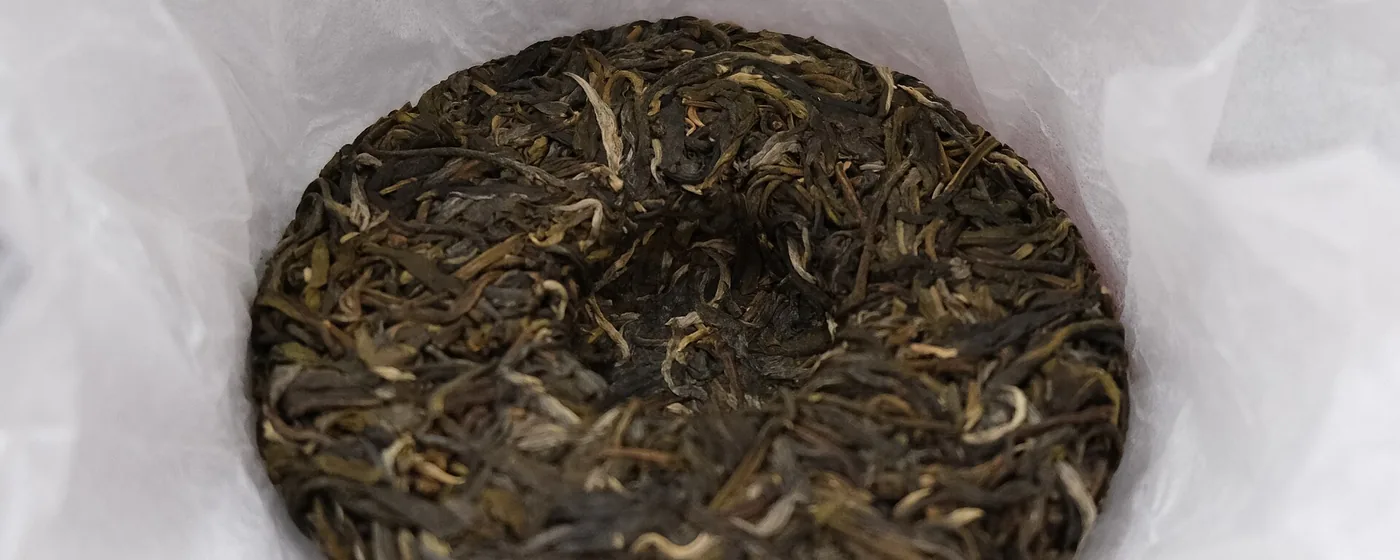
Pu-erh (also written pu'er) comes from Yunnan, China, made from the broad leaves of Camellia sinensis var. assamica. What sets it apart happens after picking: the sun-dried leaves are fermented by microbes. Ripened, or shou, pu-erh is piled, dampened, and turned for weeks under controlled heat and humidity. Raw, or sheng, pu-erh is pressed into cakes and left to change slowly over years. Either way, catechins fall and dark pigments called theabrownins build up, which is why pu-erh tastes nothing like green tea from the same plant.
In the cup, ripened pu-erh is dark reddish-brown, thick-bodied, and earthy: damp forest floor, wet stone, old wood. Good pu-erh is smooth rather than bitter and finishes faintly sweet. Raw pu-erh is brisker when young and mellows with age. It is built for repeated infusions, and the same leaves are often brewed five or more times. In Yunnan, and in Cantonese dim sum houses, it is the tea that arrives after a heavy meal.
Nearly everything you read about pu-erh's benefits comes from lab and animal work, not trials in people. A 2021 review of its chemistry said so plainly: the human trials are too limited to support the therapeutic claims made for the tea. Pu-erh is also not a probiotic, despite a great deal of tea marketing. Microbes drive the fermentation, but nothing shows a brewed cup delivers live beneficial organisms in the amounts that word requires. Pu-erh is a caffeinated tea with unusual chemistry, a long history, and an unfinished research record.
Photo: Yunnan Sourcing "Golden Pig" Raw Pu-erh Tea Cake - opened - WikiTea 01.jpg by Ash Crow — CC BY-SA 4.0. Cropped and re-encoded.
What the evidence says
Brewed pu-erh is not a meaningful source of probiotics.
"Probiotic" means live microorganisms in adequate amounts with a documented health benefit. Fungi and bacteria do drive pu-erh's ripening, converting catechins into theabrownins. But the dried leaf is brewed near boiling, and no study shows a cup delivers live organisms at a probiotic dose.
A pu-erh pigment lowers cholesterol in mice; brewed pu-erh has not been shown to lower cholesterol in people.
Theabrownin, the pigment that darkens ripened pu-erh, lowered cholesterol in mice by suppressing gut bacteria that recycle bile acids. That 2019 paper also examined gut bacteria in a small number of people, but it mapped a mechanism rather than measuring a clinical endpoint. A 2021 review judged the human trials too limited to establish a therapeutic effect. One 2007 analysis measured trace statin in a 25-year-old pu-erh, about 513 nanograms per gram of dry leaf; a few grams of leaf therefore carry a few micrograms, thousands of times less than a prescription statin dose, and not all of that reaches the cup.
A concentrated pu-erh extract modestly reduced weight and visceral fat in one small trial; brewed tea has not been tested.
In a 12-week double-blind, placebo-controlled trial, 36 preobese Japanese adults took 333 mg of a water-soluble pu-erh extract before each of three daily meals. Weight and BMI fell, separating from placebo at eight weeks, and visceral fat was lower at 12 weeks. One 36-person extract trial is not evidence that drinking pu-erh causes weight loss.
Sources: [1]
Pu-erh reshapes gut bacteria in animals; whether that helps human guts is unsettled.
Obese mice given ripened pu-erh extract gained less weight and fat, and transplanting their feces into untreated mice reproduced part of the benefit, suggesting the microbiome mediates the effect in rodents. Mouse guts are not human guts, and no powered human trial has tested any gut outcome.
Traditionally drunk after rich or fatty meals to settle the stomach.
In Yunnan and in Cantonese teahouses, aged pu-erh is the standard pour after a heavy meal, and the custom is centuries old. There are no controlled human trials of pu-erh for bloating, fullness, or indigestion.
No published human clinical trials found for this use.
How to brew Pu-erh Tea
Break leaf off a compressed cake, or measure loose leaf into a pot. Rinse first: cover with boiling water for 5 to 10 seconds, then pour that liquid away. Refill and steep 2 to 5 minutes, tasting as you go.
- Use fully boiling water; unlike green tea, pu-erh is not damaged by heat.
- The same leaves give several infusions; steep a little longer each round.
- Harsh, fishy, or overwhelmingly earthy means too much leaf, a skipped rinse, or poor tea.
- Store cakes dry and away from odors. If tea smells sour or musty, do not drink it.
Safety, side effects & who should avoid it
For most healthy adults, brewed pu-erh is about as safe as other Camellia sinensis teas; the considerations are caffeine and reduced iron absorption. It is not a probiotic, and extract capsules warrant far more caution than the brewed drink.
Who should avoid it
- People told to limit caffeine: heart rhythm problems, uncontrolled high blood pressure, anxiety disorders, insomnia, migraine, GERD, or stomach ulcers. MedlinePlus advises asking your provider.
- Anyone treated for iron-deficiency anemia, or taking oral iron, unless tea is kept away from meals and tablets.
- Children and teenagers, who are more caffeine-sensitive.
- Anyone with past liver injury from a tea supplement. NIH LiverTox rates green tea (same plant) a well-established cause of clinically apparent liver injury, nearly always from extract capsules, not brewed tea.
- Pregnant or breastfeeding people, unless their doctor says otherwise.
Possible side effects
- Caffeine effects: jitteriness, racing heart, headache, disrupted sleep.
- Stomach upset or nausea on an empty stomach; pu-erh is astringent.
- Less iron absorbed from plant foods when drunk with a meal.
- Tooth staining with heavy long-term drinking.
- Fluoride: tea plants take up fluoride from soil. In a survey of 33 teas sold in Poland, pu-erh infusions released less fluoride than black or green tea, and the authors concluded that none of the infusions they tested reached a level likely to cause fluorosis, even steeped 15 minutes. Fluoride content varies with leaf maturity and growing region, so that finding may not hold for every pu-erh. At the far end, Tibetan adults who drink large volumes of brick tea (a different dark tea) take in around 12 mg of fluoride a day, and skeletal fluorosis is common in that population.
- Quality matters: surveys have found heavy metals and mycotoxins (ochratoxin A, aflatoxins) in some teas including pu-erh. Buy from sellers who test.
- Liver injury is a risk of concentrated tea extract capsules, not of brewed tea. If you take any tea extract, stop it and get medical care if you develop yellowing of the eyes or skin, dark urine, pale stools, unusual tiredness, nausea that will not settle, or pain under the right ribs. NIH LiverTox notes that injury from these products usually appears one to six months after starting them.
Medication interactions
- Oral iron: one to two cups of black tea with a meal cut iron absorption by 49% to 67% in a stable-isotope study in young women. Separate tea and iron tablets by a couple of hours.
- Nadolol, atorvastatin, and raloxifene: NCCIH reports that green tea (same plant) at high doses lowers blood levels and effectiveness of nadolol, that green tea extract can lower atorvastatin levels, and that an interaction with raloxifene has been shown. None of this has been tested with pu-erh; tell your pharmacist.
- Warfarin: a case report describes an interaction between warfarin and black tea, another Camellia sinensis tea. Pu-erh itself has not been studied. If you take warfarin, tell your anticoagulation clinic before you start drinking it regularly, and keep your intake steady rather than variable.
- Drugs that slow caffeine breakdown (fluvoxamine, ciprofloxacin, some oral contraceptives) make tea's caffeine stronger and longer-lasting. MedlinePlus also flags stimulants, some antibiotics, asthma medicines such as theophylline, and heart medicines.
- Adenosine or regadenoson cardiac stress tests: caffeine interferes; clinics usually require 12 to 24 caffeine-free hours.
- Diabetes medication: pu-erh's effect on blood sugar has not been established in humans. It is not a substitute for, or an add-on to, prescribed treatment.
- Pu-erh or green tea extract capsules are a different risk category; ask a pharmacist before combining with prescription medicines.
Pregnancy & breastfeeding
Pu-erh has not been studied in pregnancy or breastfeeding. It contains caffeine, which crosses the placenta and passes into breast milk; MedlinePlus advises asking your provider how much caffeine is right for you. Tea also reduces iron absorption, so drink it between meals.
How much is too much
No established limit for brewed pu-erh, and no human trial has identified a safe or effective number of cups. The one weight-related trial used a concentrated extract (333 mg, three times daily, 12 weeks), not tea. That works out to about 1 gram of extract a day, and while its 36 participants reported no adverse effects, a study that size over 12 weeks cannot rule out uncommon harms. Concentrated tea extracts, not brewed tea, are the form associated with liver injury. The practical anchor for the drink is caffeine: MedlinePlus notes up to about 400 mg daily is not harmful for most adults.
Taste & pairing
Tasting notes: Earthy, Smooth, Rich, Complex.
Pairs well with: Asian cuisine, Dark chocolate.
Best time to drink: After meals.
Frequently asked questions
How long should I steep pu-erh tea?
Rinse the leaf with boiling water for 5 to 10 seconds and discard that water, then steep 2 to 5 minutes in a Western-style pot. Gongfu style, with more leaf in a small vessel, uses 10-to-30-second steeps, repeated many times.
Does pu-erh tea have caffeine?
Yes. It is Camellia sinensis, the same plant as green and black tea, and fermentation does not strip the caffeine out. One study tracking ripened pu-erh through fermentation measured caffeine rising as other compounds broke down. Drink it earlier in the day if you are sensitive.
Is pu-erh tea a probiotic?
No, though it is a common claim in tea marketing. Microbes do the fermenting, but the leaves are dried afterward and brewed near boiling. A probiotic means live microorganisms in adequate amounts with a documented health benefit. No study has shown that brewed pu-erh delivers that.
Can I drink pu-erh tea for weight loss?
We do not know. The trial people cite gave 36 preobese adults a concentrated pu-erh extract three times daily for 12 weeks and found modest drops in weight, BMI, and visceral fat. That is a supplement, not tea.
What is the difference between raw (sheng) and ripened (shou) pu-erh?
Ripened pu-erh is deliberately fermented over weeks in warm, damp piles, producing the dark, smooth, earthy tea most people picture. Raw pu-erh is simply pressed and aged, and tastes brighter and more astringent when young. Nearly all published research used ripened pu-erh.
References
- Improvements of mean body mass index and body weight in preobese and overweight Japanese adults with black Chinese tea (Pu-Erh) water extract.. Nutrition research (New York, N.Y.), 2011. PubMed 21745623 · doi:10.1016/j.nutres.2011.05.004
- Theabrownin from Pu-erh tea attenuates hypercholesterolemia via modulation of gut microbiota and bile acid metabolism.. Nature communications, 2019. PubMed 31672964 · doi:10.1038/s41467-019-12896-x
- Ripened Pu-erh Tea Extract Protects Mice from Obesity by Modulating Gut Microbiota Composition.. Journal of agricultural and food chemistry, 2019. PubMed 31070363 · doi:10.1021/acs.jafc.8b04909
- Chemical constituents and biological properties of Pu-erh tea.. Food research international (Ottawa, Ont.), 2021. PubMed 35337597 · doi:10.1016/j.foodres.2021.110899
- Unraveling the flavor formation process of mellow and thick-type ripened Pu-erh tea through non-targeted metabolomics and metagenomics.. Food chemistry: X, 2025. PubMed 40241696 · doi:10.1016/j.fochx.2025.102424
- Expert consensus document. The International Scientific Association for Probiotics and Prebiotics consensus statement on the scope and appropriate use of the term probiotic.. Nature reviews. Gastroenterology & hepatology, 2014. PubMed 24912386 · doi:10.1038/nrgastro.2014.66
- Effect of microbial fermentation on content of statin, GABA, and polyphenols in Pu-Erh tea.. Journal of agricultural and food chemistry, 2007. PubMed 17880152 · doi:10.1021/jf071629p
- Iron absorption in young Indian women: the interaction of iron status with the influence of tea and ascorbic acid.. The American journal of clinical nutrition, 2008. PubMed 18400710 · doi:10.1093/ajcn/87.4.881
- Interaction between warfarin and black tea.. The Annals of pharmacotherapy, 2009. PubMed 19126824 · doi:10.1345/aph.1L396
- Determination of fluoride content in teas and herbal products popular in Poland.. Journal of environmental health science & engineering, 2022. PubMed 36406606 · doi:10.1007/s40201-022-00811-4
- Brick tea fluoride as a main source of adult fluorosis.. Food and chemical toxicology : an international journal published for the British Industrial Biological Research Association, 2003. PubMed 12615125 · doi:10.1016/s0278-6915(02)00285-5
- Mycotoxins in Tea: Occurrence, Methods of Determination and Risk Evaluation.. Toxins, 2018. PubMed 30380767 · doi:10.3390/toxins10110444
Last reviewed and updated . HelperTea is written by an enthusiast, not a clinician, and is not medically reviewed. How we research and rate evidence. Found an error? Tell us — safety corrections get priority.