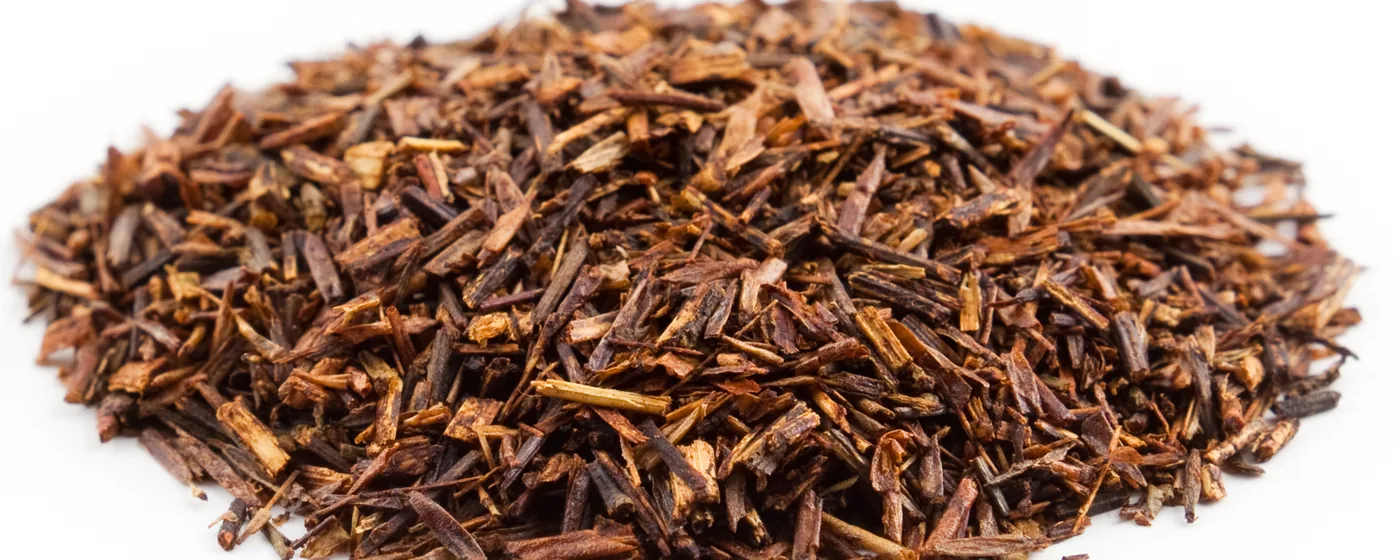
Rooibos (pronounced ROY-boss, Afrikaans for "red bush") comes from the needle-like leaves of Aspalathus linearis, a shrub that grows in South Africa's Cederberg mountains and essentially nowhere else. Despite the name, it isn't tea in the botanical sense — it has no relation to Camellia sinensis, the plant behind green and black tea. After harvest the leaves are bruised and left to oxidize, which turns them rust-red and gives the brew its amber color.
In the cup it is mellow and faintly sweet, with nutty, woody notes and a hint of vanilla. What people notice first is what's missing. Rooibos has no caffeine, and it is naturally low in the tannins that make black tea turn harsh when you forget about it. Leave it steeping for ten minutes and it gets stronger, not bitter. It takes milk and honey well.
The honest picture of its health effects is smaller than the marketing suggests. Rooibos does contain unusual polyphenols — aspalathin and nothofagin, found in almost no other plant — and they do interesting things in test tubes and in rodents. But the human research is sparse: a handful of small trials, most with fewer than fifty participants, several using concentrated extract capsules rather than brewed tea, and at least one using unfermented green rooibos rather than the red tea most people buy. South Africans have long used rooibos for infant colic, allergies, asthma, and skin problems, none of it tested in a controlled trial. A few case reports have raised a possible link to liver injury. The best reason to drink it is the simplest one: it's a good caffeine-free drink.
Photo: Rooibos geschnitten.jpg by soultea.de/André Helbig — CC BY-SA 3.0. Cropped and re-encoded.
What the evidence says
Rooibos is caffeine-free and, unlike regular tea, doesn't appear to block iron absorption.
Black and green tea contain tannins that bind non-heme iron and sharply cut absorption. In a 1979 study, 30 healthy young men took a labeled iron dose with rooibos, ordinary tea, or boiled water. Absorption was 7.25% after rooibos and 9.34% after water, versus 1.70% after ordinary tea. Only ten men per group, and as far as we can tell the study has never been repeated.
Sources: [1]
One small non-randomized study found a better cholesterol profile after six weeks of drinking rooibos.
Forty South African adults at cardiovascular risk drank six cups of fermented rooibos daily for six weeks, then went through a separate control period. After the rooibos period, LDL cholesterol and triglycerides were lower, HDL was higher, and markers of lipid peroxidation had dropped. But there was no placebo, no randomization, and no separate control group — each person was compared against their own values from a control period that ran after the tea period rather than in random order. These are blood markers, not heart attacks avoided.
Sources: [2]
Effects on the heart and blood vessels are plausible but unproven in people.
In a randomized crossover trial, 17 healthy volunteers drank a single 400 mL serving of rooibos and showed reduced blood ACE activity — the enzyme that ACE-inhibitor drugs block — at 30 and 60 minutes. Blood pressure was never measured. In a separate laboratory experiment, rooibos produced no ACE inhibition at all in cultured human endothelial cells. A 12-week trial did include a placebo, but it used rooibos extract capsules rather than brewed tea, and several of its echocardiographic changes also showed up in the placebo group.
Drinking rooibos doesn't reliably raise your blood's antioxidant capacity.
This is the claim most often overstated on packaging. When 12 healthy men drank unfermented (green) rooibos, aspalathin metabolites appeared in their urine, confirming absorption — yet only about 0.26% of the flavonoids they swallowed turned up in plasma, and plasma antioxidant capacity measured by the ORAC assay did not rise significantly. The six-week study of ordinary fermented rooibos found something similar: plasma polyphenols went up, plasma antioxidant capacity did not. A high antioxidant number in a dry leaf isn't an effect in a person.
Rooibos flavonoids stimulate bone-building cells in a dish; no human bone evidence exists.
Two lab studies applied rooibos flavonoids (orientin and luteolin), or brewed rooibos itself, to Saos2 cells — a human osteoblast-like line — and saw more mineral deposition and higher alkaline phosphatase activity. In the second study, green and black tea did the same at matched polyphenol doses, so nothing here is unique to rooibos. These are cells in a dish. Nobody has measured bone density in rooibos drinkers.
Rooibos is traditionally used in South Africa for infant colic, allergies, asthma, and skin problems.
A review of South African herbal teas records rooibos being used traditionally to relieve infantile colic, allergies, asthma and dermatological problems — weak rooibos for a colicky baby, cooled tea dabbed on irritated skin. These uses go back generations, but the plant was listed as medicinal largely on anecdotal grounds, and no controlled trial has tested any of them. Long use suggests tea-strength rooibos is broadly tolerated by adults. It doesn't tell us it works, and it isn't a reason to give rooibos to a baby without asking a pediatrician first.
How to brew Rooibos Tea
Bring water to a full rolling boil — rooibos needs more heat and time than green tea. Pour over the leaves, cover, and steep 5 to 10 minutes, then strain.
- It's low in tannins, so it won't turn bitter. A longer steep makes it stronger, not harsher.
- For a fuller cup, simmer loose rooibos in a covered pot for 10 minutes.
- Green (unfermented) rooibos is grassier. Use cooler water, about 190°F, and steep 4 to 6 minutes.
Safety, side effects & who should avoid it
For most healthy adults, rooibos at ordinary tea strength appears low-risk, and it contains no caffeine. Three things are worth knowing. A small number of case reports link rooibos-containing tea to liver injury, though causation is not established. Laboratory work shows rooibos compounds can both inhibit and potentially induce drug-metabolizing enzymes, which makes interactions hard to predict in either direction. And there is no authoritative monograph to fall back on — as of this writing rooibos has no entry in NIH's LiverTox database, NCCIH's Herbs at a Glance, or MedlinePlus. What follows is built from a few case reports and laboratory studies, not from a formal safety review.
Who should avoid it
- Anyone with liver disease or unexplained raised liver enzymes. Three published case reports describe hepatitis-like liver injury in people drinking rooibos. Causation is not established, and in the biopsy-confirmed case — a 52-year-old man — the tea was a blend of rooibos and buchu, so rooibos alone may not have been responsible. Millions of people drink rooibos without trouble. But if your liver is already under strain, this is an easy thing to skip.
- Transplant recipients taking tacrolimus. A 2025 review of food-drug interactions lists rooibos among products that may reduce tacrolimus bioavailability, apparently through CYP450 induction and the P-glycoprotein efflux pump. Lower tacrolimus levels could put a graft at risk. Don't drink it without your transplant team's approval.
- People on narrow-therapeutic-index drugs such as warfarin, some anti-seizure medicines, or immunosuppressants. Rooibos extracts inhibit CYP2C9, CYP2C19 and CYP3A4 in laboratory assays, and rooibos compounds also activate PXR, which can push some of the same enzymes the other way. The net effect in a person has never been measured, so ask a pharmacist first.
- Infants and young children. Rooibos is traditionally given to colicky babies in South Africa, but that use has never been tested in a trial, and rooibos safety has not been studied in infants at all. Herbal tea should never replace breast milk or formula. Ask a pediatrician before giving rooibos to a baby or a young child.
- Anyone taking corticosteroids, or being treated for a hormone-sensitive cancer, should mention rooibos to their doctor. Three compounds isolated from rooibos leaves showed estrogenic activity in a lab assay, and one small human study found that rooibos consumption raised plasma cortisone and lowered the cortisol-to-cortisone ratio. What either finding means clinically is unknown.
Possible side effects
- Most people report none. Rooibos contains no caffeine, so it is unlikely to interfere with sleep.
- Rare reports of liver injury: raised liver enzymes, jaundice, dark urine, fatigue, nausea, and in one report a low platelet count. In the case that included a liver biopsy, liver function recovered after the person stopped drinking the tea.
- See a doctor promptly if you develop yellowing of the eyes or skin, dark urine, pain under the right ribs, or persistent nausea — and tell them you drink rooibos. Herbal teas are easy to overlook as a cause.
Medication interactions
- Tacrolimus: a 2025 narrative review reports that rooibos may reduce tacrolimus bioavailability, apparently via CYP450 induction and the P-glycoprotein efflux pump. This is a review of reported interactions, not a controlled study in patients.
- CYP3A4 substrates: a rooibos leaf-and-stem extract inhibited CYP3A4 (IC50 1.7 µg/mL) along with CYP1A2, CYP2D6, CYP2C9 and CYP2C19. The same study found that aspalathin and nothofagin activated PXR and increased CYP3A4 and CYP1A2 messenger RNA — an induction signal pointing the opposite way. In-vitro data in both directions, not a confirmed clinical interaction.
- Statins and oral diabetes drugs: rooibos extracts inhibited CYP2C8, CYP2C9 and CYP3A4 in enzyme assays — the enzymes that clear atorvastatin, sulfonylureas and thiazolidinediones. No clinical case of this interaction has been published.
- ACE inhibitors: a single serving transiently reduced ACE activity in healthy volunteers. No clinical problem has been reported, but mention regular rooibos drinking to your prescriber.
- Other drugs or supplements that can strain the liver: given the case reports above, it is reasonable to be cautious about drinking large amounts of rooibos alongside them, and to mention it to your prescriber.
- An important caveat on all of the above: these enzyme findings come from concentrated extracts at laboratory concentrations. The authors of one study specifically flagged the risk from a high intake of nutraceuticals containing rooibos extracts, rather than from ordinary brewed tea. Whether a cup of tea ever reaches these concentrations in a person is unknown.
Pregnancy & breastfeeding
No controlled studies have looked at rooibos in pregnancy or breastfeeding. It's caffeine-free and widely drunk by pregnant women in South Africa, which is reassuring but isn't evidence of safety — and lab work has identified compounds in rooibos with estrogenic activity, which nobody has followed up in pregnancy. Keep it to ordinary tea strength, skip extract supplements, and talk to your doctor or midwife first.
How much is too much
No established limit. The most brewed rooibos anyone has been formally studied drinking is six cups a day for six weeks, in a 40-person study that measured liver and kidney function. Concentrated extract capsules deliver far higher flavonoid doses than tea, carry the enzyme-interaction concerns above, and have no long-term safety data behind them.
Taste & pairing
Tasting notes: Sweet, Nutty, Smooth.
Pairs well with: Honey, Milk, Desserts.
Best time to drink: Any time of day.
Frequently asked questions
How long should I steep rooibos tea?
Five to ten minutes in fully boiling water. Because rooibos is low in tannins, it doesn't go bitter or astringent the way over-steeped black tea does — a longer steep just gives you a stronger, darker cup.
Can I drink rooibos tea before bed?
Rooibos contains no caffeine, so it shouldn't keep you awake. But no study has shown that rooibos is sedating or improves sleep. It's a reasonable evening drink, not a sleep aid.
How many cups of rooibos a day is safe?
There's no official upper limit. The most that has been formally studied is six cups a day for six weeks. Because a few case reports have linked rooibos-containing tea to liver injury, mention your rooibos habit to your doctor if you have liver problems or feel persistently unwell.
Can I give rooibos to my baby?
Ask your pediatrician first. Rooibos is traditionally given to colicky babies in South Africa, but no trial has tested whether it helps, and its safety in infants has not been studied. Herbal tea should never take the place of breast milk or formula.
Is rooibos better for you than green tea?
Nobody can honestly rank them — the two have never been compared in a trial measuring a health outcome. They differ usefully: rooibos has no caffeine and doesn't seem to interfere with iron absorption, while green tea has both, plus far more human research behind it.
Does rooibos help with blood sugar or weight loss?
Not that anyone has demonstrated. Rooibos contains aspalathin, which lowers glucose in cell cultures and in animals fed concentrated extract — doses far beyond what a cup delivers. No human trial has tested rooibos for blood sugar or weight loss.
References
- [The effect of rooibos tea on iron absorption].. South African medical journal = Suid-Afrikaanse tydskrif vir geneeskunde, 1979. PubMed 462276
- Effects of rooibos (Aspalathus linearis) on oxidative stress and biochemical parameters in adults at risk for cardiovascular disease.. Journal of ethnopharmacology, 2010. PubMed 20833235 · doi:10.1016/j.jep.2010.08.061
- Effects of green tea, black tea and Rooibos tea on angiotensin-converting enzyme and nitric oxide in healthy volunteers.. Public health nutrition, 2010. PubMed 20144258 · doi:10.1017/S1368980010000170
- Tea flavanols inhibit angiotensin-converting enzyme activity and increase nitric oxide production in human endothelial cells.. The Journal of pharmacy and pharmacology, 2006. PubMed 16872562 · doi:10.1211/jpp.58.8.0016
- Impact of Chronic Consumption of Herbal Rooibos on Cardiovascular Function in Adults with Cardiovascular Risk.. Journal of medicinal food, 2024. PubMed 38958559 · doi:10.1089/jmf.2024.0012
- Bioavailability and antioxidant potential of rooibos flavonoids in humans following the consumption of different rooibos formulations.. Food chemistry, 2011. PubMed 25212140 · doi:10.1016/j.foodchem.2011.03.029
- Rooibos flavonoids, orientin and luteolin, stimulate mineralization in human osteoblasts through the Wnt pathway.. Molecular nutrition & food research, 2015. PubMed 25488131 · doi:10.1002/mnfr.201400592
- Comparison of black, green and rooibos tea on osteoblast activity.. Food & function, 2016. PubMed 26885714 · doi:10.1039/c5fo01222h
- South African herbal teas: Aspalathus linearis, Cyclopia spp. and Athrixia phylicoides--a review.. Journal of ethnopharmacology, 2008. PubMed 18621121 · doi:10.1016/j.jep.2008.06.014
- Hepatotoxicity due to red bush tea consumption: a case report.. Journal of clinical anesthesia, 2016. PubMed 27871602 · doi:10.1016/j.jclinane.2016.07.027
- Tea not Tincture: Hepatotoxicity Associated with Rooibos Herbal Tea.. ACG case reports journal, 2013. PubMed 26157822 · doi:10.14309/crj.2013.20
- Possible hepatotoxic effect of rooibos tea: a case report.. European journal of clinical pharmacology, 2010. PubMed 20072844 · doi:10.1007/s00228-009-0776-7
- Safety Assessment of Phytochemicals Derived from the Globalized South African Rooibos Tea ( Aspalathus linearis) through Interaction with CYP, PXR, and P-gp.. Journal of agricultural and food chemistry, 2019. PubMed 30955332 · doi:10.1021/acs.jafc.9b00846
- Inhibitory Interactions of Aspalathus linearis (Rooibos) Extracts and Compounds, Aspalathin and Z-2-(β-d-Glucopyranosyloxy)-3-phenylpropenoic Acid, on Cytochromes Metabolizing Hypoglycemic and Hypolipidemic Drugs.. Molecules (Basel, Switzerland), 2016. PubMed 27845750 · doi:10.3390/molecules21111515
- Tacrolimus, Cytochrome P450, Interactions with Food Variables in Organ Transplant Recipients; A Current and Comprehensive Review.. Current drug metabolism, 2025. PubMed 39757635 · doi:10.2174/0113892002328742241210102522
- Phytoestrogens from Aspalathus linearis.. Biological & pharmaceutical bulletin, 2006. PubMed 16755032 · doi:10.1248/bpb.29.1271
- Rooibos influences glucocorticoid levels and steroid ratios in vivo and in vitro: a natural approach in the management of stress and metabolic disorders?. Molecular nutrition & food research, 2013. PubMed 24022885 · doi:10.1002/mnfr.201300463
Last reviewed and updated . HelperTea is written by an enthusiast, not a clinician, and is not medically reviewed. How we research and rate evidence. Found an error? Tell us — safety corrections get priority.