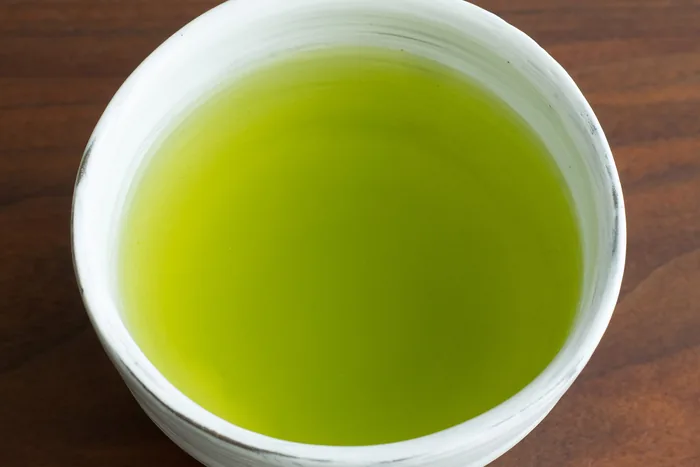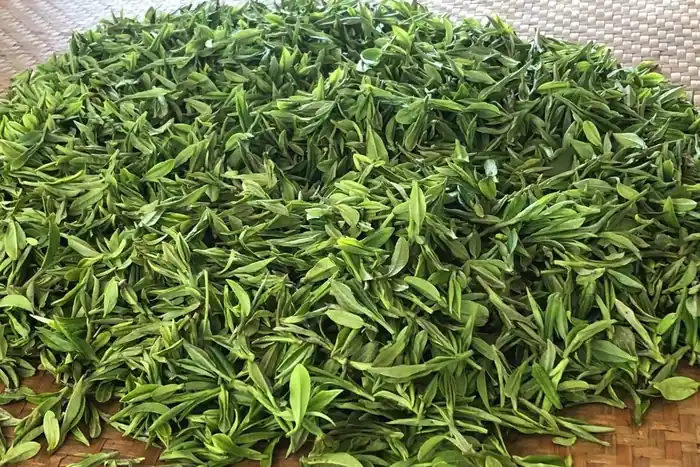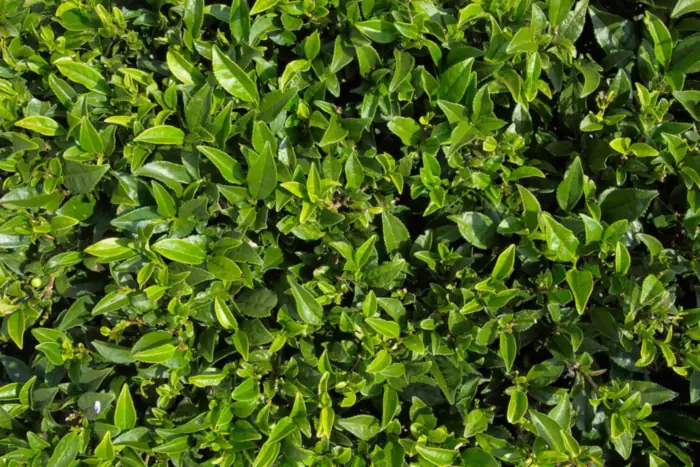
Matcha is green tea (Camellia sinensis) grown and prepared differently. For the last few weeks before harvest the plants are shaded, which slows photosynthesis and raises the leaf's chlorophyll and amino acid content, including L-theanine. The leaves are then steamed, dried, stripped of stems and veins, and stone-ground into a powder fine enough to feel like eyeshadow. Instead of steeping leaves and discarding them, you whisk the powder into water and swallow the leaf itself.
That changes both the taste and the dose. Good matcha is thick and savory, with a seaweed-and-spinach umami, a creamy body from the suspended particles, and a clean bitterness that turns harsh if your water is too hot or your scoop too generous. Ceremonial grades are sweeter and rounder; culinary grades are more astringent and hold their own in lattes and baking. Gram for gram of leaf, a bowl delivers more caffeine and catechins than steeped tea, because nothing gets thrown away: a level teaspoon carries roughly 50 to 70 mg of caffeine, between a strong black tea and a small coffee.
Most people drink matcha for a particular quality of alertness, and for the ritual of making it. Be clear about the research, though: matcha-specific trials are few, small, and often funded by Japanese tea companies. The broader green tea literature points to small effects on cholesterol and blood pressure, and disappointing results for weight loss — and most of that literature tested catechin supplements, not whisked tea. Matcha is a good drink, and the trials on attention are suggestive rather than convincing. It is not a treatment for anything, and the extract capsules sold alongside it are a different, riskier product.
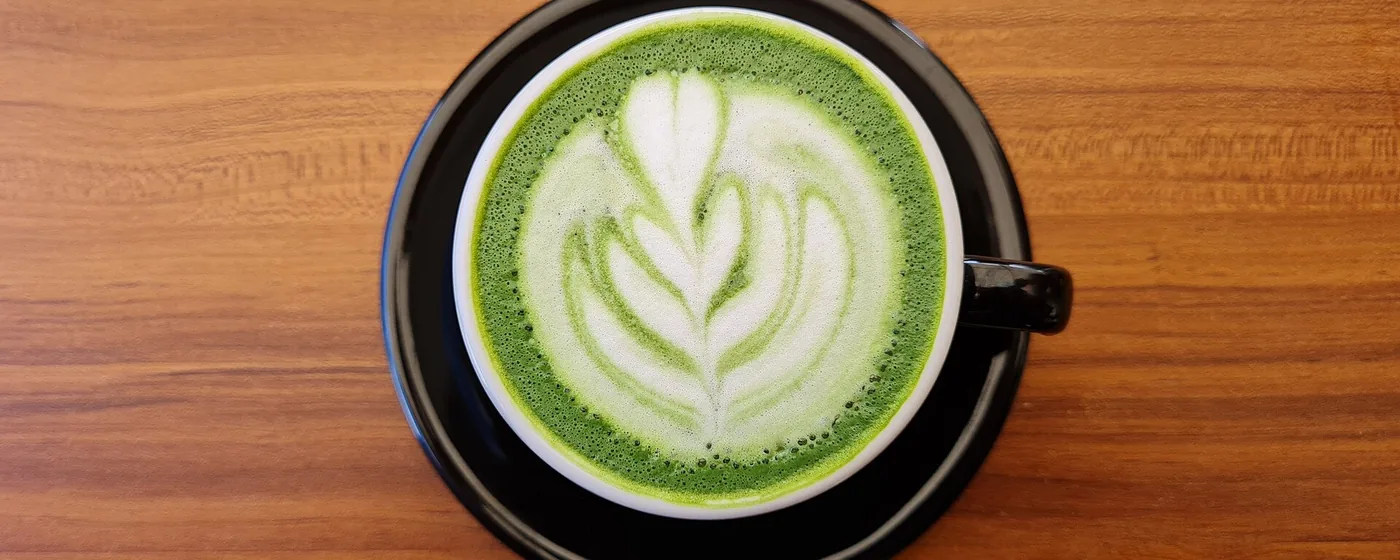
Photo: Matcha tea latte with rosetta latte art.jpg by Irvan Ary Maulana — CC BY-SA 4.0. Cropped and re-encoded.
What the evidence says
The caffeine in matcha may improve alertness and attention. The L-theanine probably contributes less than the marketing suggests.
A review of 49 human intervention studies found caffeine improved self-reported alertness and performance on long attention tasks from as little as 40 mg — a dose one bowl exceeds. L-theanine improved self-reported calm and relaxation, but only starting around 200 mg. A trial that measured its matcha found 50.3 mg of L-theanine in a 2.7 g serving, well under that threshold. Those studies tested isolated compounds, not matcha.
Small trials suggest daily matcha may help maintain attention after a stressful task. The finding is not solid.
In a placebo-controlled trial, 42 adults aged 25 to 34 took 2 g daily for two weeks and had faster Stroop-test reaction times than placebo after a stressful arithmetic test. A companion trial in middle-aged and older adults concluded that the reaction-time gain seen after a single dose of matcha was likely caffeine's doing, though continuous matcha intake did increase the amount of work completed. A separate 23-person study tested a single dose with no stress task at all, and found only slight gains in attention speed. The trials are small and short, and the first two were run by a tea company.
Green tea drinking is associated with small reductions in LDL cholesterol, total cholesterol, and blood pressure.
A meta-analysis of 31 randomized trials (3,321 people) found green tea lowered total cholesterol by about 4.7 mg/dL and LDL by about 4.6 mg/dL, with no effect on HDL or triglycerides; an earlier 20-trial meta-analysis agreed. A 13-trial meta-analysis found roughly 2 mmHg systolic and 1.7 mmHg diastolic reductions, with the larger effects in trials that gave green tea as an extract rather than as a drink. A 40,530-person Japanese cohort linked drinking five or more cups a day to lower cardiovascular mortality, though not to lower cancer mortality, and that study is observational. Two caveats: much of this literature tested catechin supplements at doses ranging up to 3,000 mg a day, and none of it tested matcha.
Green tea preparations are unlikely to produce meaningful weight loss, and there is no reason to expect matcha is different.
A Cochrane review found green tea preparations produced a mean weight difference of about -0.04 kg in trials run outside Japan, which the authors judged not clinically important. Trials run in Japan were too heterogeneous to pool and ranged from -0.2 to -3.5 kg. A 2024 meta-analysis of 10 randomized trials found that adding green tea catechins to exercise gave only a small extra reduction in weight and body fat. Neither body of work used matcha.
Whether daily matcha protects cognition in older adults is unresolved.
In a 12-month double-blind trial of 99 older adults with subjective cognitive decline or mild cognitive impairment, 2 g of matcha daily did not improve either primary outcome; a secondary measure of facial-emotion perception did improve. A 12-week trial of 3 g daily in 61 older adults found a benefit only among women, in a subgroup analysis. Both studies were funded or staffed in part by food and beverage companies.
Matcha has been used for centuries in Japanese Zen practice and the tea ceremony as an aid to wakeful calm.
Powdered tea whisked in a bowl reached Japan from Song-dynasty China and became central to Zen monastic routine and later to chanoyu, the tea ceremony. Monks valued it for staying alert but calm. Cultural history, not clinical evidence.
No published human clinical trials found for this use.
How to brew Matcha
Sift 1 teaspoon of matcha into a warmed bowl; unsifted powder clumps and whisking will not save it. Add 2 to 3 oz of water at 175F / 80C and whisk briskly in a W motion for 15 to 30 seconds, until a fine foam forms.
- Boiling water scorches matcha. Let a boiled kettle stand three to five minutes.
- A bamboo chasen gives the finest foam, but a metal whisk or a shaken jar works.
- Store airtight in the fridge, away from light; oxidized matcha tastes flat.
Safety, side effects & who should avoid it
For most healthy adults, one to three bowls a day is a modest amount of caffeine, roughly 50 to 210 mg. Reports of serious liver injury overwhelmingly involve concentrated green tea extract capsules rather than whisked tea, though a small number have involved very concentrated infusions. Matcha does differ from steeped green tea in one way worth knowing: you swallow the ground leaf, so you take in whatever the leaf holds, including vitamin K and a larger catechin load.
Who should avoid it
- People with liver disease or past drug- or supplement-induced liver injury, unless their doctor approves.
- Anyone taking nadolol; green tea sharply reduces how much of this beta-blocker reaches the bloodstream.
- Anyone taking bortezomib for multiple myeloma, or another boron-based drug, until they have asked their oncology team.
- People sensitive to caffeine. MedlinePlus advises talking with a provider about caffeine if you have a sleep disorder, an anxiety disorder, migraines or chronic headaches, a heart rhythm problem, high blood pressure, or GERD or ulcers.
- Children and teenagers: one 2 g serving carries roughly the caffeine of a small coffee, and children are especially sensitive to caffeine.
- People treated for iron-deficiency anemia, if taken alongside an oral iron supplement.
- Anyone tempted by high-dose green tea extract capsules: a different product with documented liver-injury risk.
Possible side effects
- Jitteriness, restlessness, racing heart, headache, and trouble sleeping, all scaling with the caffeine dose.
- Nausea or stomach upset, especially on an empty stomach; you swallow the ground leaf, not an infusion.
- Heartburn if you are prone to reflux, and withdrawal headache if a daily habit stops abruptly.
- Liver injury has not been linked to drinking brewed or whisked green tea in population studies, but it is well documented with concentrated extracts, including fatal cases. Whatever the source, jaundice, dark urine, pale stools, or right-sided abdominal pain are reasons to stop and seek care.
Medication interactions
- Nadolol: in 10 healthy volunteers, green tea cut nadolol exposure by about 85% and blunted its blood-pressure effect. NCCIH flags this interaction too. Do not pair them without talking to your prescriber.
- Atorvastatin: NCCIH states that green tea extract can reduce blood levels of atorvastatin.
- Other cardiovascular drugs: a review reports reduced exposure to simvastatin, rosuvastatin, and sildenafil, and altered tacrolimus levels. The warfarin and tacrolimus signals come from single case reports.
- Warfarin and other vitamin K antagonists: matcha is whole ground leaf, carrying vitamin K that steeped tea leaves behind. Vitamin K opposes warfarin; keep intake steady and tell your anticoagulation clinic.
- Bortezomib and other boron-based drugs: green tea catechins form adducts with bortezomib's boronic acid group, and in cell studies this blunted the drug's anticancer activity, including at concentrations the authors describe as reachable through ordinary tea drinking. There are no human outcome data. Many oncology teams still advise avoiding green tea products during treatment; ask yours.
- Oral iron: tea polyphenols bind non-heme iron and can blunt iron tablets. Separate them by an hour or two.
- Raloxifene: NCCIH reports that an NCCIH-funded study found an interaction between green tea and raloxifene. The direction and clinical importance are not clearly established; ask your pharmacist.
- Other caffeine: coffee, energy drinks, pre-workout, and some cold medicines stack with matcha.
Pregnancy & breastfeeding
Caffeine crosses the placenta, and a 2 g serving carries 50 to 70 mg. MedlinePlus gives no fixed pregnancy number and advises you talk with your provider; NCCIH says caffeine intake during pregnancy should not exceed moderate levels. For breastfeeding, NCCIH notes that infants usually do not have adverse effects when the parent's caffeine intake is low to moderate, but that high intake can cause fussiness and poor sleep in the infant. Avoid concentrated green tea extracts. Keep matcha occasional and ask your doctor about your total daily caffeine.
How much is too much
No established upper limit for matcha as a drink. Trials have given 2 to 3 g of powder daily for up to 12 months, but those trials were small and were not designed or powered to detect uncommon harms, so the absence of a safety signal is not the same as proof of safety. One trial measured a 2.7 g serving at about 301 mg of catechins and 71.5 mg of caffeine. MedlinePlus notes 400 mg of caffeine daily is not harmful for most healthy adults. For context on the extract problem, NIH's LiverTox reports that green tea extract doses equivalent to 800 mg of EGCG or more per day can raise liver enzymes — far more EGCG than a bowl of whisked matcha delivers.
Taste & pairing
Tasting notes: Vegetal, Umami, Slightly bitter, Creamy.
Pairs well with: Light desserts, Japanese cuisine, Dark chocolate.
Best time to drink: Morning or early afternoon.
Frequently asked questions
How much caffeine is in matcha compared with coffee?
A 2 g serving, about a level teaspoon, carries roughly 50 to 70 mg of caffeine; one trial measured 71.5 mg in 2.7 g. A standard 8 oz drip coffee runs around 95 mg. Steeped green tea is lower, since you discard the leaf.
Does the L-theanine in matcha cancel out caffeine jitters?
Blunt, perhaps. Cancel, no. A review of human trials found L-theanine improved self-reported calm starting around 200 mg. A typical bowl delivers far less: one trial measured 50.3 mg in 2.7 g. If matcha feels smoother than coffee, some of that is simply less caffeine.
Can matcha damage your liver?
Drinking brewed or whisked green tea has not been associated with liver injury in population studies. NIH's LiverTox reports that regular green tea drinkers actually tend to have slightly lower liver enzymes. The problem is concentrated extract. LiverTox counts more than 100 published cases of clinically apparent liver injury attributed to green tea extract, including acute liver failure that proved fatal or required an urgent liver transplant; in one prospective US series, 8 of 40 green tea cases went to transplant. Extract doses equivalent to 800 mg of EGCG or more per day can raise liver enzymes. Susceptibility appears partly genetic: NCCIH describes a variant in an immune-function gene, carried by 5 to 15 percent of Americans, that raises risk. If you develop jaundice or dark urine, see a doctor.
When should I drink matcha, and is it bad on an empty stomach?
Morning to early afternoon, for the same reason as coffee: 50 to 70 mg of caffeine at 4 p.m. still affects some people's sleep. Matcha on an empty stomach makes many people queasy. A US Pharmacopeia review also found that repeated doses of green tea extract taken while fasting significantly increase catechin absorption. That work was on extracts rather than whisked tea, but taking matcha with food is a reasonable precaution.
Is matcha better than regular green tea like sencha?
More concentrated, not categorically better. Because you drink the whole ground leaf, each gram gives more caffeine, catechins, L-theanine, and vitamin K. Widely repeated claims that matcha has dozens or hundreds of times the antioxidants of green tea trace back to single lab comparisons of specific products.
Does drinking the whole leaf mean more lead or other contaminants?
Possibly, and this is genuinely under-studied. With steeped tea you throw the leaf away, and much of what the leaf holds goes in the compost. With matcha you drink it. Anything in the leaf that would not have dissolved into an infusion, including any heavy metals the plant took up from the soil, ends up in your cup instead. We did not find good human data quantifying what that means at ordinary matcha intakes, and we are not going to pretend otherwise. If it concerns you, look for a brand that publishes third-party contaminant testing.
References
- Effect of Green Tea Phytochemicals on Mood and Cognition.. Current pharmaceutical design, 2017. PubMed 28056735 · doi:10.2174/1381612823666170105151800
- Matcha consumption maintains attentional function following a mild acute psychological stress without affecting a feeling of fatigue: A randomized placebo-controlled study in young adults.. Nutrition research (New York, N.Y.), 2021. PubMed 33744591 · doi:10.1016/j.nutres.2020.12.024
- Effects of Daily Matcha and Caffeine Intake on Mild Acute Psychological Stress-Related Cognitive Function in Middle-Aged and Older Adults: A Randomized Placebo-Controlled Study.. Nutrients, 2021. PubMed 34067795 · doi:10.3390/nu13051700
- An intervention study on the effect of matcha tea, in drink and snack bar formats, on mood and cognitive performance.. Food research international (Ottawa, Ont.), 2017. PubMed 28784536 · doi:10.1016/j.foodres.2017.05.002
- Effect of green tea consumption on blood lipids: a systematic review and meta-analysis of randomized controlled trials.. Nutrition journal, 2020. PubMed 32434539 · doi:10.1186/s12937-020-00557-5
- Green tea catechins decrease total and low-density lipoprotein cholesterol: a systematic review and meta-analysis.. Journal of the American Dietetic Association, 2011. PubMed 22027055 · doi:10.1016/j.jada.2011.08.009
- Green tea catechins and blood pressure: a systematic review and meta-analysis of randomised controlled trials.. European journal of nutrition, 2014. PubMed 24861099 · doi:10.1007/s00394-014-0720-1
- Green tea consumption and mortality due to cardiovascular disease, cancer, and all causes in Japan: the Ohsaki study.. JAMA, 2006. PubMed 16968850 · doi:10.1001/jama.296.10.1255
- Green tea for weight loss and weight maintenance in overweight or obese adults.. The Cochrane database of systematic reviews, 2012. PubMed 23235664 · doi:10.1002/14651858.CD008650.pub2
- Does green tea catechin enhance weight-loss effect of exercise training in overweight and obese individuals? a systematic review and meta-analysis of randomized trials.. Journal of the International Society of Sports Nutrition, 2024. PubMed 39350601 · doi:10.1080/15502783.2024.2411029
- Effect of matcha green tea on cognitive functions and sleep quality in older adults with cognitive decline: A randomized controlled study over 12 months.. PloS one, 2024. PubMed 39213264 · doi:10.1371/journal.pone.0309287
- Effects of Matcha Green Tea Powder on Cognitive Functions of Community-Dwelling Elderly Individuals.. Nutrients, 2020. PubMed 33256220 · doi:10.3390/nu12123639
- Matcha Does Not Affect Electroencephalography during Sleep but May Enhance Mental Well-Being: A Randomized Placebo-Controlled Clinical Trial.. Nutrients, 2024. PubMed 39275223 · doi:10.3390/nu16172907
- United States Pharmacopeia (USP) comprehensive review of the hepatotoxicity of green tea extracts.. Toxicology reports, 2020. PubMed 32140423 · doi:10.1016/j.toxrep.2020.02.008
- Green tea ingestion greatly reduces plasma concentrations of nadolol in healthy subjects.. Clinical pharmacology and therapeutics, 2014. PubMed 24419562 · doi:10.1038/clpt.2013.241
- Update of green tea interactions with cardiovascular drugs and putative mechanisms.. Journal of food and drug analysis, 2018. PubMed 29703388 · doi:10.1016/j.jfda.2018.01.008
- Excessive tea consumption can inhibit the efficacy of oral iron treatment in iron-deficiency anemia.. Haematologica, 1995. PubMed 8647516
- Molecular characterization of the boron adducts of the proteasome inhibitor bortezomib with epigallocatechin-3-gallate and related polyphenols.. Organic & biomolecular chemistry, 2015. PubMed 25669488 · doi:10.1039/c4ob02512a
- The SAR analysis of dietary polyphenols and their antagonistic effects on bortezomib at physiological concentrations.. Frontiers in pharmacology, 2024. PubMed 39119616 · doi:10.3389/fphar.2024.1403424
- A review on matcha: Chemical composition, health benefits, with insights on its quality control by applying chemometrics and multi-omics.. Food research international (Ottawa, Ont.), 2023. PubMed 37316075 · doi:10.1016/j.foodres.2023.113007
Last reviewed and updated . HelperTea is written by an enthusiast, not a clinician, and is not medically reviewed. How we research and rate evidence. Found an error? Tell us — safety corrections get priority.