Short answer
Neither hour is proven better; no trial has compared morning with night. What the research times is the meal, not the clock: capsule trials gave ginger from just before food to an hour ahead. Drink it 20 to 30 minutes before whichever meal bloats you, and avoid it near bedtime if you get reflux.
Nobody has run that study. No trial has compared a morning cup of ginger tea against an evening one for bloating. What exists is research on ginger capsules and how fast the stomach empties — and in the studies that timed it, the ginger went in before food. That is the only timing signal in the literature, and it points at meals, not the clock.
So: pick the meal, not the hour. If your waistband tightens after dinner, drink it before dinner. If mornings feel heavy and gassy, drink it before breakfast. Time of day matters mainly on the downside — a hot, pungent brew shortly before you lie down is the one version of this habit that can leave you feeling worse.
Does the time of day actually change anything?
A little, though not in ginger's favor at night. Your stomach really is slower in the evening: in a 1987 study, 16 healthy men ate the same test meal at 8 a.m. and 8 p.m., and the evening meal's gastric half-emptying time for solids ran about 54 percent longer PubMed. Sixteen men in one physiology study is a hint, not a rule. And if ginger's mechanism is nudging the stomach to empty faster, an evening cup is at least aimed at the harder problem — though nobody has tested that idea.
The catch is reflux. Heartburn is the side effect people report most with ginger, and a hot, spicy drink taken shortly before lying flat stacks two things that push acid the wrong way. A systematic review of reflux-disease lifestyle changes found that in randomized trials, late evening meals increased the time the esophagus spent exposed to acid while lying down, by about 5 percentage points, versus early meals PubMed. That review studied meals, not ginger tea; extending it to a mug is inference, not evidence.
Split the difference: finish an evening cup with dinner, not at bedtime, and stay upright a couple of hours after. Ginger tea is caffeine-free, so sleep is not the concern.
Should you drink ginger tea before or after a meal?
Before — when the bloating you want to head off is the post-meal, uncomfortably-full kind.
Here ginger parts company with the other bloating teas. Peppermint and fennel are used as antispasmodics — peppermint oil relaxes intestinal smooth muscle in laboratory work — so the idea is to calm a gut already cramping around trapped gas, which is why our guide to teas for bloating suggests drinking those after eating. Ginger runs the other way. In the capsule trials below it sped the stomach up and increased the contractions that push food onward, so the useful moment is before the stomach fills.
The trials fit, with one asterisk over everything that follows: every one of them used capsules, not tea. In a randomized, double-blind study of 24 healthy volunteers, 1,200 mg of ginger taken an hour before a bowl of soup cut gastric half-emptying time from about 27 minutes to 13 PubMed. A pilot crossover study gave a ginger-and-artichoke capsule immediately before the main meal and measured 24 percent less gastric area an hour afterward — but only eleven people took part, and several authors were affiliated with the company that makes it PubMed. Anywhere from just before the meal to an hour ahead of it is defensible; 20 to 30 minutes is a reasonable middle.
Now the honest problems. The finding is not settled: a randomized, placebo-controlled crossover trial in 16 volunteers, using a different method (paracetamol absorption), found 1 g of ginger had no effect at all PubMed. And where emptying did speed up, nobody felt better. Those 24 volunteers reported no difference in any gastrointestinal symptom. In 11 people with functional dyspepsia, 1.2 g of ginger shortened gastric half-emptying from roughly 16 minutes to 12 and produced no symptom improvement PubMed. So the evidence that ginger moves your stomach along is limited and contested. That it makes bloating feel better is thinner still, and none of it was tested as a brewed cup.
How long does it take to work, and how many cups?
Nobody knows. No one has timed how long brewed ginger tea takes to relieve bloating, because no one has tested brewed ginger tea for bloating. In the capsule trials, gastric emptying measurably shifted inside the first hour, so if a cup does anything for you, 20 to 40 minutes is a reasonable window to watch. That is a rule of thumb borrowed from mechanism, not a measured symptom timeline.
Trials that did report relief needed weeks, and used concentrated extracts. In a four-week randomized trial of 50 adults with functional dyspepsia, a proprietary ginger extract at 200 mg twice daily was reported to clear postprandial fullness, upper abdominal bloating, and early satiation — all three scored at zero — in 64 percent of that group against 13 percent on placebo PubMed. A 12-week trial in 80 adults found a steamed ginger extract improved a general gut symptom score PubMed. Both are small, both were authored by employees of the companies behind the extracts, and neither used tea. Read them as promising for those products, not as evidence for your mug.
On volume, follow the ginger tea page: one cup per occasion, two or three a day at most. Research doses of powdered ginger run 0.5 to 2 grams daily; a teaspoon of grated fresh ginger steeped covered in 8 oz of just-boiled water for 5 to 10 minutes delivers an unmeasured, almost certainly smaller amount. Heartburn or loose stools mean cut back.
| Morning cup | Evening cup | |
|---|---|---|
| Best for | Waking up heavy, queasy, or gassy before eating | Dinner bloat; the tight waistband at 9 p.m. |
| The case for it | Ginger's strongest human evidence is for nausea, so worth a try if yours is worst on waking | Gastric emptying of solids is slower at night in one small study PubMed |
| The case against | Strong ginger on an empty stomach nauseates some people | Reflux risk if you drink it close to lying down |
| Practical rule | 20 to 30 minutes before breakfast | With or before dinner; stop 2 to 3 hours before bed |
Ginger tea or peppermint tea for bloating?
On the evidence, peppermint has the stronger record — but read the fine print: that record belongs to enteric-coated peppermint oil capsules, not to peppermint tea, which has never been tested for bloating either. Ginger's record in gut-symptom trials, meanwhile, includes a clear miss. In a double-blind randomized pilot trial, 45 people with IBS took placebo, 1 g of ginger, or 2 g daily for 28 days. Numerically, placebo produced the most responders, 57.1 percent, against 46.7 percent on 1 g and 33.3 percent on 2 g PubMed. Ginger was well tolerated and did not beat the dummy pill. A pilot that small settles nothing, and its authors said as much — but you will never see it on a box of tea.
| Ginger tea | Peppermint tea | |
|---|---|---|
| What the evidence supports | Limited. Capsules sped gastric emptying in two small trials; another found no effect, and where emptying sped up, symptoms did not improve. Extracts eased post-meal fullness in small, industry-affiliated trials. In an IBS pilot, ginger did not beat placebo PubMed. None of it used tea. | Limited for the tea. Peppermint oil capsules beat placebo for global IBS symptoms in a meta-analysis of 12 randomized trials PubMed, but peppermint tea has never been tested that way. |
| How fast it acts | Unknown for tea. Capsules shift stomach emptying within an hour; symptom trials ran four to twelve weeks. | Unknown for tea. Capsule trials ran weeks. |
| Taste | Hot, peppery, warming, faintly sweet | Cooling, sweetly minty, refreshing |
| Caffeine | None | None |
| Who should avoid it | Anyone on an anticoagulant or antiplatelet drug until a prescriber signs off; anyone with gallstones or surgery coming up; anyone whose reflux flares with spicy food; anyone allergic to ginger | Anyone with reflux or GERD. Menthol relaxes the valve at the top of the stomach; heartburn is the most reported side effect in peppermint oil trials PubMed |
A reasonable read: try peppermint tea if gas and cramping dominate, ginger if nausea and a heavy stomach dominate, fennel tea if peppermint gives you heartburn. Skip any of them if you are allergic to the plant it comes from.
Who should skip the ginger tea entirely?
- Anyone on a blood thinner. The human data conflict. A randomized crossover trial in 12 healthy men found recommended ginger doses left INR and platelet aggregation unchanged PubMed. A case report describes a woman on phenprocoumon whose INR climbed to 10, with nosebleeds, after she started ginger products PubMed. An occasional cup is unlikely to matter; daily or concentrated ginger deserves a word with your prescriber.
- Anyone whose reflux or gastritis flares with spicy food. Ginger tea is genuinely spicy — an odd irony for a drink taken to settle the stomach.
- Anyone with gallstones or bile duct obstruction. Ask a doctor first. The caution is precautionary, not well studied.
- Anyone who has reacted allergically to ginger. Uncommon, but it happens.
- Anyone with surgery or dental work booked. Many surgical teams ask patients to stop herbal supplements, ginger included, beforehand. Ask yours.
- If you take insulin or a sulfonylurea, say so. A meta-analysis of five randomized trials in type 2 diabetes found no significant pooled effect of ginger on fasting glucose or HbA1c, so a dangerous drop looks unlikely, though two individual trials did show reductions PubMed. Tell your prescriber before daily ginger becomes a habit.
- If you are pregnant. NCCIH says ginger dietary supplements during pregnancy may be safe, and advises talking with your health care provider first. Raise regular use with your doctor or midwife rather than deciding alone.
One line matters more than any of that. Bloating on most days for three weeks or longer needs a doctor, not a kettle. So does bloating with abdominal pain, vomiting, blood in the stool, fever, or weight loss. In women, and especially after 50, persistent bloating with pelvic pain, early fullness, or urinating more often can be an early sign of ovarian cancer.
The bottom line
Morning or night is the wrong question. Before or after the meal is the better one, and the answer is probably before — roughly 20 to 30 minutes ahead of whichever meal bloats you. That is extrapolated from capsule studies of stomach emptying, not from any study of tea. Two or three cups a day, and stop a couple of hours before bed if you get reflux. Hold expectations loosely: where ginger sped the stomach up, the people taking it did not feel better.
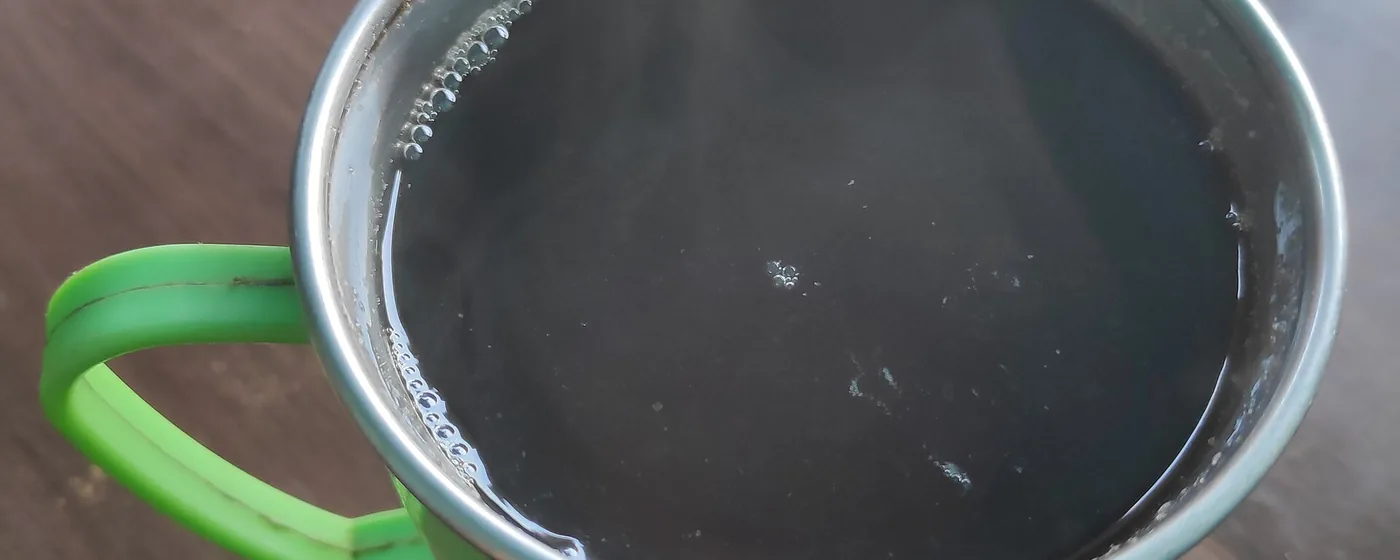
Photo: Black Ginger Tea.jpg by Gaurav Dhwaj Khadka — CC BY-SA 4.0. Cropped and re-encoded.
Frequently asked questions
Can I drink ginger tea on an empty stomach?
Most people can, and the trials that measured stomach emptying did dose ginger on an empty stomach, up to an hour before food. But strong ginger is a mild irritant, and a pungent cup with nothing else in your stomach makes heartburn, queasiness, or a burning throat more likely. If that happens, dilute the brew, cut the steep to five minutes, or drink it alongside a few bites of food.
Can I drink ginger tea every day for bloating?
There is no established upper limit and no tested dose for the tea. Two or three cups a day is an ordinary habit, unlikely to trouble a healthy adult. Daily use is a different matter if you take an anticoagulant or antiplatelet drug, or have surgery coming up; check with your prescriber. And if two weeks of daily tea changes nothing, the problem is probably not one that tea addresses. Look at constipation, eating speed, portion size, or a specific food.
How long should I wait to eat after drinking ginger tea?
You do not need to wait, and no study has tested a gap. The trials that found faster gastric emptying gave ginger anywhere from just before the meal to an hour ahead of it, so eating shortly after your cup is consistent with them. If you are drinking it for taste or warmth rather than for bloating, timing is irrelevant.
Is hot or iced ginger tea better for bloating?
Nobody has compared them. Every ginger trial cited here used capsules or concentrated extracts, so temperature is entirely untested. Two practical notes: brewing hot and covered keeps more of the volatile aromatic oils in the cup, and some people find the smell of hot ginger tea is itself nauseating and do better with it cooled. There is no evidence that warmth relaxes the gut in any measurable way.
Will ginger tea flatten a bloated stomach or reduce belly fat?
No. Visible distension has many causes, from trapped gas and constipation to conditions that need a diagnosis, and no trial has shown that ginger tea reduces abdominal girth. It certainly does not reduce body fat. Teas marketed for a flat tummy often contain senna, a stimulant laxative, and a bowel movement is not the same thing as treating bloating.
Can I mix ginger and peppermint tea for bloating?
Nothing stops you, and the two taste good together. Just know that no trial has tested the combination, and both can aggravate reflux by different routes: ginger because it is spicy, peppermint because menthol relaxes the valve at the top of the stomach. If heartburn is part of your picture, fennel or chamomile is a gentler pairing. Two caveats there. Chamomile belongs to the same plant family as ragweed, daisies, and chrysanthemums, so skip it if those set off your allergies, and NCCIH notes that interactions between chamomile and warfarin have been reported. Fennel sits in the carrot and celery family, worth knowing if you react to those.
References
- Effects of ginger on gastric emptying and motility in healthy humans.. European journal of gastroenterology & hepatology, 2008. PubMed 18403946 · doi:10.1097/MEG.0b013e3282f4b224
- Effect of ginger on gastric motility and symptoms of functional dyspepsia.. World journal of gastroenterology, 2011. PubMed 21218090 · doi:10.3748/wjg.v17.i1.105
- Zingiber officinale does not affect gastric emptying rate. A randomised, placebo-controlled, crossover trial.. Anaesthesia, 1993. PubMed 8317647 · doi:10.1111/j.1365-2044.1993.tb07011.x
- The effect of ginger (Zingiber officinalis) and artichoke (Cynara cardunculus) extract supplementation on gastric motility: a pilot randomized study in healthy volunteers.. European review for medical and pharmacological sciences, 2016. PubMed 26813467
- A Randomized, Double-Blind, Placebo Controlled, Parallel-Group, Comparative Clinical Study to Evaluate the Efficacy and Safety of OLNP-06Placebo in Subjects with Functional Dyspepsia.. Journal of dietary supplements, 2020. PubMed 33305631 · doi:10.1080/19390211.2020.1856996
- Efficacy and safety of steamed ginger extract for gastric health: a randomized, double-blind, placebo-controlled multi-center clinical trial.. Food & function, 2025. PubMed 40878144 · doi:10.1039/d5fo01172h
- Is ginger effective for the treatment of irritable bowel syndrome? A double blind randomized controlled pilot trial.. Complementary therapies in medicine, 2014. PubMed 24559811 · doi:10.1016/j.ctim.2013.12.015
- Circadian variation in gastric emptying of meals in humans.. Gastroenterology, 1987. PubMed 3609660 · doi:10.1016/0016-5085(87)90913-9
- Lifestyle Intervention in Gastroesophageal Reflux Disease.. Clinical gastroenterology and hepatology : the official clinical practice journal of the American Gastroenterological Association, 2015. PubMed 25956834 · doi:10.1016/j.cgh.2015.04.176
- The impact of peppermint oil on the irritable bowel syndrome: a meta-analysis of the pooled clinical data.. BMC complementary and alternative medicine, 2019. PubMed 30654773 · doi:10.1186/s12906-018-2409-0
- Peppermint oil for the treatment of irritable bowel syndrome: a systematic review and meta-analysis.. Journal of clinical gastroenterology, 2014. PubMed 24100754 · doi:10.1097/MCG.0b013e3182a88357
- Effect of ginkgo and ginger on the pharmacokinetics and pharmacodynamics of warfarin in healthy subjects.. British journal of clinical pharmacology, 2005. PubMed 15801937 · doi:10.1111/j.1365-2125.2005.02322.x
- Ginger-associated overanticoagulation by phenprocoumon.. The Annals of pharmacotherapy, 2003. PubMed 14742762 · doi:10.1345/aph.1D225
- The effect of oral supplementation of ginger on glycemic control of patients with type 2 diabetes mellitus - A systematic review and meta-analysis.. Clinical nutrition ESPEN, 2024. PubMed 39053695 · doi:10.1016/j.clnesp.2024.07.011
Last reviewed and updated . HelperTea is written by an enthusiast, not a clinician, and is not medically reviewed. How we research and rate evidence. Found an error? Tell us — safety corrections get priority.