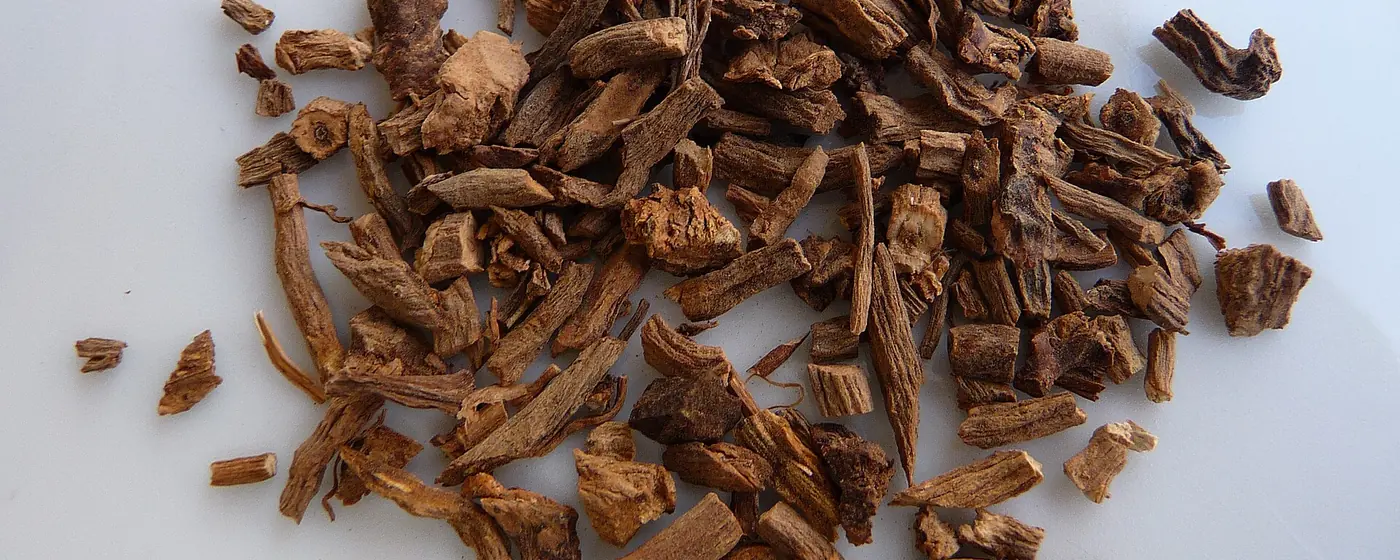
Valerian root tea is an infusion of the dried root and rhizome of Valeriana officinalis, a tall perennial that grows wild across Europe and much of Asia. The flowers smell sweet. The root, which is the part you brew, does not. It has been a fixture of European herbal medicine for centuries, taken in the evening, for more or less the reason people reach for it now: to wind down and sleep.
The taste is an acquired one, and the smell is the real hurdle. Valerian brews dark, earthy, and woody, with a musty edge that people compare to damp cellars, old leather, or gym socks. That last comparison is chemistry rather than insult. As the root dries it develops isovaleric acid, the same short-chain fatty acid behind aged cheese and sweaty feet. Honey is the traditional pairing, and it helps enormously.
What valerian actually does is worth being clear about. This is not a neutral bedtime beverage in the way chamomile is. In laboratory studies, its constituent valerenic acid binds and modulates GABA-A receptors — the same receptor family that benzodiazepines, Z-drug sleep aids, and alcohol act on, though valerenic acid appears to work at a different site on the receptor than benzodiazepines do. That pharmacology is why authoritative sources treat valerian as a sedative and warn against combining it with alcohol or sedating medication, even though those combinations have not been formally tested in people. And yet the human evidence that valerian improves sleep is thin. Review after review finds the same pattern: people report sleeping better, while objective measurements of their sleep barely move. The American Academy of Sleep Medicine suggests that clinicians not use valerian for sleep-onset or sleep-maintenance insomnia, though it grades that as a weak recommendation. Plausible sedative pharmacology paired with weak proof of benefit is an unusual combination, and it is why this page spends as much space on interactions as on brewing.
Photo: Baldrianwurzel getrocknet.JPG by 3268zauber — CC BY-SA 3.0. Cropped and re-encoded.
What the evidence says
People often report sleeping better on valerian, but the trials behind that are small, mixed, and likely skewed toward positive results
A 2006 meta-analysis covered 16 randomized placebo-controlled trials (1,093 patients); in the six that reported sleep improvement as a yes/no outcome, valerian came out ahead (relative risk 1.8), but the authors detected publication bias in exactly that estimate. A 2010 meta-analysis of 18 randomized trials found a weaker version of the same effect (relative risk 1.37) and concluded that valerian's effectiveness "has not been demonstrated with quantitative or objective measurements." A 2024 umbrella review of eight systematic reviews concluded there is "no evidence of efficacy for the treatment of insomnia," the underlying studies being heterogeneous, low-quality, and inconsistent in dose and preparation.
Valerian has not been shown to shorten how long it takes to fall asleep, or to shift objective sleep measures
This negative finding is better supported than any positive one. Pooling 18 placebo-controlled trials, the mean difference in sleep-onset latency between valerian and placebo was 0.70 minutes (95% CI -3.44 to 4.83) — essentially zero. A systematic review covering 37 studies concluded valerian is "safe but not effective," noting that the most recent trials, which were also the most methodologically rigorous, found no effect on sleep. A 2023 umbrella review of alternative insomnia treatments likewise found that valerian did not significantly improve sleep outcomes.
Traditionally taken for anxiety and restlessness, though human evidence is too weak to recommend it for that
A 2020 systematic review pooled 8 anxiety studies (535 participants) and reported signals of benefit, but attributed the inconsistency between trials to variable extract quality and the unstable nature of some active compounds. An earlier evidence review graded valerian for anxiety disorders as insufficient to recommend, and NCCIH states there is not enough evidence to allow any conclusion about whether valerian helps anxiety. The animal data look better than the human data, which is not a reason to assume a human effect.
Valerenic acid, a valerian constituent, modulates GABA-A receptors in cell and animal models — and hot water may extract it poorly
Researchers identified a binding site with nanomolar affinity for valerenic acid on GABA-A receptors, and in mice carrying a point mutation in the receptor's beta-3 subunit, valerenic acid's calming effect disappeared. Voltage-clamp work in frog oocytes shows the potentiation requires beta-2 or beta-3 subunits and is not blocked by flumazenil, meaning valerenic acid acts somewhere other than the benzodiazepine site. Rat brainstem recordings point the same way. But when one study compared valerian extracts of different polarity, only the apolar ones enhanced GABA-A currents, with activity tracking valerenic acid content; polar extracts showed no effect. Hot water is a polar solvent, which raises a fair question about how much of this chemistry a mug of tea actually delivers. All of this is cells and animals, not people.
One small trial found valerian capsules eased menstrual cramps, but they did not outperform standard painkillers
In a double-blind trial, 100 students took 255 mg of valerian or placebo three times daily for the first three days of two consecutive cycles, and pain fell further in the valerian group. The 2016 Cochrane review of dietary supplements for dysmenorrhea classed this as "very limited" evidence resting on that single trial, judged all the evidence in the field low or very low quality, and found no evidence of any difference between valerian and NSAIDs. That was a standardized capsule, not tea.
One small trial of valerian capsules reported fewer hot flashes, and a second tested a fennel-valerian combination; both are preliminary
One double-blind trial gave 68 menopausal women 255 mg of valerian or a starch placebo three times daily for eight weeks and reported hot flashes that were less severe and less frequent. A second randomized trial in 76 postmenopausal women used a combined fennel-valerian capsule, so valerian's own contribution cannot be separated out. Both were small, both used capsules rather than tea, and neither has been independently replicated.
Valerian root has a long history as a nervine and digestive antispasmodic in European herbalism
Centuries before anyone described a GABA receptor, valerian was a standard herbal entry for restlessness, nervous tension, and cramping, including cramping of the gut and uterus. That reputation is presumably why it survived into the modern supplement aisle. But traditional use records what people did, not that it worked, and controlled trials of valerian for digestive complaints are essentially absent.
No published human clinical trials found for this use.
How to brew Valerian Root Tea
Bring water to a full boil and pour it over the root. Keep the cup or pot covered for the whole steep, since valerian's aromatic compounds are volatile and leave with the steam. Roots are dense, so give it 10 to 15 minutes, then strain well.
- Honey earns its keep here. Valerian is bitter and heavily earthy, and sweetening is often the difference between finishing the cup and pouring it out.
- A mug of tea is not a standardized dose. Potency swings with the root's age, cut, storage, and steep time, and some of valerian's active compounds degrade on the shelf.
- Read the label if you are drinking a blend. Valerian is often sold mixed with hops, passionflower, lemon balm, or chamomile, and sedative effects add up.
- Drink it 30 minutes to two hours before bed, and only once you are done driving for the day.
- Try one cup on a night with nothing scheduled the next morning before you make it a habit.
Safety, side effects & who should avoid it
Valerian is pharmacologically active in the central nervous system — treat it as a sedative, not a neutral bedtime drink. Its main danger is additive drowsiness: do not mix it with alcohol, sleep medication, or other sedating drugs, and do not drive after drinking it.
Who should avoid it
- Anyone driving, cycling, or operating machinery within a few hours. A controlled trial found a small but statistically significant dip in vigilance one to two hours after a single valerian dose.
- Anyone drinking alcohol. NCCIH states plainly that valerian "should not be taken along with alcohol or sedatives."
- Anyone taking benzodiazepines, Z-drug sleep aids, opioids, barbiturates, muscle relaxants, sedating antihistamines, or other central nervous system depressants, unless a doctor or pharmacist has cleared it.
- Anyone already taking other sedating herbs or supplements — hops, passionflower, kava, skullcap, lemon balm, melatonin, or CBD. Sleep blends stack these routinely and the sedation adds up. Kava carries a liver-injury risk of its own.
- Anyone facing surgery or procedural sedation. A JAMA review of perioperative herbal use lists valerian among the herbs that can potentiate the sedative effect of anesthetics, and animal data point the same way. Because stopping abruptly after long-term use can trigger withdrawal-like symptoms, do not simply quit the night before. Tell your anesthesia team weeks in advance so they can plan.
- People with liver disease, or anyone on a medication known to stress the liver.
- Older adults, who are generally more sensitive to sedatives and more likely to be seriously hurt by a fall.
- Pregnant or breastfeeding women, and young children. Safety has not been established in any of these groups.
- Anyone whose poor sleep has never been evaluated. Insomnia, sleep apnea, and depression look alike from the outside; cognitive behavioral therapy for insomnia is the recommended first-line treatment, and valerian is not.
Possible side effects
- Headache, stomach upset, mental dullness, excitability, uneasiness, and vivid dreams — the side effects NCCIH lists. NIH LiverTox adds sedation and dizziness.
- Paradoxical reactions in some people: excitability or uneasiness rather than calm.
- Withdrawal-like symptoms after stopping long-term nightly use. NCCIH lists anxiety, irritability, heart disturbances, insomnia, and in rare cases hallucinations, if valerian is stopped abruptly after chronic use. Taper rather than quitting cold.
- Rare liver injury. NIH LiverTox gives valerian a likelihood score of "C" — a probable but rare cause of clinically apparent liver injury — with onset typically 3 to 12 weeks after starting and recovery within 2 to 4 months of stopping. Most reported cases involved valerian combined with other botanicals such as skullcap or black cohosh; one published case was attributed to valerian root alone. Stop and see a doctor for jaundice, dark urine, or persistent nausea.
- For scale: a 2020 review of 60 studies (about 6,900 people, aged 7 to 80) reported no severe adverse events associated with valerian.
Medication interactions
- Alcohol. Additive central nervous system depression. Do not combine. This is the most important line on this page.
- Benzodiazepines (diazepam, lorazepam, alprazolam, clonazepam) and barbiturates. A review of herbal drug interactions warns that excessive sedation may occur with concomitant use of valerian and barbiturates, and the shared GABA-A receptor target makes the whole class a concern.
- Z-drug hypnotics: zolpidem, eszopiclone, zaleplon, zopiclone.
- Opioids (oxycodone, hydrocodone, morphine, tramadol, codeine). Additive sedation.
- Sedating antihistamines, and over-the-counter "PM" or "nighttime" products containing diphenhydramine or doxylamine. These are very easy to double up on by accident.
- General anesthetics and procedural sedation. A JAMA review names valerian as an herb that can potentiate anesthetic sedation. Disclose valerian use to your anesthesiologist.
- Other sedating prescriptions: gabapentin, pregabalin, cyclobenzaprine, baclofen, trazodone, mirtazapine, quetiapine, and many anti-seizure drugs.
- Cannabis and sedating CBD products.
- Other sedating herbs and supplements: hops, passionflower, kava, skullcap, lemon balm, melatonin. Valerian is rarely sold on its own, and most reported cases of valerian-associated liver injury involved multi-herb products.
- Worth knowing what valerian probably does not do: a 28-day study in 12 volunteers found no meaningful change in CYP1A2, CYP2D6, CYP2E1, or CYP3A4/5 activity, so classic liver-enzyme drug interactions look unlikely. The hazard here is sedation stacking on sedation, not metabolism.
Pregnancy & breastfeeding
There is not enough good human safety data, and NCCIH says little is known about whether valerian is safe in pregnancy or while breastfeeding. Because it is pharmacologically active in the central nervous system, the sensible default is to avoid it. Talk to your doctor or midwife first.
How much is too much
No established limit, and a mug of tea is not a standardized dose. For context, NCCIH says valerian has been used with apparent safety at 300 to 600 mg daily for up to six weeks, and the small cramp and hot-flash trials used 255 mg three times daily. Long-term safety is genuinely unknown. Nightly use beyond a few weeks is a conversation to have with your doctor, and if you have been drinking it every night for a while, taper rather than stopping abruptly.
Taste & pairing
Tasting notes: Earthy, Woody, Distinctive.
Pairs well with: Honey.
Best time to drink: Before bedtime.
Frequently asked questions
How long should you steep valerian root tea?
Ten to fifteen minutes, covered. Valerian is a root, not a leaf, and dense root material gives up its compounds slowly. A three-minute steep produces something close to warm water. Keeping a lid on matters too, since much of what you are extracting is volatile and will leave with the steam. To make it stronger, steep longer rather than adding more root.
When should you drink valerian tea before bed?
Most people drink it 30 minutes to two hours before they want to be asleep. No trial pins down ideal timing for tea specifically, so that is convention rather than science. The firmer rule sits on the other end: do not drink it and then drive or operate machinery. A controlled trial found a slight dip in vigilance one to two hours after a dose, which is exactly the window you are in after an evening cup. Reassuringly, a separate trial in 102 volunteers found no impairment in reaction time, alertness, or concentration the morning after a 600 mg evening dose, so the concern is the hours right after you drink it, not the next day.
Can you drink valerian root tea every night?
Nobody really knows. NCCIH notes valerian has been used with apparent safety at 300 to 600 mg daily for up to six weeks, but says the safety of long-term use is unknown. NCCIH also documents withdrawal-like symptoms in some people who stop abruptly after chronic use. If nightly valerian has become a fixture, taper rather than stopping cold, and raise it with your doctor. Persistent insomnia deserves a real evaluation.
Why does valerian root tea smell so bad?
Isovaleric acid, mostly. It forms as the root dries, and it is the same compound behind aged cheese and worn socks. Fresh valerian root smells far milder; the funk develops in storage, and it is not a sign the root has spoiled. Honey, lemon, or blending with peppermint all help. Some people cold-infuse the root overnight and gently warm it for a less pungent cup, though whether that delivers the same compounds has never been tested.
Is valerian tea stronger than chamomile for sleep?
No trial has compared the two head to head, so "stronger" is not really answerable. What is clear is that valerian gets treated as a sedative and chamomile generally does not: valerian carries explicit warnings about combining it with alcohol and sedating medication, and its constituent valerenic acid modulates GABA-A receptors in laboratory models. But receptor activity in a dish is not the same as working better for your insomnia, and pooled trial data show valerian does not reliably shorten sleep onset. If you want a low-stakes evening ritual, chamomile is the safer default.
Can you take valerian tea with a sleeping pill or a glass of wine?
No. Valerian acts on the same receptor family as benzodiazepines, Z-drugs, and alcohol, and combining central nervous system depressants produces additive sedation that is hard to predict. NCCIH is explicit that valerian should not be taken with alcohol or sedatives. That includes over-the-counter "PM" painkillers, which contain sedating antihistamines. If you take any prescription sedative, opioid, muscle relaxant, or anti-seizure drug, ask a pharmacist before adding valerian.
References
- Valerian for sleep: a systematic review and meta-analysis.. Am J Med, 2006. PubMed 17145239 · doi:10.1016/j.amjmed.2006.02.026
- Effectiveness of Valerian on insomnia: a meta-analysis of randomized placebo-controlled trials.. Sleep Med, 2010. PubMed 20347389 · doi:10.1016/j.sleep.2009.12.009
- A systematic review of valerian as a sleep aid: safe but not effective.. Sleep Med Rev, 2007. PubMed 17517355 · doi:10.1016/j.smrv.2007.03.002
- Does valerian work for insomnia? An umbrella review of the evidence.. Eur Neuropsychopharmacol, 2024. PubMed 38359657 · doi:10.1016/j.euroneuro.2024.01.008
- Complementary and alternative treatments for insomnia disorder: a systematic umbrella review.. J Sleep Res, 2023. PubMed 37527850 · doi:10.1111/jsr.13979
- Clinical Practice Guideline for the Pharmacologic Treatment of Chronic Insomnia in Adults: An American Academy of Sleep Medicine Clinical Practice Guideline.. J Clin Sleep Med, 2017. PubMed 27998379 · doi:10.5664/jcsm.6470
- Valerian Root in Treating Sleep Problems and Associated Disorders-A Systematic Review and Meta-Analysis.. J Evid Based Integr Med, 2020. PubMed 33086877 · doi:10.1177/2515690X20967323
- [Use of valerian in anxiety and sleep disorders: what is the best evidence?].. Acta Med Port, 2011. PubMed 22863505
- GABA A receptors as in vivo substrate for the anxiolytic action of valerenic acid, a major constituent of valerian root extracts.. Neuropharmacology, 2008. PubMed 18602406 · doi:10.1016/j.neuropharm.2008.06.013
- Valerenic acid potentiates and inhibits GABA(A) receptors: molecular mechanism and subunit specificity.. Neuropharmacology, 2007. PubMed 17585957 · doi:10.1016/j.neuropharm.2007.04.018
- The gamma-aminobutyric acidergic effects of valerian and valerenic acid on rat brainstem neuronal activity.. Anesth Analg, 2004. PubMed 14742369 · doi:10.1213/01.ANE.0000096189.70405.A5
- Modulation of GABAA receptors by valerian extracts is related to the content of valerenic acid.. Planta Med, 2007. PubMed 18095218 · doi:10.1055/s-2007-993761
- Effects of valerian on the severity and systemic manifestations of dysmenorrhea.. Int J Gynaecol Obstet, 2011. PubMed 21959068 · doi:10.1016/j.ijgo.2011.06.022
- Dietary supplements for dysmenorrhoea.. Cochrane Database Syst Rev, 2016. PubMed 27000311 · doi:10.1002/14651858.CD002124.pub2
- The effects of valerian root on hot flashes in menopausal women.. Iran J Pharm Res, 2013. PubMed 24250592
- Effect of Fennel-Valerian Extract on Hot Flashes and Sleep Disorders in Postmenopausal Women: A Randomized Trial.. J Menopausal Med, 2023. PubMed 37160299 · doi:10.6118/jmm.22026
- The influence of valerian treatment on "reaction time, alertness and concentration" in volunteers.. Pharmacopsychiatry, 1999. PubMed 10599933 · doi:10.1055/s-2007-991100
- [Vigilance-decreasing effects of 2 plant-derived sedatives].. Praxis (Bern 1994), 1996. PubMed 8657986
- Herbal medicines and perioperative care.. JAMA, 2001. PubMed 11448284 · doi:10.1001/jama.286.2.208
- In vivo effects of goldenseal, kava kava, black cohosh, and valerian on human cytochrome P450 1A2, 2D6, 2E1, and 3A4/5 phenotypes.. Clin Pharmacol Ther, 2005. PubMed 15900287 · doi:10.1016/j.clpt.2005.01.009
- [Herbal drug-drug interaction and adverse drug reactions].. Ther Umsch, 2011. PubMed 21184395 · doi:10.1024/0040-5930/a000120
- A case of valerian-associated hepatotoxicity.. J Clin Gastroenterol, 2008. PubMed 18431248 · doi:10.1097/MCG.0b013e3180500348
- Acute Liver Injury After Long-Term Herbal "Liver Cleansing" and "Sleep Aid" Supplement Use.. J Emerg Med, 2021. PubMed 33579656 · doi:10.1016/j.jemermed.2021.01.004
Last reviewed and updated . HelperTea is written by an enthusiast, not a clinician, and is not medically reviewed. How we research and rate evidence. Found an error? Tell us — safety corrections get priority.