Short answer
Chamomile is the easier default: it tastes better and interacts with fewer common medicines. Valerian has more sedative pharmacology, but pooled trials found no reduction in the time it takes to fall asleep. Evidence for both is limited, neither was tested as brewed tea, and no published trial has compared them head to head.
Both teas are caffeine-free, and for most healthy adults who are not on interacting medicines both are low risk. Neither one treats insomnia. Chamomile is a mild flower tea with a small, wobbly evidence base built mostly on how people rate their own sleep. Valerian is a root with real sedative chemistry in the laboratory — and pooled human trials that still fail to show it helps you fall asleep.
Lab-level sedative pharmacology, weak proof of benefit, more drug interactions, and a smell most people struggle with: that is why chamomile tea is the easier default for most people, and why valerian root tea deserves more caution than its gentle-bedtime-herb reputation suggests.
Which one has better evidence for sleep?
Chamomile, narrowly — and only because valerian's evidence is so poor. Both sit at the limited end of the scale.
For chamomile the evidence is limited and inconsistent. A 2019 meta-analysis found chamomile improved self-reported sleep quality, while the single trial it found for insomnia severity showed no change (PubMed). A 2024 systematic review of ten trials (772 participants) pooled the five reporting the Pittsburgh Sleep Quality Index: scores fell about 1.9 points, though the studies disagreed sharply with one another, and sleep duration, sleep efficiency, and daytime functioning did not improve (PubMed). The one randomized, double-blind, placebo-controlled trial in 34 adults with chronic insomnia found no significant difference from placebo in any sleep-diary measure over 28 days (PubMed).
Valerian is one of the most-studied herbal sleep aids, and the results disappoint. A 2010 meta-analysis of 18 placebo-controlled trials found a benefit only on a crude yes-or-no question about whether sleep improved (PubMed); a 2006 meta-analysis found the same yes-or-no effect and detected publication bias in exactly that estimate (PubMed). A systematic review of 37 studies concluded valerian is “safe but not effective” (PubMed), and a 2024 umbrella review of eight systematic reviews found “no evidence of efficacy for the treatment of insomnia” (PubMed). The American Academy of Sleep Medicine suggests clinicians not use valerian for insomnia, grading that a weak recommendation (PubMed).
Chamomile vs valerian at a glance
| Chamomile tea | Valerian root tea | |
|---|---|---|
| What the evidence supports | Limited: small gains in self-rated sleep quality, a faint signal for fewer awakenings. Mostly capsule and extract trials; brewed tea barely tested. | Limited; the best-supported finding is a negative one. Pooled trials show no effect on falling asleep. Brewed tea untested. |
| How fast it acts | No reliable onset. Trials ran nightly for one to four weeks. Convention: 30–60 minutes before bed. | One controlled trial found a slight vigilance dip 1–2 hours after a dose, which is not the same as a sleep benefit. Drink 30 minutes to 2 hours before bed. |
| Taste | Apple-like, floral, honeyed. Fine plain. Steep 3–5 min at 200°F, covered. | Earthy, bitter, musty; often likened to old socks. Steep 10–15 min at a full boil, covered. |
| Caffeine | None. | None. |
| Who should avoid it | Ragweed, mugwort, daisy or marigold allergy; warfarin or cyclosporine; before surgery; infants under 12 months. | Alcohol, sedatives, sleep drugs, opioids; driving; liver disease; before surgery; older adults at risk of falls. |
Which is better for falling asleep?
Neither is proven, and valerian is the one with a clear negative result. In a meta-analysis of 18 placebo-controlled trials, the pooled mean difference in sleep-onset latency between valerian and placebo was 0.70 minutes (95% CI −3.44 to 4.83) — statistically indistinguishable from no effect (PubMed). That absence of effect is better documented than any positive claim made for the herb.
Chamomile has never been pooled for sleep latency. The 2024 review noted that three of four trials measuring sleep onset or “ease of getting to sleep” reported improvement (PubMed), but that is vote-counting across four small studies, not a pooled effect, and the placebo-controlled insomnia trial found no significant difference from placebo in how long people took to fall asleep (PubMed). Limited evidence, tilted very slightly toward chamomile.
Which is better for staying asleep?
Chamomile, again faintly, again on limited evidence. In that same 2024 review, awakenings after sleep onset improved in two of the three trials that measured them, even as sleep duration and efficiency did not move (PubMed) — the closest thing either herb has to a repeated, specific signal.
Valerian gives no sign of helping here, and this is the part the box never mentions. A randomized, double-blind crossover trial gave 16 older women with insomnia 300 mg of concentrated valerian extract nightly for two weeks and measured sleep with polysomnography and actigraphy, not just questionnaires. There was no significant difference from placebo in sleep latency, wake after sleep onset, sleep efficiency, or self-rated quality. Measured against their own baseline rather than against placebo, wake after sleep onset increased by roughly 18 minutes on valerian; the placebo arm rose about 7 minutes, which was not significant (PubMed). One small trial settles nothing, and a within-group comparison is weak evidence, but a sleep herb that shows no reduction in night-time wakefulness is worth knowing about.
Why does valerian smell so bad, and can you get past it?
Isovaleric acid, mostly. It forms as the root dries, and it is the same short-chain fatty acid behind aged cheese and worn socks. It is not spoilage. Honey helps a great deal, and so does lemon. Blending with peppermint works too — but peppermint relaxes the lower esophageal sphincter, which can let stomach acid back up. If you get heartburn or reflux, a peppermint blend right before you lie down is a poor choice.
Valerian is a dense root that needs 10 to 15 minutes in fully boiling water, covered, to give up much of anything; a three-minute steep produces a thin, weak cup. Chamomile takes three to five minutes just off the boil and tastes like apples. Any small benefit depends on drinking it night after night, and a ritual you dread is not a ritual. Passionflower is the one common sleep herb with a double-blind, placebo-controlled trial of the brewed tea itself, in 41 healthy young adults with mild sleep fluctuations (PubMed); the full sleep tea ranking compares the rest.
Does the brewed tea deliver what the trials tested?
Almost certainly not, for either herb, and that is the honest headline here. Chamomile's sleep studies largely used standardized extract in capsules: the nursing-home trial gave 200 mg of extract twice daily against a wheat-flour capsule, single-blind (PubMed). The best-known trial of brewed chamomile tea, in 80 postpartum women, compared it against routine postpartum care rather than a placebo, and its two-week benefit had vanished by the four-week follow-up (PubMed).
Valerian is a step worse. The trials in those reviews used standardized capsules, tinctures, and extracts; none tested brewed tea. And when researchers compared valerian extracts of differing polarity in frog oocytes, only the apolar ones enhanced GABA-A receptor currents, with activity tracking valerenic acid content — the polar extracts did nothing (PubMed). Hot water is a polar solvent. That is laboratory work, not human data, but it raises a fair question about how much of valerian's chemistry survives into a mug. No published randomized trial appears to have compared the two herbs head to head.
Which one is riskier?
Valerian, because of what it stacks with. Valerenic acid modulates GABA-A receptors in cell and animal models — the same receptor family that benzodiazepines, Z-drug sleep aids, and alcohol act on. That is laboratory pharmacology rather than a measured human effect, but NCCIH states plainly that valerian “should not be taken along with alcohol or sedatives.” In practice that means benzodiazepines, zolpidem and its relatives, opioids, muscle relaxants, gabapentin and pregabalin, sedating antihistamines, and the over-the-counter “PM” painkillers that contain them. Ask a pharmacist if you take any of these. Do not drive after a cup either: a controlled trial of two plant-based sedative preparations — a valerian syrup and a valerian-and-hops tablet, neither of them tea — found a slight but statistically significant dip in vigilance one to two hours after a single dose (PubMed).
The next morning looks clearer. In 102 volunteers, a 600 mg evening dose of a valerian root extract — again, an extract, not tea — produced no measurable impairment in reaction time, alertness, or concentration the following morning (PubMed).
Three more cautions. NIH LiverTox gives valerian a likelihood score of C, a “probable rare cause of clinically apparent liver injury,” and notes that reported cases usually involved multi-herb products; NCCIH agrees that liver injury has been reported very rarely, most often in combination with other herbs, and that valerian's long-term effect on the liver is unknown. One case report attributes hepatotoxicity to valerian itself (PubMed), though a single report cannot establish cause. NCCIH also documents withdrawal-like symptoms in people who stop abruptly after chronic use, so taper rather than quitting cold. And because valerian can add to the sedative effect of anesthetics, tell your surgical and anesthesia team well before an operation rather than stopping the night before. Older adults are more sensitive to sedatives and more likely to be badly hurt by a fall.
Chamomile's risks are smaller but not zero, and different in kind. It is a daisy-family plant that cross-reacts with mugwort and birch pollen: in a series of 14 sensitized patients, ten had a history of immediate-type reactions to chamomile, some of them life-threatening (PubMed), and a separate case report describes anaphylaxis to chamomile tea in a woman with mugwort pollinosis (PubMed). If you react to ragweed, mugwort, daisies, chrysanthemums, or marigolds, skip it — and wheezing or facial swelling after a cup is a call-911 situation. A woman on warfarin was hospitalized with multiple internal hemorrhages after using chamomile tea and lotion (PubMed). Chamomile has also been reported to raise cyclosporine blood levels, which matters enormously in transplant patients (PubMed). NCCIH notes possible estrogen-like effects and preliminary evidence that chamomile might reduce the effect of birth control pills. Dried flowers can carry botulism spores, so it is not for infants under 12 months, and herbal products are usually stopped before surgery.
Drinking both, as commercial bedtime blends have you do, has never been tested; sedative effects add up, and valerian is the likelier source of them. For pregnancy and breastfeeding there is not enough reliable human data on either herb, and NCCIH says little is known. Because valerian is centrally active, avoiding it is the sensible default. Ask your doctor or midwife.
The bottom line
If you are choosing between the two, chamomile is the easier default. It is pleasant, cheap, caffeine-free, and low risk unless you are allergic to daisy-family plants or take warfarin or cyclosporine. Its evidence is limited, but it is the least bad in a weak field, and the only one of the two with any signal for staying asleep.
Try valerian only if chamomile does nothing for you, and treat it the way its own label implies: no alcohol, no driving, no stacking it on sleeping pills, and taper if you have been drinking it nightly. Do not count on it to shorten how long you lie awake; the pooled trial data show no such effect.
Neither tea treats insomnia. If you have had trouble sleeping at least three nights a week for three months, that is chronic insomnia disorder, and cognitive behavioral therapy for insomnia is what the American Academy of Sleep Medicine recommends first (PubMed). That is a conversation with a doctor, not a purchase.
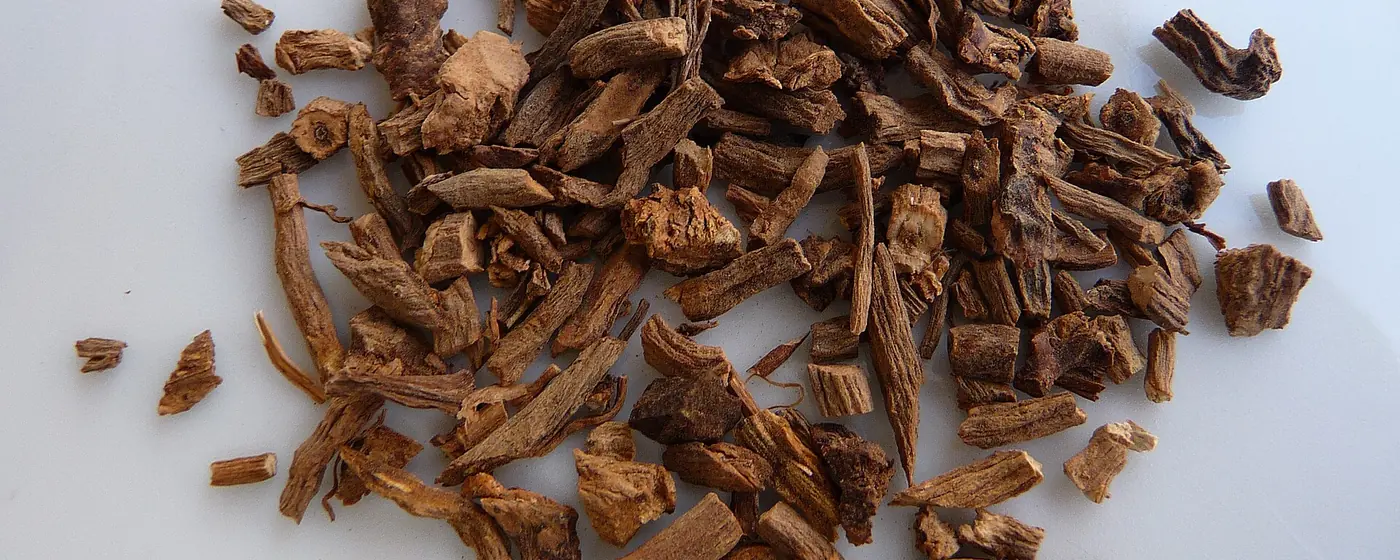
Photo: Baldrianwurzel getrocknet.JPG by 3268zauber — CC BY-SA 3.0. Cropped and re-encoded.
Frequently asked questions
Can you drink chamomile and valerian tea together?
Most commercial bedtime blends already combine them, but no trial has tested the pair, so any added benefit is guesswork. The real issue is that sedative effects stack, and valerian is the likelier source of them. If you take any prescription sedative, opioid, muscle relaxant, sedating antihistamine, or anti-seizure drug, ask a pharmacist before drinking a blend that contains valerian. Never combine either with alcohol.
Does valerian tea leave you groggy the next morning?
Probably not, though the trial that looked at this used an extract rather than tea. In 102 volunteers, a 600 mg evening dose of valerian root extract produced no measurable impairment in reaction time, alertness, or concentration the following morning. The window that matters is the one to two hours right after you drink it, when a controlled trial of valerian preparations found a slight but statistically significant dip in vigilance. Some people do report vivid dreams or mental dullness; NCCIH lists both.
Is valerian root tea habit-forming?
It is not addictive in the way benzodiazepines are, and it is not a controlled substance. But NCCIH documents withdrawal-like symptoms — anxiety, irritability, heart disturbances, insomnia, and in rare cases hallucinations — in people who stop abruptly after chronic use. If nightly valerian has become a fixture, taper rather than quitting cold, and raise it with your doctor. Long-term safety has never been properly studied.
What can I drink instead if I can't stand valerian's smell?
Passionflower is the sensible pick. It is the one common sleep herb with a double-blind, placebo-controlled trial of the actual brewed tea rather than a capsule — though it enrolled 41 healthy young adults with mild sleep fluctuations rather than insomnia, and only one of the six sleep-diary measures, subjective sleep quality, improved. Lemon balm is another light, citrusy option, with weaker evidence. Both are mild-tasting and caffeine-free.
Can I take chamomile or valerian tea with melatonin?
Ask a pharmacist first, especially with valerian. Melatonin, valerian, and sedating herbs all push in the same direction, and sleep blends routinely stack three or four of them without any evidence that the combination has been tested. Chamomile alongside melatonin is lower risk, but NCCIH still flags additive drowsiness as theoretically possible. Do not drive after any of these.
Is chamomile or valerian tea safe during pregnancy?
There is not enough reliable human data on either one, and NCCIH says plainly that little is known about whether either is safe in pregnancy or while breastfeeding. Valerian is pharmacologically active in the central nervous system, which makes avoiding it the sensible default. Occasional food amounts of chamomile have not been shown to cause harm, but daily medicinal use has never been properly studied. Talk to your doctor or midwife before drinking either regularly.
References
- Therapeutic efficacy and safety of chamomile for state anxiety, generalized anxiety disorder, insomnia, and sleep quality: A systematic review and meta-analysis of randomized trials and quasi-randomized trials.. Phytotherapy research : PTR, 2019. PubMed 31006899 · doi:10.1002/ptr.6349
- Effects of chamomile (Matricaria chamomilla L.) on sleep: A systematic review and meta-analysis of clinical trials.. Complementary therapies in medicine, 2024. PubMed 39106912 · doi:10.1016/j.ctim.2024.103071
- Preliminary examination of the efficacy and safety of a standardized chamomile extract for chronic primary insomnia: a randomized placebo-controlled pilot study.. BMC complementary and alternative medicine, 2011. PubMed 21939549 · doi:10.1186/1472-6882-11-78
- Effects of an intervention with drinking chamomile tea on sleep quality and depression in sleep disturbed postnatal women: a randomized controlled trial.. Journal of advanced nursing, 2015. PubMed 26483209 · doi:10.1111/jan.12836
- The effects of chamomile extract on sleep quality among elderly people: A clinical trial.. Complementary therapies in medicine, 2017. PubMed 29154054 · doi:10.1016/j.ctim.2017.09.010
- Effectiveness of Valerian on insomnia: a meta-analysis of randomized placebo-controlled trials.. Sleep medicine, 2010. PubMed 20347389 · doi:10.1016/j.sleep.2009.12.009
- Valerian for sleep: a systematic review and meta-analysis.. The American journal of medicine, 2006. PubMed 17145239 · doi:10.1016/j.amjmed.2006.02.026
- A systematic review of valerian as a sleep aid: safe but not effective.. Sleep medicine reviews, 2007. PubMed 17517355 · doi:10.1016/j.smrv.2007.03.002
- Does valerian work for insomnia? An umbrella review of the evidence.. European neuropsychopharmacology : the journal of the European College of Neuropsychopharmacology, 2024. PubMed 38359657 · doi:10.1016/j.euroneuro.2024.01.008
- A randomized clinical trial of valerian fails to improve self-reported, polysomnographic, and actigraphic sleep in older women with insomnia.. Sleep medicine, 2008. PubMed 18482867 · doi:10.1016/j.sleep.2008.02.001
- Clinical Practice Guideline for the Pharmacologic Treatment of Chronic Insomnia in Adults: An American Academy of Sleep Medicine Clinical Practice Guideline.. Journal of clinical sleep medicine : JCSM : official publication of the American Academy of Sleep Medicine, 2017. PubMed 27998379 · doi:10.5664/jcsm.6470
- Behavioral and psychological treatments for chronic insomnia disorder in adults: an American Academy of Sleep Medicine clinical practice guideline.. Journal of clinical sleep medicine : JCSM : official publication of the American Academy of Sleep Medicine, 2021. PubMed 33164742 · doi:10.5664/jcsm.8986
- A double-blind, placebo-controlled investigation of the effects of Passiflora incarnata (passionflower) herbal tea on subjective sleep quality.. Phytotherapy research : PTR, 2011. PubMed 21294203 · doi:10.1002/ptr.3400
- Modulation of GABAA receptors by valerian extracts is related to the content of valerenic acid.. Planta medica, 2007. PubMed 18095218 · doi:10.1055/s-2007-993761
- [Vigilance-decreasing effects of 2 plant-derived sedatives].. Praxis, 1996. PubMed 8657986
- The influence of valerian treatment on "reaction time, alertness and concentration" in volunteers.. Pharmacopsychiatry, 1999. PubMed 10599933 · doi:10.1055/s-2007-991100
- A case of valerian-associated hepatotoxicity.. Journal of clinical gastroenterology, 2008. PubMed 18431248 · doi:10.1097/MCG.0b013e3180500348
- Anaphylaxis to camomile: clinical features and allergen cross-reactivity.. Clinical and experimental allergy : journal of the British Society for Allergy and Clinical Immunology, 2000. PubMed 10998021 · doi:10.1046/j.1365-2222.2000.00902.x
- A case of anaphylactic reaction to chamomile tea in a patient with mugwort pollinosis.. Allergology international : official journal of the Japanese Society of Allergology, 2019. PubMed 30952586 · doi:10.1016/j.alit.2019.02.011
- Warfarin interaction with Matricaria chamomilla.. CMAJ : Canadian Medical Association journal = journal de l'Association medicale canadienne, 2006. PubMed 16636327 · doi:10.1503/cmaj.051191
- Cyclosporine and herbal supplement interactions.. Journal of toxicology, 2014. PubMed 24527031 · doi:10.1155/2014/145325
Last reviewed and updated . HelperTea is written by an enthusiast, not a clinician, and is not medically reviewed. How we research and rate evidence. Found an error? Tell us — safety corrections get priority.